
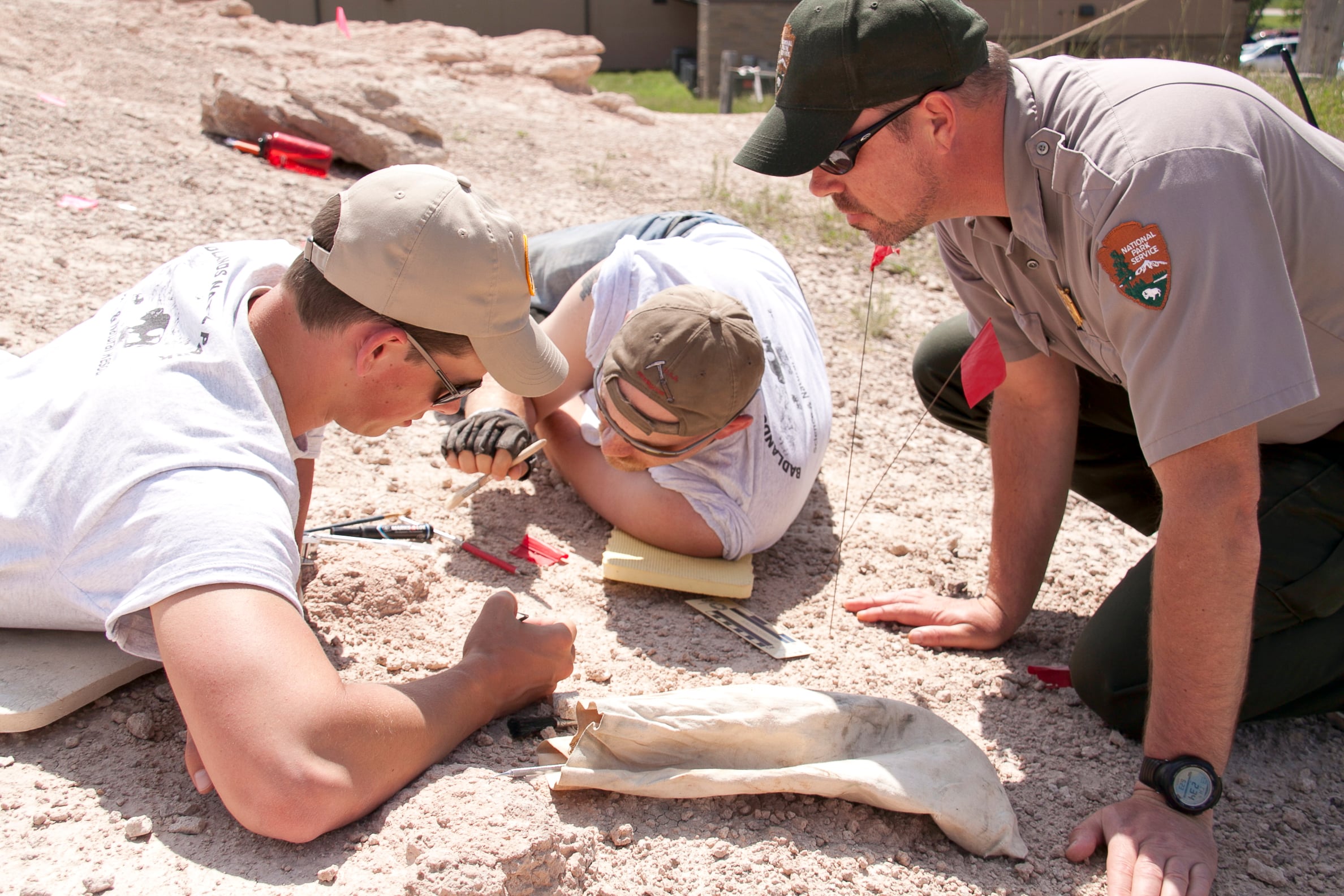
A study utilizing surveys from Badlands National Park and Denali National Park & Preserve, both recognized for their globally significant paleontological resources, has offered insight into visitor attitudes related to fossils and their management by the National Park Service.
The 2025 study (attached) aimed to determine whether there are any relationships between visitor values or level of knowledge about fossils and the visitor’s decision about whether to participate in specific park programs and activities related to fossil resources.
According to the researchers, the surveys included in the study represent two of the most comprehensive research studies involving the relationships between park visitors and paleontological resources.
Badlands National Park
The survey carried out at Badlands, which collected 700 responses, included questions related to visitor demographics, awareness and knowledge, values, understanding, fossil stewardship attitudes, and recreational choice.
The results showed that most visitors to the park are knowledgeable about the significant park resources at Badlands. However, the study did note that a significant number of people incorrectly identified the park as being a “dinosaur locality,” or having dinosaur fossils as part of its resources.
The researchers wrote that “[t]he basis for this misunderstanding is simple and tied to the fact that many visitors automatically think ‘dinosaur’ when they hear the word ‘fossil’” and noted that the survey provides the first scientific data to confirm what the rangers at Badlands have long recognized about visitor misunderstanding of fossils at the park.
While Badlands is one of the richest fossil localities on Earth, there are no dinosaur fossils in the park. Instead, the world-renowned fossils are primarily a rich assemblage of fossil mammals that existed after the extinction of the dinosaurs.
The majority of participants recognized that unauthorized fossil collection in the park could lead to fines or other penalties. They also agreed that fossil discoveries should be reported to park rangers. However, about a fourth of participants thought that visitors were allowed to collect common fossils in parks, which is not the case. At Badlands, collecting fossils is prohibited unless a visitor has an approved research and collecting permit.
The survey included six individuals who responded that they had collected a fossil or fossils during their visit to Badlands. While this is a very low percentage of visitors, it still underscores the need for education surrounding the legality of fossil collecting in national parks.
Approximately 59 percent of participants had viewed fossils at the visitor center, though the researchers note that “[t]his would suggest that approximately 40 percent or greater of the visitors did not yet experience the BADL visitor center or at least view the exhibits in the visitor center at the time they participated in the visitor fossil survey or they did not visit the visitor center at all.”
With the viewing of fossils at the park’s visitor center being the activity with the highest response rate in the survey, the study notes the importance of highlighting fossil education and outreach at the visitor center.
Hiking the “Fossil Exhibit Trail” (42 percent) and viewing fossil preparation (nearly 38 percent) in the visitor center were also reported as other fossil themed activities visitors were participating in.
Denali National Park and Preserve
The fossil resources at Denali National Park and Preserve are much less known compared to Badlands, but documentation of extensive dinosaur trackways, preserved in backcountry wilderness, has revealed one of the largest fossil track localities in North America at Denali, making it a significant fossil site.
The fossils at Denali are helping scientists understand both the geology and paleontology linking Alaska with Asia and the circum-Pacific landmasses during the Paleozoic and Mesozoic eras. Because of this, notes the study, the park is becoming recognized as a “paleontological frontier” by the scientific community, the media, and the public.
The survey carried out at Denali, which collected 477 responses, was specifically interested in visitors’ attitudes, interests, awareness, and opinions about hypothetical management actions.
Participants in the study were particularly interested in seeing fossils preserved in rock in a natural setting. However, the vast majority of respondents (93.6 percent) indicated that viewing fossils was not a large reason for their trip to the park.
About 59 percent of the survey participants indicated they were “Not at all aware” about Denali’s fossil resources, marking the need for increased education and awareness. However, this is not all that surprising considering that the importance of the park’s fossils has really only come to light in the past three decades, while Badlands has been recognized as an important fossil locality for more than 175 years.
For those who did know about Denali’s fossils before arriving at the park, most indicated that they had obtained that information from news articles and the Denali website.
Interestingly, bus drivers within the park were marked as the largest source of information about Denali’s fossils once visitors had arrived, with approximately 36 percent of respondents indicating they had learned about the fossils from their bus driver.
The study noted that “Given the apparent importance of the ‘Bus Drivers’ in providing information about park resources and specifically park fossils, the park management may want to provide some guidance and training to the ‘Bus Drivers’ to ensure accurate, consistent, and appropriate information is being shared…with the public. This should include information promoting resource stewardship and protection of the park’s non-renewable paleontological resources.”
Most respondents supported establishing more exhibits and displays in the visitor center where people can learn about fossils in Denali. They also supported creating ranger-led trips to view fossils but restricting all other visitor use in areas with fossils.
However, respondents did not support closing all areas with fossils to the public, demonstrating an interest in keeping these spaces accessible to visitors.
The researchers noted that in both Badlands and Denali, “viewing and experiencing fossils by the public in a natural state (within a geologic context in rock strata) has important educational values to broaden a greater understanding of fossils, their occurrence and preservation in the geologic record, and the processes used by scientists to collect, study, and understand these non-renewable remains of life from the past.”

Stories about:
Story Categories:
A copy of National Parks Traveler's financial statements may be obtained by sending a stamped, self-addressed envelope to: National Parks Traveler, P.O. Box 980452, Park City, Utah 84098. National Parks Traveler was formed in the state of Utah for the purpose of informing and educating about national parks and protected areas.
Residents of the following states may obtain a copy of our financial and additional information as stated below:
- Florida: A COPY OF THE OFFICIAL REGISTRATION AND FINANCIAL INFORMATION FOR NATIONAL PARKS TRAVELER, (REGISTRATION NO. CH 51659), MAY BE OBTAINED FROM THE DIVISION OF CONSUMER SERVICES BY CALLING 800-435-7352 OR VISITING THEIR WEBSITE. REGISTRATION DOES NOT IMPLY ENDORSEMENT, APPROVAL, OR RECOMMENDATION BY THE STATE.
- Georgia: A full and fair description of the programs and financial statement summary of National Parks Traveler is available upon request at the office and phone number indicated above.
- Maryland: Documents and information submitted under the Maryland Solicitations Act are also available, for the cost of postage and copies, from the Secretary of State, State House, Annapolis, MD 21401 (410-974-5534).
- North Carolina: Financial information about this organization and a copy of its license are available from the State Solicitation Licensing Branch at 888-830-4989 or 919-807-2214. The license is not an endorsement by the State.
- Pennsylvania: The official registration and financial information of National Parks Traveler may be obtained from the Pennsylvania Department of State by calling 800-732-0999. Registration does not imply endorsement.
- Virginia: Financial statements are available from the Virginia Department of Agriculture and Consumer Services, 102 Governor Street, Richmond, Virginia 23219.
- Washington: National Parks Traveler is registered with Washington State’s Charities Program as required by law and additional information is available by calling 800-332-4483 or visiting www.sos.wa.gov/charities, or on file at Charities Division, Office of the Secretary of State, State of Washington, Olympia, WA 98504.


National parks and their natural resources belong to you. The National Parks Traveler works to ensure you know how these essential places are being cared for.
Sign Up For Our Weekly Newsletter
Unsubscribe at any time.
INN Member

The easiest way to explore RV-friendly National Park campgrounds.

Here’s the definitive guide to National Park System campgrounds where RVers can park their rigs.
Our app is packed with RVing- specific details on more than 250 campgrounds in more than 70 national parks.
You’ll also find stories about RVing in the parks, tips helpful if you’ve just recently become an RVer, and useful planning suggestions.

