
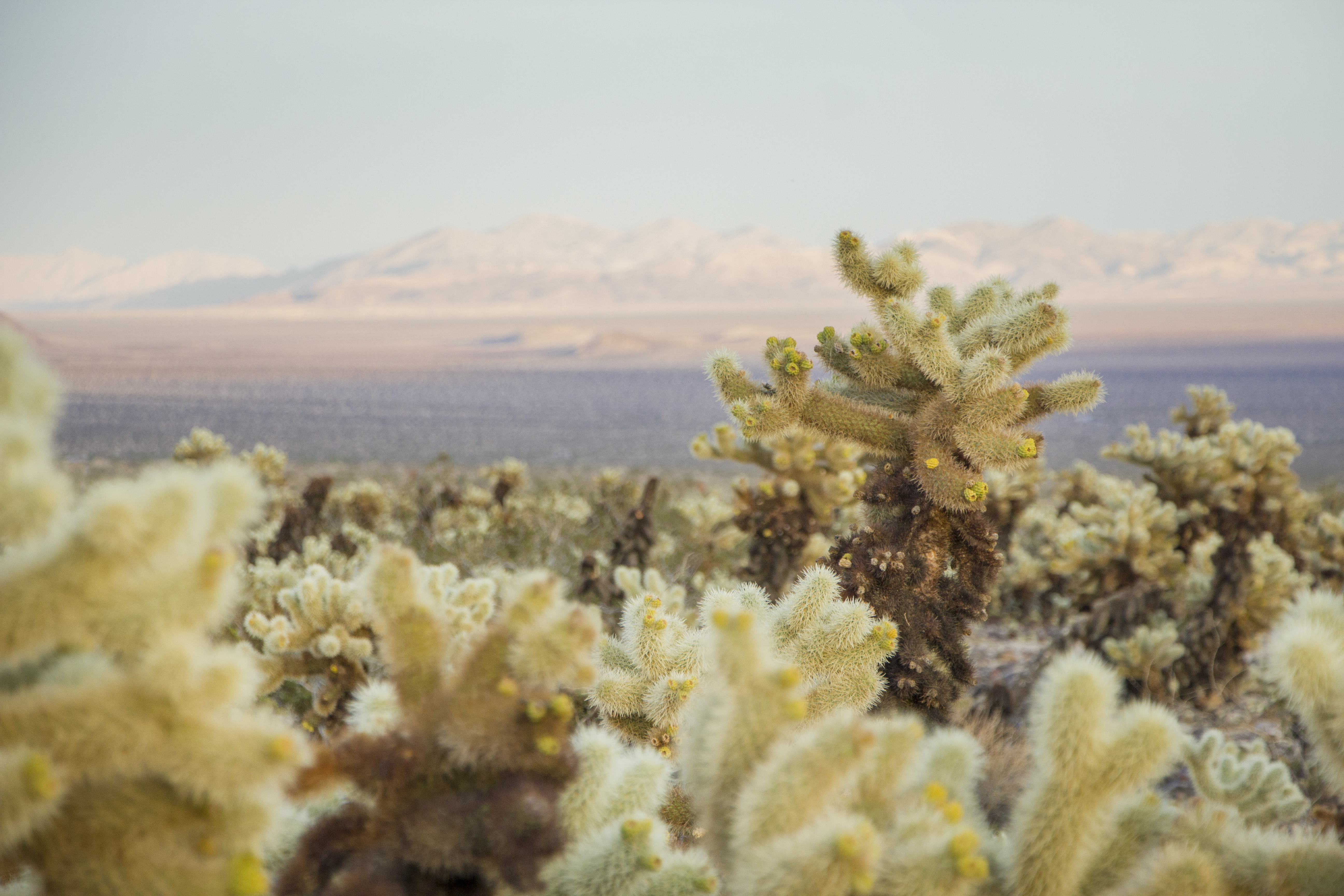
Joshua Tree National Park will be able to enhance its Desert Plant Restoration Program thanks to a new grant from Yuhaaviatam of San Manuel Nation, a federally recognized Indian tribe located on the San Manuel Indian Reservation near Highland, California. The grant offers $25,000 to support the park’s rare plant program.
The rare plant program aims to document, protect, and preserve Joshua Tree National Park’s rare desert plant species, including those with medicinal, scientific, and cultural significance. The program will involve systematic monitoring, data analysis, volunteer engagement, and the development of a comprehensive conservation plan for rare plants.
In the long-term, it is hoped that the program will contribute to the preservation of biodiversity and ecosystem stability.
“We are grateful to Yuhaaviatam of San Manuel Nation for their investment in community wellbeing,” said Jacqueline Guevara, executive director of Joshua Tree National Park Association. “This grant will allow us to protect and preserve rare desert plant species, helping build a stronger, more resilient ecosystem for future generations.”
The annual desert milkvetch has a global distribution constrained to unconsolidated sand ramps and dunes at elevations less than 350 m within Inyo, San Bernardino, Riverside, San Diego, and Imperial counties in California. It barely reaches into western Arizona and northwest Mexico. The herbage is covered with distinctive silvery, silky hairs and it has a large, 1-chambered fruit. The white (sometimes pink-tinged) flowers can be seen between February and April. In JTNP, it is only known from one population of fewer than 10 individuals on the southeastern edge of the Eagle Mtns. It is threatened by industrial-scale renewable energy development, off-road vehicles, and Brassica tournefortii.
There are 54 rare plants in Joshua Tree National Park, including the triple-ribbed milkvetch, a short-lived perennial herb and the park’s only federally endangered species; the alkali mariposa lily, whose distribution is mostly contained within a narrow region in the western Mojave Desert of California; and Parish’s daisy, the only federally threatened species in the park.
According to the Park Service, most of the plants are threatened beyond the park’s boundaries by mining, off-road vehicle use, industrial-scale solar development, and increasing urbanization. Within the park, hydrological alterations, trampling, grazing, and fire suppression activities threaten the plants.
Stories about:
Story Categories:
A copy of National Parks Traveler's financial statements may be obtained by sending a stamped, self-addressed envelope to: National Parks Traveler, P.O. Box 980452, Park City, Utah 84098. National Parks Traveler was formed in the state of Utah for the purpose of informing and educating about national parks and protected areas.
Residents of the following states may obtain a copy of our financial and additional information as stated below:
- Florida: A COPY OF THE OFFICIAL REGISTRATION AND FINANCIAL INFORMATION FOR NATIONAL PARKS TRAVELER, (REGISTRATION NO. CH 51659), MAY BE OBTAINED FROM THE DIVISION OF CONSUMER SERVICES BY CALLING 800-435-7352 OR VISITING THEIR WEBSITE. REGISTRATION DOES NOT IMPLY ENDORSEMENT, APPROVAL, OR RECOMMENDATION BY THE STATE.
- Georgia: A full and fair description of the programs and financial statement summary of National Parks Traveler is available upon request at the office and phone number indicated above.
- Maryland: Documents and information submitted under the Maryland Solicitations Act are also available, for the cost of postage and copies, from the Secretary of State, State House, Annapolis, MD 21401 (410-974-5534).
- North Carolina: Financial information about this organization and a copy of its license are available from the State Solicitation Licensing Branch at 888-830-4989 or 919-807-2214. The license is not an endorsement by the State.
- Pennsylvania: The official registration and financial information of National Parks Traveler may be obtained from the Pennsylvania Department of State by calling 800-732-0999. Registration does not imply endorsement.
- Virginia: Financial statements are available from the Virginia Department of Agriculture and Consumer Services, 102 Governor Street, Richmond, Virginia 23219.
- Washington: National Parks Traveler is registered with Washington State’s Charities Program as required by law and additional information is available by calling 800-332-4483 or visiting www.sos.wa.gov/charities, or on file at Charities Division, Office of the Secretary of State, State of Washington, Olympia, WA 98504.


National parks and their natural resources belong to you. The National Parks Traveler works to ensure you know how these essential places are being cared for.
Sign Up For Our Weekly Newsletter
Unsubscribe at any time.
INN Member

The easiest way to explore RV-friendly National Park campgrounds.

Here’s the definitive guide to National Park System campgrounds where RVers can park their rigs.
Our app is packed with RVing- specific details on more than 250 campgrounds in more than 70 national parks.
You’ll also find stories about RVing in the parks, tips helpful if you’ve just recently become an RVer, and useful planning suggestions.

