
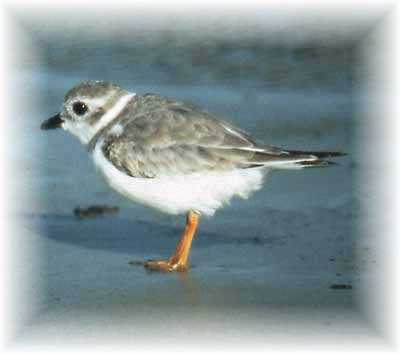
Piping plover nesting was down at Cape Lookout National Seashore in 2009, but fledgling success was high. Photo by Gene Nieminen, USFWS.
When it comes to piping plovers, a threatened species, the nesting habitat at Cape Lookout National Seashore is some of the best in North Carolina. That's evidenced by the fact that in 2009 the 37 nests counted at the seashore represented 70 percent of all piping plover nests in North Carolina. While the tally reflected a slight decline from 2008's record high of 46 nests, the number of chicks that fledged was a record high.
The Portsmouth Flats and the aptly named Plover Inlet/Ophelia Inlet area between mileposts 23 and 24 on the seashore proved the most popular for nesting plovers, with 12 and 11 nests, respectively, counted in those areas, the seashore's annual plover census noted. Overall, "24 of the nests hatched and 30 chicks were fledged from 17 different broods," the report said. "The average clutch size was 3.29 eggs and 83 of 145 eggs hatched."
While the fledgling success rate of 0.83 per nesting pair seems low, the report noted that that actually marked fourth-highest success rate recorded at the seashore, trailing only the 2004 (0.92), 2005 (0.85) and 2006 (0.88) nesting seasons. "Though the nesting pair count dipped this year, productivity was high. The actually number of chicks fledged, 30 fledglings, is the highest on record for Cape Lookout," it noted.
The drop in nesting pairs could be traced to low fledglings in 2007 and 2008, the report said. "The fledging success was only 0.24 (11 fledglings) in 2007 and 0.20 (9 fledglings) in 2008. The pair losses primarily occurred at Plover Inlet on the north end of SCB (South Care Banks) which lost 7 pairs from 2008. The area has revegetated since the scouring effects of Hurricanes Isabel (2003) and Ophelia (2005). It appears that the habitat can no longer support the density of pairs it did in 2007 and 2008," noted the document.
Additionally, nesting success last year was down.
"Only 53 percent of the nests and 57 percent of the eggs hatched successfully. The ten weather-related nest losses accounted for 48 percent of total losses," the report noted. "These weather losses were primarily related to strong winds in May that buried nests in sand or flooded nests. Predation took five (24 percent) nests, three were ghost crab predation and two were raccoon predation. One (5 percent) nest was abandoned. Five (23 percent) nest losses were recorded as unknown."
And yet, 2009 was a record year for the number of chicks that successfully fledged.
The majority of the fledglings were produced from North Core Banks at two sites, Portsmouth Flats and New Drum. Typically unproductive, Portsmouth Flats had a record year with the highest fledge success in the last 12 years. These chicks foraged primarily on open wet sand flats near pools of water. Weather may have played a role at this site and others this year. 2009 was a cool and wet nesting season. Not too wet to completely flood the flats, but wet enough to support abundant prey for the chicks. The relatively cool weather may also have reduced the heat stress level. The timing of weather events in the reproductive cycle is important and may have aligned just right for the chicks at Portsmouth Flats.
This same weather pattern negatively effected the growing nesting population at Old Drum Flats. Two nests were flooded out by the cool north winds that pushed soundside water against the banks. For much of the summer the soundside mudflats were flooded by north winds. This may explain the increased foraging use of the ocean intertidal zone at Plover Inlet in 2009, in addition to the marsh vegetation crowding.
Given the unpredictable weather patterns and piping plover breeding behavior monitoring and management should allow for these dynamic changes. Further study of the environmental/weather’s role in reproductive success is needed.
Despite the bird's threatened status, seashore officials noted that "(P)osted closures for bird nesting areas were not always respected by park visitors. In 2009 a record of violations was maintained by natural resource staff in order to enter these records into the case incident system. There were 53 records of pedestrians or footprints within bird closures and 20 records of vehicles or tracks within bird closures. These numbers are conservative since footprints and tire tracks disappear, before they are recorded, after moderate wind, tide changes, and or rain. Law enforcement rangers issued 1 citation for pedestrian in bird area and 6 citations for vehicles in bird areas."
Story Categories:
A copy of National Parks Traveler's financial statements may be obtained by sending a stamped, self-addressed envelope to: National Parks Traveler, P.O. Box 980452, Park City, Utah 84098. National Parks Traveler was formed in the state of Utah for the purpose of informing and educating about national parks and protected areas.
Residents of the following states may obtain a copy of our financial and additional information as stated below:
- Florida: A COPY OF THE OFFICIAL REGISTRATION AND FINANCIAL INFORMATION FOR NATIONAL PARKS TRAVELER, (REGISTRATION NO. CH 51659), MAY BE OBTAINED FROM THE DIVISION OF CONSUMER SERVICES BY CALLING 800-435-7352 OR VISITING THEIR WEBSITE. REGISTRATION DOES NOT IMPLY ENDORSEMENT, APPROVAL, OR RECOMMENDATION BY THE STATE.
- Georgia: A full and fair description of the programs and financial statement summary of National Parks Traveler is available upon request at the office and phone number indicated above.
- Maryland: Documents and information submitted under the Maryland Solicitations Act are also available, for the cost of postage and copies, from the Secretary of State, State House, Annapolis, MD 21401 (410-974-5534).
- North Carolina: Financial information about this organization and a copy of its license are available from the State Solicitation Licensing Branch at 888-830-4989 or 919-807-2214. The license is not an endorsement by the State.
- Pennsylvania: The official registration and financial information of National Parks Traveler may be obtained from the Pennsylvania Department of State by calling 800-732-0999. Registration does not imply endorsement.
- Virginia: Financial statements are available from the Virginia Department of Agriculture and Consumer Services, 102 Governor Street, Richmond, Virginia 23219.
- Washington: National Parks Traveler is registered with Washington State’s Charities Program as required by law and additional information is available by calling 800-332-4483 or visiting www.sos.wa.gov/charities, or on file at Charities Division, Office of the Secretary of State, State of Washington, Olympia, WA 98504.


National parks and their natural resources belong to you. The National Parks Traveler works to ensure you know how these essential places are being cared for.
Sign Up For Our Weekly Newsletter
Unsubscribe at any time.
INN Member

The easiest way to explore RV-friendly National Park campgrounds.

Here’s the definitive guide to National Park System campgrounds where RVers can park their rigs.
Our app is packed with RVing- specific details on more than 250 campgrounds in more than 70 national parks.
You’ll also find stories about RVing in the parks, tips helpful if you’ve just recently become an RVer, and useful planning suggestions.


Comments
Are you aware that the National Seashore service on Cape Cod, Massachusetts is poisoning other birds to protect piping plovers? They have gone so far as to make the public aware that the "protected" enclosures, referred to as "exclosures" by the National Seashore representatives, are in fact killing more adult birds than having no enclosures at all. Someone please tell me how we as humans determine what birds live and what birds die? Isn't environmentalism preserving the environment and all its creatures, rather than selectively pruning one species? What makes the National Seashore representatives think they have scientific superiority over mother nature. If we are going to preserve the environment, then we should not interfere with its unique ability to adjust its ecosystem to further prosper.
The control of so-called smart predators at Cape Cod NS will target native crows. The plan submitted by seashore officials is to bait fake exclosures with poison chicken eggs in order to kill crows that may wish to dine on plover eggs. The USFWS started a similar program several years ago targeting gulls at Monomoy NWR to the south of CCNS. They stopped amid public outcry when hundreds of the poisoned gulls were found dead and dying in ponds, and on the streets, beaches, and neighborhoods of Chatham, MA. I thought NPS was managing for habitat and biological systems; not for species specific goals. Several news stories have appeared in the Boston and New England media and have been picked up by the AP and other national news media. Surprised the Traveler hasn't covered this.