
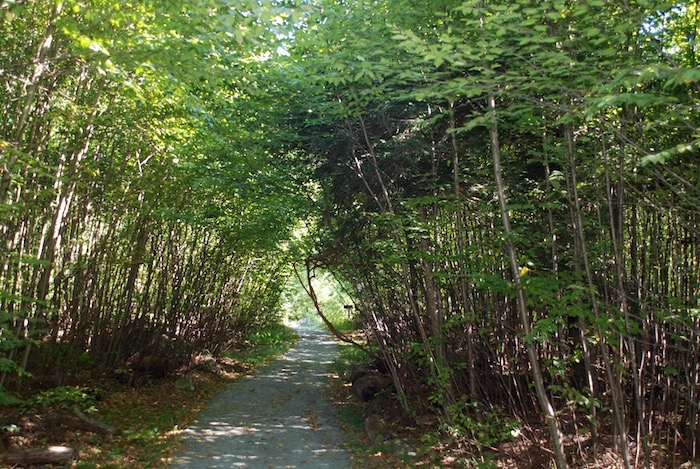
A study conducted in Europe found that birds just never get used to people hiking on trails through forests, such as the Limberlost Trail at Shenandoah National Park/Kurt Repanshek file
One of the reasons my wife and I like to head into the mountains to hike is to see what wildlife we can encounter, as well as to get some fresh air and exercise. And one thing we've noticed over the years is that there are not as many birds flitting about the trees as we expected. Now a study explains why: birds just don't feel comfortable in the presence of hikers.
Published in Frontiers in Ecology and Evolution, the study's results suggest that the trails themselves have less of an impact on forest birds than how frequently these paths are used by people. To minimize the impact on these forest creatures, people should avoid roaming from designated pathways, the researchers say.
"We show that forest birds are quite distinctly affected by people and that this avoidance behavior did not disappear even after years of use by humans. This suggests not all birds habituate to humans and that a long-lasting effect remains," says Dr. Yves Bötsch, lead author of this study, based at the Swiss Ornithological Institute, Sempach, Switzerland and affiliated with Institute of Evolutionary Biology and Environmental Studies, University Zurich, Switzerland. "This is important to show because pressure on natural habitats and nature protection areas is getting stronger and access bans are often ignored."
Many outdoor activities rely on infrastructure, with roads and trails being most common. Previous research has shown that trails cause habitat loss and fragmentation, where larger areas of habitat are dissected into smaller pieces thereby separating wildlife populations. However it has been difficult to say for certain whether it is the presence of trails or humans that have the most impact on forest birds.
"Previous studies provide conflicting results about the effects of trails on birds, with some studies showing negative effects while others do not," said Bötsch. "We thought differences in the intensity of human use may cause this discrepancy, which motivated us to disentangle the effect of trails from the presence of humans."
The researchers visited four forests with a similar habitat, but which differed in the levels of recreation. They recorded all birds heard and seen at points near to the trails, as well as within the forest itself, and found that a lower number of birds were recorded in the forests used more frequently by humans. In addition, they noticed certain species were more affected than others.
"Species with a high sensitivity, measured by flight initiation distance (the distance at which a bird exposed to an approaching human flies away), showed stronger trail avoidance, even in rarely frequented forests. These sensitive species were raptors, such as the common buzzard and Eurasian sparrowhawk, as well as pigeons and woodpeckers," says Bötsch.
"Generally it is assumed that hiking in nature does not harm wildlife," he added. "But our study shows even in forests that have been used recreationally for decades, birds have not habituated to people enough to outweigh the negative impact of human disturbance."
Bötsch concludes with some advice, which may help to minimize the adverse effects on forest birds by people who use forests recreationally.
"We believe protected areas with forbidden access are necessary and important, and that new trails into remote forest areas should not be promoted. Visitors to existing forest trails should be encouraged to adhere to a 'stay on trail' rule and refrain from roaming from designated pathways."
Story Categories:
A copy of National Parks Traveler's financial statements may be obtained by sending a stamped, self-addressed envelope to: National Parks Traveler, P.O. Box 980452, Park City, Utah 84098. National Parks Traveler was formed in the state of Utah for the purpose of informing and educating about national parks and protected areas.
Residents of the following states may obtain a copy of our financial and additional information as stated below:
- Florida: A COPY OF THE OFFICIAL REGISTRATION AND FINANCIAL INFORMATION FOR NATIONAL PARKS TRAVELER, (REGISTRATION NO. CH 51659), MAY BE OBTAINED FROM THE DIVISION OF CONSUMER SERVICES BY CALLING 800-435-7352 OR VISITING THEIR WEBSITE. REGISTRATION DOES NOT IMPLY ENDORSEMENT, APPROVAL, OR RECOMMENDATION BY THE STATE.
- Georgia: A full and fair description of the programs and financial statement summary of National Parks Traveler is available upon request at the office and phone number indicated above.
- Maryland: Documents and information submitted under the Maryland Solicitations Act are also available, for the cost of postage and copies, from the Secretary of State, State House, Annapolis, MD 21401 (410-974-5534).
- North Carolina: Financial information about this organization and a copy of its license are available from the State Solicitation Licensing Branch at 888-830-4989 or 919-807-2214. The license is not an endorsement by the State.
- Pennsylvania: The official registration and financial information of National Parks Traveler may be obtained from the Pennsylvania Department of State by calling 800-732-0999. Registration does not imply endorsement.
- Virginia: Financial statements are available from the Virginia Department of Agriculture and Consumer Services, 102 Governor Street, Richmond, Virginia 23219.
- Washington: National Parks Traveler is registered with Washington State’s Charities Program as required by law and additional information is available by calling 800-332-4483 or visiting www.sos.wa.gov/charities, or on file at Charities Division, Office of the Secretary of State, State of Washington, Olympia, WA 98504.
INN Member

The easiest way to explore RV-friendly National Park campgrounds.

Here’s the definitive guide to National Park System campgrounds where RVers can park their rigs.
Our app is packed with RVing- specific details on more than 250 campgrounds in more than 70 national parks.
You’ll also find stories about RVing in the parks, tips helpful if you’ve just recently become an RVer, and useful planning suggestions.

