
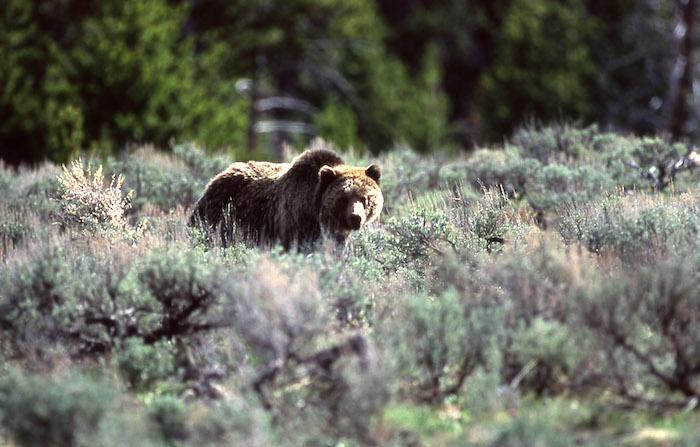
As expected, a coalition of groups on Wednesday filed a lawsuit to overturn the Trump administration's decision to remove grizzly bears in the Greater Yellowstone Ecosystem from the Endangered Species List.
The groups, including tribes, the National Parks Conservation Association, Sierra Club, and Center for Biological Diversity, said the U.S. Fish and Wildlife Service’s delisting decision in June came despite a recent increase in grizzly deaths in the Yellowstone region following the demise of some of the bears’ key food sources, including the seeds of whitebark pine.
While Yellowstone Superintendent Dan Wenk has opposed the delisting strategy in the past, Grand Teton National Park Superintendent Dave Vela has supported it.
Federal biologists documented a record-high 61 grizzly deaths in 2015 and 58 in 2016, with the majority of those caused by people, a release said. As a result, the government’s own estimate of the Yellowstone grizzly population level has declined from 757 in 2014 to 695 in 2016.
“With grizzly deaths spiking and the population in apparent decline, the Yellowstone population needs continued protection, not a new threat of state-sponsored trophy hunting,” said Earthjustice attorney Timothy Preso. “The grizzly is a major part of what makes the region in and around Yellowstone National Park so special and unique. We should not be taking a gamble with the grizzly’s future.”
The coalition’s legal challenge takes issue with the Fish and Wildlife Service’s evaluation of the mortality consequences of the bears’ recent shift to a more heavily meat-based diet following the loss of other foods. It also faults the agency for "surgically delisting" the isolated Yellowstone grizzly population instead of focusing on a broader, more durable grizzly recovery in the West.
“Without continued Endangered Species Act protections, the recovery of grizzly bears in Greater Yellowstone is in serious jeopardy. Inadequate requirements to protect and connect Yellowstone grizzlies to other populations and hostile state management policies will mean fewer bears restricted to an even smaller area," said Bonnie Rice, Greater Yellowstone senior representative with Sierra Club’s Our Wild America campaign. "Grizzly bears will be killed through trophy hunts on the doorstep of Yellowstone and Grand Teton national parks instead of inspiring millions who come to the region just for a chance to see a live grizzly bear in the wild."
At NPCA, Stephanie Adams, the group's Yellowstone program manager, said the organization "refutes the Department of the Interior’s short-sighted decision, which threatens Yellowstone grizzlies and ignores concerns, including those raised by many in the National Park Service. Despite Interior’s claim, the long-term health of Yellowstone and Grand Teton grizzlies is far from certain."
Since 1975, Yellowstone-area grizzly bears have been listed as threatened under the Endangered Species Act. Federal biologists acknowledge that population growth of the Yellowstone grizzly bear has flattened over the past decade and their own data indicates a decline from 2014 to 2016, the groups' release said. Prior to and during that same period, the grizzly population has faced the loss of two of its most important food sources in the Yellowstone region—whitebark pine seeds and cutthroat trout—due to changing environmental conditions driven in part by a warming climate.
The Fish and Wildlife Service previously attempted to delist the Yellowstone grizzly population in 2007, but that decision was overturned by a federal district court in Montana along with the 9th Circuit Court of Appeals on the basis that the Service ignored the impacts of the whitebark pine loss on the grizzly population. In rejecting the Service’s 2007 grizzly delisting decision, the 9th Circuit admonished the agency that “the Service cannot take a full-speed ahead, damn-the-torpedoes approach to delisting—especially given the ESA’s ‘policy of institutionalized caution.’”
Stories about:
Story Categories:
A copy of National Parks Traveler's financial statements may be obtained by sending a stamped, self-addressed envelope to: National Parks Traveler, P.O. Box 980452, Park City, Utah 84098. National Parks Traveler was formed in the state of Utah for the purpose of informing and educating about national parks and protected areas.
Residents of the following states may obtain a copy of our financial and additional information as stated below:
- Florida: A COPY OF THE OFFICIAL REGISTRATION AND FINANCIAL INFORMATION FOR NATIONAL PARKS TRAVELER, (REGISTRATION NO. CH 51659), MAY BE OBTAINED FROM THE DIVISION OF CONSUMER SERVICES BY CALLING 800-435-7352 OR VISITING THEIR WEBSITE. REGISTRATION DOES NOT IMPLY ENDORSEMENT, APPROVAL, OR RECOMMENDATION BY THE STATE.
- Georgia: A full and fair description of the programs and financial statement summary of National Parks Traveler is available upon request at the office and phone number indicated above.
- Maryland: Documents and information submitted under the Maryland Solicitations Act are also available, for the cost of postage and copies, from the Secretary of State, State House, Annapolis, MD 21401 (410-974-5534).
- North Carolina: Financial information about this organization and a copy of its license are available from the State Solicitation Licensing Branch at 888-830-4989 or 919-807-2214. The license is not an endorsement by the State.
- Pennsylvania: The official registration and financial information of National Parks Traveler may be obtained from the Pennsylvania Department of State by calling 800-732-0999. Registration does not imply endorsement.
- Virginia: Financial statements are available from the Virginia Department of Agriculture and Consumer Services, 102 Governor Street, Richmond, Virginia 23219.
- Washington: National Parks Traveler is registered with Washington State’s Charities Program as required by law and additional information is available by calling 800-332-4483 or visiting www.sos.wa.gov/charities, or on file at Charities Division, Office of the Secretary of State, State of Washington, Olympia, WA 98504.


National parks and their natural resources belong to you. The National Parks Traveler works to ensure you know how these essential places are being cared for.
Sign Up For Our Weekly Newsletter
Unsubscribe at any time.
INN Member

The easiest way to explore RV-friendly National Park campgrounds.

Here’s the definitive guide to National Park System campgrounds where RVers can park their rigs.
Our app is packed with RVing- specific details on more than 250 campgrounds in more than 70 national parks.
You’ll also find stories about RVing in the parks, tips helpful if you’ve just recently become an RVer, and useful planning suggestions.


Comments
I do not have money to spare right now, but would love to have the opportunity to sign a petition in this regard.