
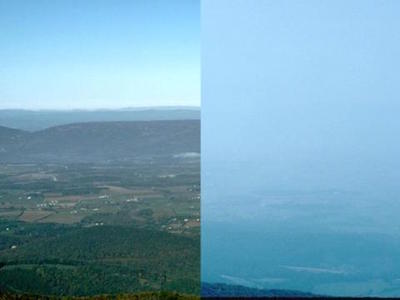
A decision by the Trump administration not to delay a tightening of ozone standards was welcomed by the National Parks Conservation Association, though staff there said the administration had no choice but to reverse itself.
“It was an illegal action, so EPA did the right thing in walking it back," Stephanie Kodish, NPCA's senior director and counsel for clean air and climate, said Thursday evening. "The Clean Air Act has a pretty specific pathway forward and a pretty specific exemption for when that path can be walked away from, and nothing here met that.”
The Trump administration and some members of Congress had wanted to delay Obama-era regulations that would require states to reduce acceptable ozone levels from 75 parts per billion to 70 ppb. Congress has been considering legislation to keep the 75 ppb standard in place and delay the more stringent ozone standards established by the Obama administration until 2025.
EPA Administrator Scott Pruitt in June moved until October 1, 2018, the deadline for implementing the Clean Air Act of 2015 standards. But now he has scrapped that plan on the heels of lawsuits brought by 16 states.
"We believe in dialogue with, and being responsive to, our state partners. Today’s action reinforces our commitment to working with the states through the complex designation process,” said Mr. Pruitt on Wednesday.
At NPCA, Ms. Kodish said the more stringent 70 ppb standard is needed to protect the health of the elderly, young children "with developing lungs," and even healthy visitors to the National Park System.
“If you’re a healthy person and you happen to be in Rocky Mountain or Joshua Tree on a day when it happens to be about 70 ppb and you’re having a walk with your family and you’re having trouble walking, I‘d say it’s an issue," she said.
The standard, the NPCA official pointed out, is "designed to protect the most vulnerable population, as well as the rest of us.”
“What’s important here is that EPA, the agency that is designated to protect public health and the environment, use the science that exists," Ms. Kodish added. "It’s the science that governs these standards, not ideology, and that’s how the EPA justified landing on that 70 ppb. That's the outer range of where the science led.”
Ozone forms "when pollutants emitted by cars, power plants, industrial boilers, refineries, chemical plants" react with sunlight, according to the Environmental Protection Agency. High levels can exacerbate bronchitis, emphysema, and asthma, particularly among the young and old, people who are exercising, or those who work outdoors.
So far this year Acadia National Park's air quality has exceeded that 70 ppb limit on six days, with the maximum 8-hour average this year peaking at 98 ppb.
In California, meanwhile, Joshua Tree National Park, has exceeded the limit 33 times this year at Black Rock, and 18 days at Cottonwood Canyon, while Sequoia National Park has exceeded it on 22 days. Other parks that have surpassed 70 ppb this year include Chiricahua National Monument in Arizona, Mesa Verde National Park in Colorado, Petrified Forest National Park in Arizona, Saguaro National Park in Arizona, and Tonto National Monument, also in Arizona.
In some areas of the National Park System, such as Acadia, Zion, and Yosemite, shuttle bus systems help lower ozone levels by reducing the number of vehicles on the roads. Some parks are even installing recharging stations for visitors with electric vehicles.
Stories about:
Story Categories:
A copy of National Parks Traveler's financial statements may be obtained by sending a stamped, self-addressed envelope to: National Parks Traveler, P.O. Box 980452, Park City, Utah 84098. National Parks Traveler was formed in the state of Utah for the purpose of informing and educating about national parks and protected areas.
Residents of the following states may obtain a copy of our financial and additional information as stated below:
- Florida: A COPY OF THE OFFICIAL REGISTRATION AND FINANCIAL INFORMATION FOR NATIONAL PARKS TRAVELER, (REGISTRATION NO. CH 51659), MAY BE OBTAINED FROM THE DIVISION OF CONSUMER SERVICES BY CALLING 800-435-7352 OR VISITING THEIR WEBSITE. REGISTRATION DOES NOT IMPLY ENDORSEMENT, APPROVAL, OR RECOMMENDATION BY THE STATE.
- Georgia: A full and fair description of the programs and financial statement summary of National Parks Traveler is available upon request at the office and phone number indicated above.
- Maryland: Documents and information submitted under the Maryland Solicitations Act are also available, for the cost of postage and copies, from the Secretary of State, State House, Annapolis, MD 21401 (410-974-5534).
- North Carolina: Financial information about this organization and a copy of its license are available from the State Solicitation Licensing Branch at 888-830-4989 or 919-807-2214. The license is not an endorsement by the State.
- Pennsylvania: The official registration and financial information of National Parks Traveler may be obtained from the Pennsylvania Department of State by calling 800-732-0999. Registration does not imply endorsement.
- Virginia: Financial statements are available from the Virginia Department of Agriculture and Consumer Services, 102 Governor Street, Richmond, Virginia 23219.
- Washington: National Parks Traveler is registered with Washington State’s Charities Program as required by law and additional information is available by calling 800-332-4483 or visiting www.sos.wa.gov/charities, or on file at Charities Division, Office of the Secretary of State, State of Washington, Olympia, WA 98504.


National parks and their natural resources belong to you. The National Parks Traveler works to ensure you know how these essential places are being cared for.
Sign Up For Our Weekly Newsletter
Unsubscribe at any time.
INN Member

The easiest way to explore RV-friendly National Park campgrounds.

Here’s the definitive guide to National Park System campgrounds where RVers can park their rigs.
Our app is packed with RVing- specific details on more than 250 campgrounds in more than 70 national parks.
You’ll also find stories about RVing in the parks, tips helpful if you’ve just recently become an RVer, and useful planning suggestions.


Comments
Great - EPA says 1--PPb is safe and we are going to waste money forcing a reduction from 75 ppb to 70pp. More costly regulation with no meaningful benefit. Kind of like 10 years of lead ammo regulation that has had no effect.
Again, clueless lies. ecbuck, you know that lead ammo regs in CA do not fully start until 2019 from now, and the regs don't include game animals like deer and elk, and only one type of sheep. Re-read your nonsensical tirade on the previous post: Traveler's View: Psst! Our National Parks Are In Danger
and you should read this: http://www.oneidadispatch.com/general-news/20170717/bald-eagle-threat-le...
ecbuck, You sound stupid enough to be the president
There have been regulations for 10 years. The fact that more regulations are coming on doesn't negate the fact that the ones that have been in place for as many as 10 years have done nothing.
ecbuck, Do you read? There is no ban on using lead ammo on game animals, do you get that? Do you understand that these are big birds that often eat large gutpiles from game animals? Do you understand that gutpiles have lead bullet fragments in them? Can you tie all these things together like a logical person? Try reading the link I added to my last post, you might understand, but I doubt it. Maybe your mom dropped you.
Well thats not true in the Condor Corridor, the core feeding area for the Condors. There is an absolute ban there with an estimated 99% compliance rate. That are also lesser bans throughout the rest of the state. Yet despite ten years of bans of one form or another, lead levels in the Condors have not gone down. Typical liberal response. All our prior regulations have been non-effective so lets enact more. Or as the case here with ozone, we already are well within safe levels but lets make more regulations anyway.
Typical conservative response, to decry any regulation at all.
Anyhow, lead was good enough for Baby Boomers like ecbuck so it's good enough for condors: http://www.telegraph.co.uk/news/uknews/crime/9790009/Was-lead-pollution-...
Where did I "decry any regulation at all"? Nowhere. What I did decry is regulation that has no positive impact like ten years of lead bans of one form or another or forcing are reduction in ozone from levels that are already well below those considered safe.