
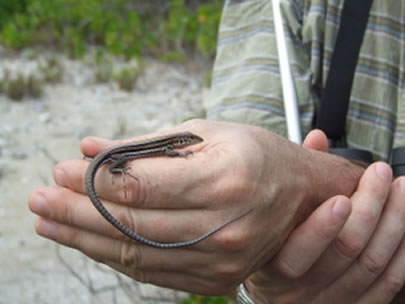
An endangered St. Croix ground lizard at Buck Island Reef National Monument in the U.S. Virgin Islands. NPS photo by Zandy Hillis-Starr.
For many going to Great Smoky Mountains National Park, Pigeon Forge is a town they pass en route to the park. Others spot the Pigeon River, or even spend a day rafting it during their stay.
The pigeon that influenced these place names no longer darts through the skies nor perches in the forests. It's extinct. The last American Passenger Pigeon died in captivity at the Cincinnati Zoological Garden in September 1914.
Passenger Pigeons, thought by many to have been the most numerous bird species during the height of their existence, would travel in such large flocks that they would darken the sky, and at times it could take two or three days for the entire flock to pass by.
What happened to them? Their downfall was brought on by the arrival of Europeans on the North American continent.
When the white man appeared on this continent, conditions rapidly changed. Practically all the early settlers were accustomed to the use of firearms; and whenever Pigeons appeared in great numbers, the inhabitants armed themselves with guns,clubs, stones, poles, and whatever could be used to destroy the birds. The most destructive implement was the net, to which the birds were attracted by bait, and under which vast numbers of them were trapped. Gunners baited the birds with grain. Dozens of birds sometimes were killed thus at a single shot. In one case seventy-one birds were killed by two shots. A single shot from the old flint-lock, single-barreled gun, fired into a tree, sometimes would procure a back load of pigeons.
The plight of the Passenger Pigeon is one worth remembering today, which the National Park Service honors as Endangered Species Day, a day that has been recognized only since 2006. The purpose of this recognition is to draw attention to the threats to wildlife, fish and plants that are listed under the Endangered Species Act. The Park Service also uses it to celebrate success stories, such as the delisting of the American bald eagle, American peregrine falcon, and some populations of gray wolf and grizzly bear (although not all would agree that the wolf or grizzly bear populations around Yellowstone National Park are ready to be delisted).
According to the Park Service, there currently are 389 "T&E," or threatened or endangered, species in 195 national park units: Of these, 280 are endangered, 108 are threatened, and one, the American alligator, is listed because of its similarity to the threatened American crocodile. These species are represented by 1,053 park populations. More than 1,700 Park Service biologists, botanists, and resource specialists implement recovery plan actions for T&E park populations.
About 70 percent of these populations are currently found on park lands, while 30 percent are historic. Park Service management policies direct parks to restore listed species’ habitats and to reestablish extirpated populations to maintain the species and the habitats upon which they depend. In 2008, 35 percent of T&E park populations were either not-at-risk, had stable populations, or had populations that were increasing in numbers, while 65 percent were either declining, unknown, or historic.
NPS units have restored 39 T&E populations – about 60 percent are plant species while 40 percent are mammals, mollusks, fishes, birds, or reptiles. The Hawaiian Island parks have restored 17 plant species and parks in the Southeast Region have restored four mollusks.
But this picture is not all bright. Land development threatens to turn some national park units into species-crippling biological islands, there's not always enough money to fund habitat restoration work or recovery programs, and some fear climate change, if left unchecked, will lead to mass extinctions.
You can head to this site to discover which species are listed at your favorite parks. And this site offers a running "box score" on the numbers of T&E species throughout the world.
Traveler trivia: Throughout the United States and foreign lands, there are currently 1,891 threatened and endangered listed species. The ESA celebrated its 35th anniversary on December 28, 2008. On March 28th, the secretaries of Interior and Commerce revoked a Bush administration rule that had become effective this past January 15th. Federal action agencies will once again consult with biologists at the U.S. Fish and Wildlife Service and the National Marine Fisheries Service for “not likely to adversely affect” determinations. The secretaries will conduct a joint review of the ESA consultation regulations to determine if any improvements should be proposed.
Story Categories:
A copy of National Parks Traveler's financial statements may be obtained by sending a stamped, self-addressed envelope to: National Parks Traveler, P.O. Box 980452, Park City, Utah 84098. National Parks Traveler was formed in the state of Utah for the purpose of informing and educating about national parks and protected areas.
Residents of the following states may obtain a copy of our financial and additional information as stated below:
- Florida: A COPY OF THE OFFICIAL REGISTRATION AND FINANCIAL INFORMATION FOR NATIONAL PARKS TRAVELER, (REGISTRATION NO. CH 51659), MAY BE OBTAINED FROM THE DIVISION OF CONSUMER SERVICES BY CALLING 800-435-7352 OR VISITING THEIR WEBSITE. REGISTRATION DOES NOT IMPLY ENDORSEMENT, APPROVAL, OR RECOMMENDATION BY THE STATE.
- Georgia: A full and fair description of the programs and financial statement summary of National Parks Traveler is available upon request at the office and phone number indicated above.
- Maryland: Documents and information submitted under the Maryland Solicitations Act are also available, for the cost of postage and copies, from the Secretary of State, State House, Annapolis, MD 21401 (410-974-5534).
- North Carolina: Financial information about this organization and a copy of its license are available from the State Solicitation Licensing Branch at 888-830-4989 or 919-807-2214. The license is not an endorsement by the State.
- Pennsylvania: The official registration and financial information of National Parks Traveler may be obtained from the Pennsylvania Department of State by calling 800-732-0999. Registration does not imply endorsement.
- Virginia: Financial statements are available from the Virginia Department of Agriculture and Consumer Services, 102 Governor Street, Richmond, Virginia 23219.
- Washington: National Parks Traveler is registered with Washington State’s Charities Program as required by law and additional information is available by calling 800-332-4483 or visiting www.sos.wa.gov/charities, or on file at Charities Division, Office of the Secretary of State, State of Washington, Olympia, WA 98504.


National parks and their natural resources belong to you. The National Parks Traveler works to ensure you know how these essential places are being cared for.
Sign Up For Our Weekly Newsletter
Unsubscribe at any time.
INN Member

The easiest way to explore RV-friendly National Park campgrounds.

Here’s the definitive guide to National Park System campgrounds where RVers can park their rigs.
Our app is packed with RVing- specific details on more than 250 campgrounds in more than 70 national parks.
You’ll also find stories about RVing in the parks, tips helpful if you’ve just recently become an RVer, and useful planning suggestions.


Comments
A good reminder about one of the important reasons we have national parks. Protected areas for a wide variety of plants and animals are increasingly valuable in today's world.
Kurt and Jim, I totally agree. Our national parks are safe havens for a wide variety of plants and animals. Unfortunately, sometimes these safe havens are not large enough and pristine enough to do a better job BUT they preserve more than most realize. Thank goodness we have them because a look around shows how development has destroyed so very much of our precious wild lands and their bounty !
Hello Kurt,
Thank you for the great post - your message is exactly what Endangered Species Day is all about - becoming aware of what there is to lose if we don't strive to further protect our ecosystems both far away and locally.
Best,
Gina
Nice post, unfortunately in a lot of cases the habitat provided by the parks isn't itself adequate to ensure their survival. There's more to "habitat" than the immediate area in which species lives, you have to consider the air they breathe and the water they drink, plus the shallowness of the gene pool.
===============================================
My travels through the National Park System: americaincontext.com
Paul--
What you say is true. Another compliicating factor is, of course, that the boundaries of most national park areas outside of Alaska are political, not ecoclogical, boundaries. Significant sections of the original habitat of some threatened/endangered species lie outside park boundaries. Park Service managers have limited powers to protect such land, having to rely mostly on persuasion and building good partnerships with adjacent land owners.
The classic case is the Everglades, one of the only "down-stream" parks in the system. Most of the bad stuff that happens to the water, both in terms of quality and quantity, happens before it arrives in the park. Big Cypress partially addressed this problem, buffering some of the northern boundaries of Everglades. And, the CERP (Comprehensive Everglades Restoration Project) was supposed to address many of the other problems. CERP, however, seems a bit bogged down and one wonders whether the full complement of projected "fixes" will ever get off the ground. I am increasingly doubtful.
Rick Smith