

Just 15 minutes from Mobile, Alabama, the Greater Mobile-Tensaw River Area features biodiversity so rich that it has been called “America’s Amazon,” and a recent report aims to shine a light on this natural and cultural landmark in hopes of protecting it and its surrounding areas from development.
The new "State of Knowledge" report, authored by dozens of scientists and scholars interested in the future of the delta, surveys the region’s key resources, including likely the greatest turtle diversity in the world, unique geology and hydrology, and evidence of human settlements from thousands of years ago. One of its leading proponents is Dr. Edward O. Wilson, a Pulitzer Prize-winning Harvard University scientist and native Alabaman.
“Remarkably little has changed in the Red Hills and Mobile-Tensaw Delta since my boyhood in the 1940s,” Dr. Wilson said in the forward of the report. “Industries and housing are pressing in on the habitable edges, and the pollution of the river waters is rising inexorably. The populations of Mobile and the Bay coasts are growing and spreading rapidly. Yet for a while longer this small wilderness will persist, a priceless window on deep history, and a national treasure at multiple levels. The value of the greater Mobile-Tensaw River area is great, unique, and if lost cannot be recreated.”
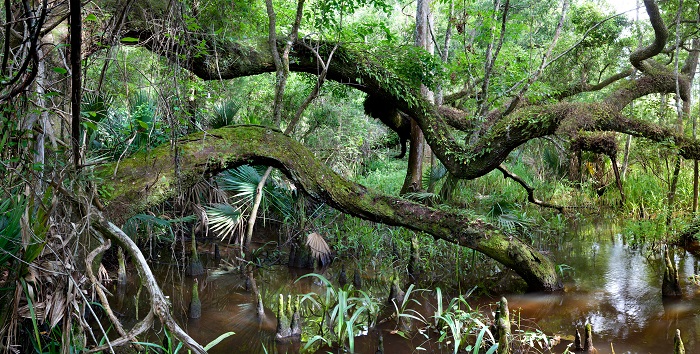
In 1974, the Mobile-Tensaw River Bottomlands were designated a National Natural Landmark. While locals have long appreciated the wildness and the hunting and fishing potential of the Mobile-Tensaw Delta, this report lays out information that the larger natural, cultural, and economic systems surrounding the delta floodplain are inextricably bound together with the surrounding uplands in the larger landscape ecology of a Greater Mobile-Tensaw River Area of several million acres.
"This area of North America is one of the richest in regards to intact biodiversity," said Elaine F. Leslie, chief of the National Park Service Natural Resource Stewardship and Science Biological Resources Division. "And its cultural history and heritage is of equal treasure."
According to the report, tectonic uplift created cliffs lining the eastern shore of Mobile Bay at Montrose, Alabama, as well as the steep bluffs of the Red Hills stretching far to the north that provide unique habitats for dozens of endemic plants and animals.
"More species of oaks, of mussels, of crayfish, of lizards and turtles are found in this region than in any other comparable area of North America," said Dr. Greg Waselkov of the University of South Alabama, one of the study editors. "And the same may well be true for many families of insects that we are only now beginning to identify to species in this massive natural laboratory."
The report’s contributors explore how this landscape’s connectivity is organized and point out potential consequences if our collective stewardship fails to preserve the delta.
"Who among us knew that the most abundant vertebrates in this region are the inconspicuous, shy salamanders that contribute mightily to water quality and carbon management in wetlands?” said study editor C. Fred Andrus of the University of Alabama. “The Mobile-Tensaw Delta is full of surprises, as much for the scientist as for the casual visitor enjoying fishing, bird-watching, or simply canoeing this watery maze."
The report results from a partnership between the National Park Service’s Biological Resources Division and Southeast Regional Office, the University of South Alabama, and the University of Alabama through the Gulf Coast Cooperative Ecosystems Unit. The state of Alabama and the National Park Service have a strong history of cooperation. Between 1960 and 1994, six National Historic Landmarks were designated in the area, including Fort Morgan, Mobile City Hall and Southern Market, USS Alabama, USS Drum, Government Street Presbyterian Church, and Bottle Creek archaeological site.

Story Categories:
A copy of National Parks Traveler's financial statements may be obtained by sending a stamped, self-addressed envelope to: National Parks Traveler, P.O. Box 980452, Park City, Utah 84098. National Parks Traveler was formed in the state of Utah for the purpose of informing and educating about national parks and protected areas.
Residents of the following states may obtain a copy of our financial and additional information as stated below:
- Florida: A COPY OF THE OFFICIAL REGISTRATION AND FINANCIAL INFORMATION FOR NATIONAL PARKS TRAVELER, (REGISTRATION NO. CH 51659), MAY BE OBTAINED FROM THE DIVISION OF CONSUMER SERVICES BY CALLING 800-435-7352 OR VISITING THEIR WEBSITE. REGISTRATION DOES NOT IMPLY ENDORSEMENT, APPROVAL, OR RECOMMENDATION BY THE STATE.
- Georgia: A full and fair description of the programs and financial statement summary of National Parks Traveler is available upon request at the office and phone number indicated above.
- Maryland: Documents and information submitted under the Maryland Solicitations Act are also available, for the cost of postage and copies, from the Secretary of State, State House, Annapolis, MD 21401 (410-974-5534).
- North Carolina: Financial information about this organization and a copy of its license are available from the State Solicitation Licensing Branch at 888-830-4989 or 919-807-2214. The license is not an endorsement by the State.
- Pennsylvania: The official registration and financial information of National Parks Traveler may be obtained from the Pennsylvania Department of State by calling 800-732-0999. Registration does not imply endorsement.
- Virginia: Financial statements are available from the Virginia Department of Agriculture and Consumer Services, 102 Governor Street, Richmond, Virginia 23219.
- Washington: National Parks Traveler is registered with Washington State’s Charities Program as required by law and additional information is available by calling 800-332-4483 or visiting www.sos.wa.gov/charities, or on file at Charities Division, Office of the Secretary of State, State of Washington, Olympia, WA 98504.


National parks and their natural resources belong to you. The National Parks Traveler works to ensure you know how these essential places are being cared for.
Sign Up For Our Weekly Newsletter
Unsubscribe at any time.
INN Member

The easiest way to explore RV-friendly National Park campgrounds.

Here’s the definitive guide to National Park System campgrounds where RVers can park their rigs.
Our app is packed with RVing- specific details on more than 250 campgrounds in more than 70 national parks.
You’ll also find stories about RVing in the parks, tips helpful if you’ve just recently become an RVer, and useful planning suggestions.


Comments
So, is there any movement toward securing the largest possible area under a national protective designation? Alabama, as the East's most diverse state would trumpet this status with a National Park designation here.
Agreed. National Park or monument status, to conserve as much of the area as possible. Alabama has no national parks, and while it has a few monuments, area wise they are tiny, 2 of the 3 were designated by Obama on his way out in 2017. A million acre monument would make it stand out in the region, only Everglades National Park in Florida would rival it in size. and as the recent lands bill shows , monuments often get upgraed to national park or national historic park status .