
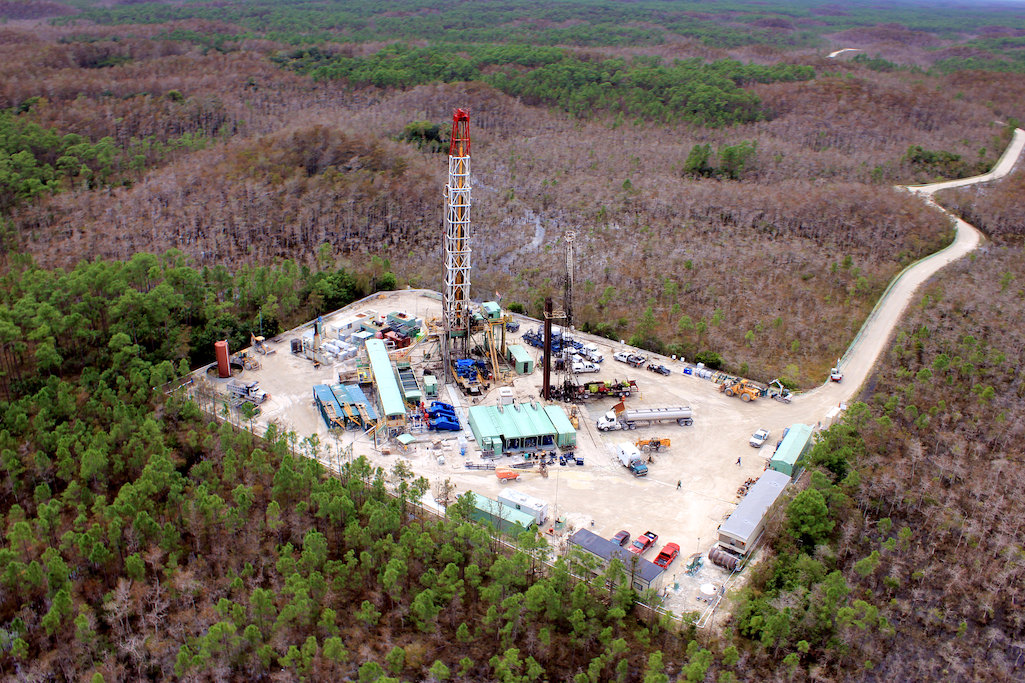
Once the Biden administration has a Senate-confirmed Interior secretary, that person needs to see that the National Park Service conducts an environmental impact statement, not a less rigorous environmental assessment, on the current plans to drill for oil in Big Cypress National Preserve.
Nothing less should be expected to protect the integrity not only of the nation's first national preserve, but also that of Everglades National Park next door. What is potentially at risk from drilling activities -- not just from the actual drilling itself, but also the supporting roads and other infrastructure needed to enable it -- is a landscape rife with threatened and endangered species and which is a conduit for roughly 40 percent of the water that flows through Everglades.
Though Big Cypress Superintendent Thomas Forsyth has said the park staff will prepare an environmental assessment on the drilling proposal put forth by Burnett Oil Co., a proposal that includes two well pads supporting a horizontal drilling project that can tap multiple wells, the project deserves a more intensive environmental impact statement. And not just because of the natural resources at risk.
Think not? Track down a copy of the preserve's 1991 general management plan -- that's right, the preserve is being managed under a 30-year-old plan that doesn't take into consideration current drilling technology or practices -- and dig into Appendix B: Area of Influence for Oil and Gas Development. Here are some key takeaways:
- Exploration and drilling activities may last for only a few months, but a single production activity may last as long as 40 to 80 years. Reclamation activities, regardless of how well they are performed, may still not provide a total return to a natural condition.
- The vast expanses of prairie in the central and southern portions of the preserve would allow oil and gas developments to be seen at great distances ( possibly 2-3 miles ), particularly during drilling operations.
- Visually , reclaimed roads and pads may require many decades to return to a somewhat natural condition.
- Surface spills of production fluids would affect surface water quality near producing wells. Spills of crude oil or brines would be possible at the wellhead, at the tank battery, or along the pipelines. While crude oil can have severe effects on the environment, brine spills may be more damaging in both the short - and long - term.
- The amount of freshwater used for drilling operations in the preserve can be enormous. Freshwater wells for oil and gas drilling operations are generally drilled on the pad. The average volume of freshwater extracted during a typical 45-day drilling operation in the preserve is 1,323,000 gallons ( personal communication, Palmer, Exxon 1987 ). Wastewater is then pumped into the "boulder zone," a deeper brackish water zone and unconsolidated formation found between 1,800 and 4,000 feet.
- The National Park Service has calculated the distance that an oil spill could travel, based on maximum surface water flow rate and probable detection and containment time. Although surface water flow rates have not been determined in the preserve, Leach et .al ( 1972 ) reported that flow rates in the Everglades ranged from 0 to 1,550 feet/day. The maximum of 1,550 feet/day was used in the calculation because the preserve probably has a slightly higher gradient than the Everglades.
- If oil or brine was spilled or leaked onto dry ground, it could percolate downward to the groundwater table. Upon reaching groundwater, most of the constituents would spread along the groundwater surface and assume the direction of lateral groundwater flow, making cleanup extremely difficult and costly. A loss of produced water brines from an earthen storage pit from 1984 to 1986 degraded groundwater quality and resulted in damage to vegetation downgradient from the impoundment. A 3-acre "dead zone" of pond cypress was reported, and abnormal pond cypress growth was reported in a 7-acre area, extending approximately 700 feet from the source (NPS, Roy et .al 1987).
There are more concerns raised in the Final Environmental Impact Statement attached to the 1991 GMP, and they're equally worrisome. The fact alone that those conclusions were raised 30 years ago should be enough to justify an EIS on Burnett's current plans to see 1) if technology has mitigated some of them or, 2) how Burnett would respond to a worse-case situation.
What also can't be overlooked are the floral and faunal wonders that reside at Big Cypress, and which need a healthy Big Cypress to survive.
The state of Florida lists nearly 70 plant species within Big Cypress as endangered, and if you include threatened species, the state’s tally reaches 100 for the preserve. More than 30 species of orchids grow in Big Cypress, perhaps most notable among them the ghost orchid that snakes its roots around the trunk of its host tree, anchoring its beautiful flowers.
Then there's the resident charismatic megafauna, the Florida panther, which some view as the most endangered mammal on the continent. The 1991 EIS noted the panther and how it was coping with oil development in the preserve's Bear Island and Raccoon Point fields.
Habitat loss and fragmentation, and disruption of normal travel routes, are concerns in the preserve, especially as they relate to the Florida panther. Large predators may be severely affected by development activities due to their secretive nature and tendency to avoid humans ( BLM 1979 ). Panthers are believed to be relatively sensitive to human intrusion into their habitat ( USFWS 1987a ). While the best documented panther populations in the preserve coincide with the Bear Island and Raccoon Point oil fields, which could indicate a fairly high tolerance level, the current population is a remnant of a once larger, more vigorous population in the region. The demise has been attributed to loss of habitat quality due to many things, including petroleum operations and road construction ( FGFWFC 1985c ; USFWS 1986).
Something else shouldn’t be overlooked. The state of Florida and the federal government are investing billions of dollars — that’s billions with a b — to restore the river of grass and improve the health of the Everglades.
Why stop short of doing the most intensive and rigorous assessment of proposals to drill for oil in one of the most biodiverse and vital ecosystems not only in the National Park System, but also on the continent?
Stories about:
Story Categories:
A copy of National Parks Traveler's financial statements may be obtained by sending a stamped, self-addressed envelope to: National Parks Traveler, P.O. Box 980452, Park City, Utah 84098. National Parks Traveler was formed in the state of Utah for the purpose of informing and educating about national parks and protected areas.
Residents of the following states may obtain a copy of our financial and additional information as stated below:
- Florida: A COPY OF THE OFFICIAL REGISTRATION AND FINANCIAL INFORMATION FOR NATIONAL PARKS TRAVELER, (REGISTRATION NO. CH 51659), MAY BE OBTAINED FROM THE DIVISION OF CONSUMER SERVICES BY CALLING 800-435-7352 OR VISITING THEIR WEBSITE. REGISTRATION DOES NOT IMPLY ENDORSEMENT, APPROVAL, OR RECOMMENDATION BY THE STATE.
- Georgia: A full and fair description of the programs and financial statement summary of National Parks Traveler is available upon request at the office and phone number indicated above.
- Maryland: Documents and information submitted under the Maryland Solicitations Act are also available, for the cost of postage and copies, from the Secretary of State, State House, Annapolis, MD 21401 (410-974-5534).
- North Carolina: Financial information about this organization and a copy of its license are available from the State Solicitation Licensing Branch at 888-830-4989 or 919-807-2214. The license is not an endorsement by the State.
- Pennsylvania: The official registration and financial information of National Parks Traveler may be obtained from the Pennsylvania Department of State by calling 800-732-0999. Registration does not imply endorsement.
- Virginia: Financial statements are available from the Virginia Department of Agriculture and Consumer Services, 102 Governor Street, Richmond, Virginia 23219.
- Washington: National Parks Traveler is registered with Washington State’s Charities Program as required by law and additional information is available by calling 800-332-4483 or visiting www.sos.wa.gov/charities, or on file at Charities Division, Office of the Secretary of State, State of Washington, Olympia, WA 98504.


National parks and their natural resources belong to you. The National Parks Traveler works to ensure you know how these essential places are being cared for.
Sign Up For Our Weekly Newsletter
Unsubscribe at any time.
INN Member

The easiest way to explore RV-friendly National Park campgrounds.

Here’s the definitive guide to National Park System campgrounds where RVers can park their rigs.
Our app is packed with RVing- specific details on more than 250 campgrounds in more than 70 national parks.
You’ll also find stories about RVing in the parks, tips helpful if you’ve just recently become an RVer, and useful planning suggestions.


Comments
It's good news to see NPT staying with this story and showing persistence in chasing it down. There has been some rightwing gossip that the NPS (in Florida) and Burnett Oil may try to get away with just an EA resulting in what is called a "mitigated" FONSI. I haven't been taking that approach seriously because I couldn't see how they could possibly get away with such a strategy, at this point, without the aid of a staggering amount of administrative and/or judicial corruption. But, it is Florida after all; so, perhaps some explanation of a "mitigated" FONSI and why it isn't appropriate is in order.
In the NEPA context, Environmental Assessments (EAs), if you can get away with them, are almost always cheaper and almost always avoid the required glaring levels of public input and scrutiny that a full Environmental Impact Study involves. Entrenched exploitive industries and their rightwing lackeys know that, if they can get away with an EA resulting in a FONSI that can be legally sustained, they can almost walk out onto Fifth Avenue, shoot somebody, and get away with it, which is generally not the case with a full EIS.
So, especially over the past ten years, the use of what are called "mitigated" FONSIs has became a popular way to keep the NEPA process contained at the EA level and avoid having to go to a full EIS. In order to get to a "mitigated" FONSI for activities that actually have "significant" impacts otherwise requiring a full EIS and a ROD, the scope of the action itself is expanded to include additional "restoration" efforts to allegedly "erase" the impacts of the desired activities. It is simply a legal and administrative tactic to reduce, if not avoid, the levels of public input and scrutiny that would otherwise be required. In at least one case, what was actually a small strip mining action got away with a "mitigated" FONSI because they included backfilling the hole and throwing some native seeds on the scar as part of the original scope. That was just wrong. In other cases, for actions where subsequent trustworthy clean up work can realistically remove everything that would cause "significant" impacts to persist beyond the period the action is underway, a "mitigated" FONSI can be a more reasonable way to go.
But, in this case, in the case of the NPS (in Florida) and Burnett Oil wanting to continue their previous exploratory work and now do exploratory drilling in Big Cypress National Preserve, a "mitigated" FONSI is definitely not appropriate for at least a couple of specific reasons.
First, the article above provides an ample bullet list of incontrovertibly "significant" impacts that simply cannot be "mitigated" into insignificance and will certainly persist long after everyone currently associated with the NPS (in Florida) and Burnett Oil has passed.
Second and as I mentioned in my previous comments on this topic, the use of a "mitigated" FONSI is always based on the ability to trust that "restoration" efforts included in the scope of action will be implemented properly and truly will "erase" the impacts of the desired activities; but, it is absolutely inappropriate when the parties involved have clearly demonstrated that they cannot be so trusted. When Burnett Oil was previously permitted to use "thumper" trucks in Big Cypress National Preserve, the NPS (in Florida) imposed "47 mitigation requirements" that Burnett Oil had to meet, including requirements to repair, on a daily basis, the impacts of those "thumper" truck movements and their use, to recover some types of the vegetation, and to restore the compacted ground resulting from the heavy trucks and their operations, which is very important because, when the ground in the preserve is compacted, it changes both surface and subsurface water flows, results in longterm impacts to the vegetation, and initiates a destructive environmental cascade. Burnett Oil took that deal and avoided the need for a costly EIS then; but, conservation groups and their experts, backed up by extensive photographic evidence, some of which has been posted in previous NPT articles, say Burnett Oil didn't bother to do an adequate job of meeting the mitigation requirements they agreed to back in 2015 and the damage from those previous activities remans.
As I've said before, I suspect Burnett Oil's efforts are actually only a Trojan Horse, another Tom Chapman or maybe Gary Engle kind of scam (republicans are all the same), aided and abetted by the NPS in Florida and setting the stage to up the bid for a buy-out, in this case of the mineral rights remaining under Big Cypress National Preserve.
Thanks foe the write up.
Any change from an EA to an EIS needs to come from the Regional Director. The staff and fINDE needed to make that happen (or an EA for that matter) are deployed out of Atlanta - not the park. Given the appointment of the current principal deputy for fish and parks is from Florida - the pressure to make the change in this case should be put above the park superintendent.