
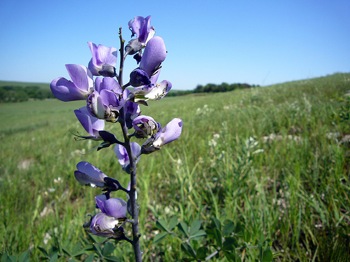
The landscape of the Tallgrass Prairie National Preserve. Photo via Flickr.
On a recent trip, my wife and I decided to explore Kansas, being fascinated by the horizon to horizon of open sky and low population density of this State. We drove off of I-70 taking major highways from Hays, KS to the Sante Fe Trail and US 56 to Strong City and the Tallgrass Pairie National Preserve.
This part of the National Park Service is only 10,861 acres, most of which is owned by the Nature Conservancy and the Kansas Park Trust. The NPS is in control of 32 acres, which were donated by the National Parks Trust. The small percentage of land managed by the US Government appears to have been part of the plan to preserve this portion of the Flint Hills of Kansas while keeping it taxable. There are no bison grazing in this area (yet), only cattle.
I found the views to be spectacular. Horizon to horizon of semi-natural grassland. Few human intrusions other than wire fences, remnants of stone fences, dirt roads, a few artificial ponds, and some grazing cattle.
We took the guided bus tour led by an NPS uniformed interpreter at a cost of $5.00 per person. The interpreter was a former local cowboy who spent 30 years in the military and then retired and returned home to reside locally among the Flint Hills. Rangering, as he described his duties, was now part of his retirement life.
Our guide described the preserve, its current vegetation cover, its active management for grazing of cattle, rotational burning of the plains (once every three years) to favor the tall grasses of the natural plains ecosystem. He pointed out aspects of the geology of the area, and the grazing patterns of cattle versus bison. He also pointed out the importance of stone walls that were used as fencing prior to the use of barbed wire. Narration aboard the bus was somewhat compromised by a dismally substandard sound system, but the best interpretation was given during the stops when we got off the bus and walked out onto the rolling landscape of the prairie. Some questions, that I would put in the "frequently asked" category, were beyond our interpreter's reach.
The region is known as the Flint Hills of Kansas. The prairie remains preserved in a semi-natural state because the rocky soils make mechanical plowing quite difficult. Our interpreter showed us erosional gullies and the layering of limestone and flint rock.
"What's the difference between flint and limestone?" he was asked. "I really don't know," was the answer.
As a former park ranger-naturalist, I expected a uniformed NPS interpreter to know the answer to this question. I say this, based on my past training and experience, but also on the fact that this interpreter had been giving near-daily bus tours since this past May.
I'm sure he's been asked this question before. I thus became curious as to how much NPS supervision, training and auditing are given to those whose primary assignment is public contact and interpretation at the preserve.
Fortunately, there's a detailed description of this issue on the preserve's NPS web site. So, I now know from having researched the answer to this question on the web that flint has a higher silica content than does the surrounding layers of limestone (which is nearly pure calcium carbonate). The source of the silica in the flint remains a mystery, but some geologists hypothesize that it deposited onto ancient shallow seas in the form ash fallout from distant volcanic eruptions.
"If and when bison are eventually reintroduced to the Tallgrass Prairie National Preserve, how many bison will this preserve support?" "Gosh, I really don't know the answer to that either..." was the response. Unfortunately, there's no mention of this fact on the TGPNP NPS website either.
Yet, one would think that visitor curiosity about the number of bison that the preserve could eventually support would make this question among the most common asked. Another visitor said, "We should Google it!" Well, I did, and there's no answer immediately available. My suspicion is that 10,861 acres might not be enough to support many bison at all (without supplemental feeding and extensive fencing). And the fencing required to keep the bison within the preserve while facilitating rotational grazing might be prohibitively expensive.
I asked my wife how she would have rated the quality of the interpretation. She said that she enjoyed his demeanor with the visitors aboard the bus, but that the over-all quality of interpretation merited a solid 'C'. I think I would agree with that. I wonder if this is the current NPS standard for front-line performance of its uniformed personnel?
Our guide, however, was quite eager to point out a small depression in the elevated prairie where the Kansas City Symphony Orchestra performed classical music to 6,000 park visitors last year. Symphony on the Prairie it was called. This is scheduled to be an annual event. It reminded me of continuing discussions about appropriate park events and the incentives for such events to become magnets promoting local tourism.
On the other hand, the low humidity, with horizon to horizon of clear skies combined with the relative remote setting of this preserve immediately brought to mind the excellent opportunity this preserve has for night sky interpretive programs. Unfortunately, the park closes at 4:30 PM. The gift store, although officially closed, stayed open until 5 PM to cater to the last bus load of people who completed the final interpretive bus tour of the day. We were told, however, that if we moved our car outside of the gated parking area, that we could stay as long as we wanted, but not beyond sunset.
In the evening hours, I did some more reading about the preserve, and learned that a much larger park was envisioned by Stuart Udall back during the early 1960's. He and Conrad Wirth landed by helicopter to oversee the proposed 35,000 acre national park area, but were told to leave by gunpoint by local cattlemen. Local cattlemen associations and their elected representatives in Congress have opposed the US Government's take-over of the Flint Hills prairie ever since. Perhaps for this reason, the Tallgrass Prairie remains as a private preserve. Cattle still have grazing rights. Only 32 acres currently belonging to the NPS, all donated by the National Park Trust. At present the NPS is allowed to own up to 180 acres.
When will the present cattle on the Tallgrass Prairie Preserve be replaced by bison and how many bison will there be, eventually? These remain unanswered questions. The side trip to explore this relatively small piece of semi-preserved ecosystem of the Flint Hills plains was definitely worth the journey. I highly recommend it.
Story Categories:
A copy of National Parks Traveler's financial statements may be obtained by sending a stamped, self-addressed envelope to: National Parks Traveler, P.O. Box 980452, Park City, Utah 84098. National Parks Traveler was formed in the state of Utah for the purpose of informing and educating about national parks and protected areas.
Residents of the following states may obtain a copy of our financial and additional information as stated below:
- Florida: A COPY OF THE OFFICIAL REGISTRATION AND FINANCIAL INFORMATION FOR NATIONAL PARKS TRAVELER, (REGISTRATION NO. CH 51659), MAY BE OBTAINED FROM THE DIVISION OF CONSUMER SERVICES BY CALLING 800-435-7352 OR VISITING THEIR WEBSITE. REGISTRATION DOES NOT IMPLY ENDORSEMENT, APPROVAL, OR RECOMMENDATION BY THE STATE.
- Georgia: A full and fair description of the programs and financial statement summary of National Parks Traveler is available upon request at the office and phone number indicated above.
- Maryland: Documents and information submitted under the Maryland Solicitations Act are also available, for the cost of postage and copies, from the Secretary of State, State House, Annapolis, MD 21401 (410-974-5534).
- North Carolina: Financial information about this organization and a copy of its license are available from the State Solicitation Licensing Branch at 888-830-4989 or 919-807-2214. The license is not an endorsement by the State.
- Pennsylvania: The official registration and financial information of National Parks Traveler may be obtained from the Pennsylvania Department of State by calling 800-732-0999. Registration does not imply endorsement.
- Virginia: Financial statements are available from the Virginia Department of Agriculture and Consumer Services, 102 Governor Street, Richmond, Virginia 23219.
- Washington: National Parks Traveler is registered with Washington State’s Charities Program as required by law and additional information is available by calling 800-332-4483 or visiting www.sos.wa.gov/charities, or on file at Charities Division, Office of the Secretary of State, State of Washington, Olympia, WA 98504.


National parks and their natural resources belong to you. The National Parks Traveler works to ensure you know how these essential places are being cared for.
Sign Up For Our Weekly Newsletter
Unsubscribe at any time.
INN Member

The easiest way to explore RV-friendly National Park campgrounds.

Here’s the definitive guide to National Park System campgrounds where RVers can park their rigs.
Our app is packed with RVing- specific details on more than 250 campgrounds in more than 70 national parks.
You’ll also find stories about RVing in the parks, tips helpful if you’ve just recently become an RVer, and useful planning suggestions.


Comments
Typically in the area of Kansas where the Tallgrass Prairie Preserve is located, the requirement for support of year-round Bison grazing is between 8-10 acres per animal, although the estimates vary depending upon rainfall and subsequent plant conditions. There are also widely varied opions regarding the fencing required to keep bison contained, as well as the requirements for interior fencing that would allow managed grazing. I have a small bison ranch approximately 45 miles northwest of the Preserve and have been successful with a 9 wire 6 foot tall fence. For additional information about Bison in Kansas and in the US, I would recommend contacting the Kansas Buffalo Association (http://www.kansasbuffalo.org), as well as the National Bison Assocation (http://www.bisoncentral.com). I am a member of both organizations and one of the many functions of both organizations is to provide further education about the Bison.
I also was a part of the Symphony on the Prairie (I sing with the Kansas City Symphony Chorus) when it was held at the preserve and I can tell you that it brought a number of people out to the Preserve that would otherwise have never come there. It was amazing to me to listen to the comments of the 'city dwellers' that had no idea there was anyplace like that in Kansas. There were many that were absolutely amazed at the vastness they experienced compared to what they are normally accustomed to. This is indeed going to be an annual event, but it is not held in the same location each year so that should help to limit the impact on the Preserve itself, yet still raise awareness among those that normally would not be exposed to the true beauty and grandeur of the native tallgrass prairie occuring in Kansas.
I am very pleased to see this article about the National Tallgrass Prairie Preserve here, and to see that you took the time to visit it while in the state of Kansas!!
geeez.... i bet that you, as a former interpreter, would know one of the best things to say when you don't know the answer is "i don't know." kudos to the ranger for his honesty rather than making something up like a lot of interpreters do. additionally, one of the jobs of an interpreter is to get people excited about something so they go on to learn more themselves. what's that tilden quote about spark something.... i can't remember. but the fact that you were left with questions, rather than a bored yawn, is good, don't you think? i mean, you did google it, you did get more responses so his answer, rather than a lie that stopped your inquisition there, instigated more thought and research?
it's not that i don't agree with you in some regard, perhaps someone should know the story behind the area's name. however, you spent an awful lot of time analyzing one individual and one set of expertise that clearly comes from something else (grazing and ranching) and perhaps had more to offer based on his experience. not all interpreters know every subject in detail. i think your research may have been more fruitful asking the park administration (easy nps reformers anti-gov types, this isn't a door to get all trollish, OK?) about the time the interpreter's supervisor has to do training, tour audits, asking for training materials, etc. and then give grades (perhaps) there rather than on an individual. i dunno.
the symphony thing sounds great. i would pay to see that. man and nature aren't separate and it's not like our national parks are always this pristine chapel of untouched nature as pop culture has misrepresented.
as i've wanted to visit this area for a long time, my vote is for another post, expanding on what you did, what you saw and what we should do if we were to visit. this place is intriguing.
I would like to thank you for your thoughtful comments. The Tallgrass Prairie National Preserve is indeed intriguing and worth the visit. I'd like it even more if there were bison grazing instead of cattle.
My comments about the quality of interpretation during the bus tour of the preserve reflect my concern that there has been a gradual decline in the general quality of NPS interpretive/ educational services over the decades. Indeed, to his credit, this uniformed interpreter did not make up an answer for questions to which he did not know the answer. But, he made no attempt to follow-up, either. These were questions that I would consider to be of the frequently asked type. I'm positive that he's been confronted with variations of these questions many times before. My critique is not so much a reflection on the performance of a single person, but an indication of lower standards and expectations of local NPS management.
In my travels, the best park interpreters and volunteers would first ask their colleagues for an answer to questions they could not address. Failing to find an immediate answer, they would request my home or e-mail address so that they could follow-up (provided that I was interested to get this information, and I ususally am).
When I returned to my home in Oak Ridge, TN, I got online and visited the Tallgrass Prairie NPS web site. I communicated my questions and concerns to park staff via the e-mail address given on their "contact us" button, but to date there has been no response. Interestingly, when reviewing the preserve's web site, I did notice that they have a "Frequently Asked Questions" button, but when I clicked on it, only one single question came up ("where is all the tall grass?"). I expected more.
Since I posted the original trip report, several individuals have written me with information about the Tallgrass Prairie carrying capacity for American bison. It seems that if properly fenced and maintained, the 10,861 acres of the TGP National Preserve is sufficient to sustain a population of serveral hundred grazing bison. That would indeed be a sight that would prompt a return visit.
I have to agree with Owen here. Not only has the quality of interpretation slipped, but the quantity of interpretation has seriously declined. Used to be a host of walks and evening programs and other programs to help one better understand the park and its history, geology, etc. Now they're hard to find and now the few that are offered are often the same programs as last year and the year before.
And of even further concern, in my opinion, is the way some of the parks (Yosemite's on my mind here) have really turned interpretation over to the concession. Delaware North does a big portion of evening programs and even nature walks in the park and this seems to me not to really be in the park's or the visitors' interests. The concessions are, after all, a profit-motivated business and if you don't think that the programs include a lot of info on where to get the best pizza rather than where to find the best glacial polish, you aren't paying attention. It bothers me that the NPS is so neglected by federal funders that we are left with turning over interpretation to private interests.
I do have to say, I've been impressed by the interpretation brought to Yosemite recently by the Sierra Club at LeConte Memorial and by Yosemite Association. But there's no substitute for the ranger naturalist.
In reflecting upon Owen's experiences during his recent visit to Tallgrass Prairie National Preserve, I am afraid that the NPS interpretive program might indeed be operating at the C grade level. Now had the interpreter lied, or fabricated information, I would have given them an F, not a C. Sadly, this reported experience is not inconsistent with a growing number of other observations reporting increasing mediocrity within NPS Interpretive programs.
Not that long ago, the NPS had a first class educational program staffed with professional naturalists and historians who took personal pride in striving for excellence in park interpretation. Most seasonal uniformed interpreters were secondary teachers and college professors who were employed during their summers as educational liaisons with the NPS and the visiting public.
P.J. Ryan, of Thunderbear fame suggests that the reason mediocrity may have become so noticeable in NPS interpretive programs over the years is that no one has ever bothered to sue the NPS over a substandard guided walk or evening program. Of course, suing a government agency requires high attorney fees and lots of time.
On the other hand, critical evaluations of interpretive experiences that are reported on the internet via electronic trip reports might be far more effective in bringing about positive corrective action.
Preparing a fact sheet of Frequently Asked Questions is easy to revise and serves as an excellent learning reference for new personnel and the visiting public. Why is it that the Tallgrass Prairie National Preserve home webpage lists 2006 Bus Tour Schedules? Why is it that only one FAQ is posted ("Where has all the tall grass gone?"). Obviously, NPS website maintenance is clearly needed here in addition to a more comprehensive Frequently Asked Questions and Answers Section.
I recall my first role as an NPS Naturalist at The General Sherman Tree when the SEKI superintendent would frequently appear with visitors and listen to the presentation. He demonstrated a clear management concern for the quality of the program. SEKI Chief Naturalist Russ Grater would frequently demonstrate in the field what he wanted us to do in communicating an understanding of the value of ancient giant Sequoia forests. NPS Budgets were far less than today's (inflation adjusted) but a professional work ethic was more evident.
Electronic trip reports published by knowledgeable park visitors which evaluate the integrity and effectiveness of NPS interpretive programs might serve as a modern method by which the NPS can get feedback from the public that will utlimately enhance the overall quality of the park experience.
What's the difference between flint and limestone?" he was asked. "I really don't know," was the answer.
Everyone clap for Owen. He already knew the answer.
MJ,
I did not know about the differences between flint and limestone before I took the guided bus tour last Saturday. This tour was conducted through a portion of the Flint Hills of Kansas (within which the Tallgrass Prairie National Preserve is situated).
Being naturally curious, I asked my question during the tour stop that featured a discussion of the geology of the area. Not having obtained an answer, I proceeded to search online for further information, some days later. Here's what I found on the NPS' website:
"Mineral deposits often form in the cracks and pores of limestone. Calcite deposits can be found in the form of geodes and crystals in some layers. Perhaps the most well-known deposits are those from which the hills receive their name. Chert or "flint" is common in many Kansas limestones as nodules or continuous beds. It breaks with a shell-like fracture, and the edges of the broken pieces are sharp. Chert is a sedimentary rock composed of microscopic crystals of quartz (silica, SiO2). It is unknown for sure what the source of silica would have been. However, it has been theorized that it was precipitated from volcanic ash and hardened in cracks and voids of the limestone."