
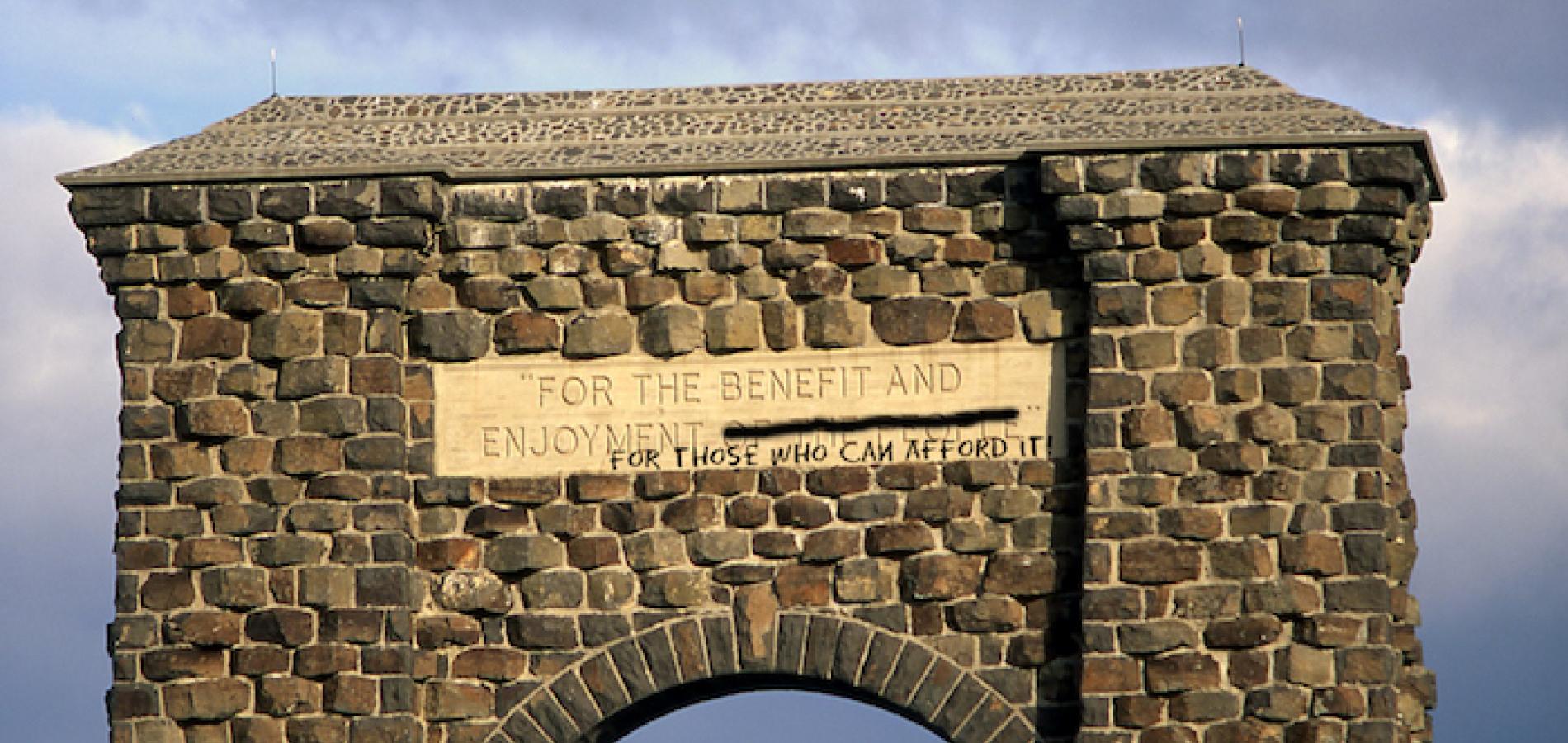

Having to hand over $70 to gain entrance to Yellowstone National Park for a week's stay is not outrageous. Indeed, there are many who say the fee should be higher. But the problems with Interior Secretary Ryan Zinke's plan to institute surge pricing for 17 national parks during their busiest seasons are many.
* It will hit families whose summer vacation schedules are dictated by school calendars harder than those who can travel to the parks any time of year.
* The contention that this fee structure will help address the $11 billion-$12 billion maintenance backlog in the park system is weak at best, and probably laughable. Even if the new structure, if approved, generates $70 million a year, President Trump wants to cut nearly $400 million a year from the National Park Service's budget. And even if Congress rejects the president's budget, which it likely will, this bump in fees will never make a significant impact on the backlog when you take into consideration inflation and ongoing, and unexpected, needs across the 417 units of the park system. (See: Scotty's Castle, Hurricane Irma and Maria)
* It's inequitable when you look at other fees assessed across the federal landscape.
* Why would someone spend $70 to enter a park for a week when, for $80, they could purchase a public lands access pass and enter as many parks as they wanted for an entire year?
* The biggest parks will benefit, while smaller ones continue to struggle.
* Why include Canyonlands National Park, which saw 776,218 visitors in 2016, for the higher surge fees and not the Blue Ridge Parkway, which counted 15.1 million, or Cape Cod National Seashore, which saw 4.7 million?
* Wasn't the president's much-ballyhooed infrastructure plan supposed to take care of much of the backlog in the National Park System?
* It gives Congress more reason not to take better care of the National Park System.
How did Secretary Zinke and his staff settle on that $70 fee for a week in Yellowstone, Arches, Bryce Canyon, Canyonlands, Denali, Glacier, Grand Canyon, Grand Teton, Olympic, Sequoia and Kings Canyon, Yosemite, Acadia, Mount Rainier, Joshua Tree, Shenandoah, and Zion national parks? By comparing prices around the marketplace.
"The proposed rates for this seasonal pricing were determined by analyzing historical NPS entrance fee and visitation data along with entrance fees at other park systems and family attractions," said Park Service spokesman Jeff Olson. "The proposed seasonal pricing structure is intended to balance the need to generate revenue to maintain high quality visitor experiences in our busiest national parks while still providing value to our visitors. The proposed pricing structure will likely generate significant new revenues that will positively impact our busiest national parks while maintaining existing prices in the vast majority of national park sites."
One aspect of what's wrong with that justification is that there are many parks struggling with deferred maintenance that are not among the 17. For instance, according to 2016 figures from the National Park Service:
* Petrified Forest National Park in Arizona had a maintenance backlog of $46.9 million;
* Death Valley National Park, $140.1 million;
* Mojave National Preserve, $113.8 million;
* Everglades National Park, $78.2 million;
* Mammoth Cave National Park, $94.5 million;
* Boston National Historic Park, $106.6 million;
* Gateway National Recreation Area, over $811 million when you consider both the New Jersey and New York sides of the NRA.
The list goes on, but you get the point. Even if this proposed surge pricing raised $70 million a year, it won't dent the needs of the park system, as just 20 percent, or $14 million, of that $70 million would be redistributed to the other 400 units with needs.
The ongoing financial plight of the parks can be blamed, largely, on two facts, Dr. Alfred Runte, author of National Parks: The American Experience and a Traveler contributing writer, told me: no one likes to pay more for anything, and the National Park System has never been properly funded.
He's no doubt correct.
And yet, ideally, the parks would be free to enter for all comers. The ideals behind the national parks movement should demand that, and Congress's role in holding these incredible landscapes and cultural and historical sites in trust for the American people should see that that is possible. The history of the country, its incredible landscapes, and the recuperative benefits of visiting the parks should raise these places above for-profit, commercial models that Congress is pushing them towards by refusing to properly fund them.
Secretary Zinke can work toward that goal rather than proposing a piecemeal approach that stands to serve nothing but to increase the cost of visiting the parks and presumably justify more concessions operations in the park system so the Park Service can get, on average, a single-digit percentage return. He only need look across his entire public lands portfolio -- and other market prices -- when figuring out how to make ends meet. Unfortunately, the secretary, who oversees a public lands kingdom of nearly 500 million acres when you combine the Park Service, U.S. Bureau of Land Management, and U.S. Fish and Wildlife Service holdings, seems to be looking at these agencies separately, not collectively, as he tries to balance his budgets.
Consider, for instance, how little ranchers pay the BLM to graze cattle on public lands in the West. These fees are reflected as AUMs -- Animal Units per Month, which reflect one cow and her calf, one horse, or five sheep or goats for a month. In 1966, the base year for calculating AUMs, the rate was $1.23 per AUM. For 2017, the rate has been $1.87. But if you based the cost of AUMs by the cost of living, the fee should be $9.38 per AUM. And perhaps it should be higher, for when you look at the AUM ranchers are charged to graze their livestock on private lands, the figures can be upwards of $17 per AUM.
Whether or not you agree that $1.87 per AUM on public lands is reasonable, when you consider that there were 12,365,877 AUMs active on BLM lands as of January 2016, you can see that a higher fee could generate a significantly higher return for Interior.
If you play that same cost-of-living game with park entrance fees, you'll see the current rates are perhaps much higher than they should be, especially when you glance back at the AUM scenario. Back in 1966, for example, the fee to drive into Yellowstone was $1 per car, according to park staff. If you used the cost-of-living to adjust that fee from year to year, it would now be $7.63, not the $30 the park currently charges, and far from the $70 Interior Secretary Zinke wants to charge.
When playing with these figures, let's look at what other revenues Interior has to work with. The department also oversees energy development on land and under the sea, and earlier this year the Interior secretary said he would like to use revenues from energy lease auctions to help address the park system's maintenance woes. While Interior has trumpeted its lease sales (here and here), which are generating hundreds of millions of dollars, there has been no mention from the secretary's office that some of the revenues will be applied to the park system's backlog.
Also yet to be tallied by Interior is the relative "haul" it took in this year in senior pass sales. During 2016, the Park Service realized at least $1 million in these sales, according to agency figures. That number surely spiked this year, as there was a rush by those 62 and older to purchase the $10 pass before the price jumped to $80 late in August. So hectic were the sales that the agency is far behind in sending out passes that were purchased in August.
It also would be better to ensure the Park Service's concessions program is accurately and timely recording revenues owed it by concessionaires. As the U.S. Government Accountability Office told the agency earlier this year, "we found that some of these data are incomplete because concessioners did not submit required financial reports or data were reported incorrectly and were not identified in the agency’s review of the reports."
For 39 of 485 contracts, concessioners reported gross revenues, but did not report paying a franchise fee in their 2015 financial report. Under these contracts, a total of about $21 million in gross revenues was reported in 2015. According to Park Service data, a franchise fee should have been paid under these contracts. Park Service officials said that they believed these were instances where the concessioner had paid franchise fees, but had not filled out the annual financial reports properly. They added that these inconsistencies should have been identified by the relevant park unit or the regional office during their review of these financial reports. Some park unit officials said that they are overwhelmed by the number of reports, including financial reports, they receive from concessioners and do not have time to review all of them. In addition, we found that the data from these financial reports are entered into a spreadsheet that does not contain edit checks that could identify possible errors.
But then, if the administration cuts 1,200 staff from the Park Service as it would like to, this situation might get worse, not better.
Let's not kid ourselves and think Park Service fee revenues alone are going to wipe out the agency's maintenance backlog and remedy all the infrastructure woes across the system. They won't come close. But perhaps if the Interior secretary considered all his revenues and expenses collectively, and if Congress met its responsibility to properly fund the parks, there just might not be a need for a $70 entrance fee that will accomplish little more than discouraging some folks from visiting their parks.
Story Categories:
A copy of National Parks Traveler's financial statements may be obtained by sending a stamped, self-addressed envelope to: National Parks Traveler, P.O. Box 980452, Park City, Utah 84098. National Parks Traveler was formed in the state of Utah for the purpose of informing and educating about national parks and protected areas.
Residents of the following states may obtain a copy of our financial and additional information as stated below:
- Florida: A COPY OF THE OFFICIAL REGISTRATION AND FINANCIAL INFORMATION FOR NATIONAL PARKS TRAVELER, (REGISTRATION NO. CH 51659), MAY BE OBTAINED FROM THE DIVISION OF CONSUMER SERVICES BY CALLING 800-435-7352 OR VISITING THEIR WEBSITE. REGISTRATION DOES NOT IMPLY ENDORSEMENT, APPROVAL, OR RECOMMENDATION BY THE STATE.
- Georgia: A full and fair description of the programs and financial statement summary of National Parks Traveler is available upon request at the office and phone number indicated above.
- Maryland: Documents and information submitted under the Maryland Solicitations Act are also available, for the cost of postage and copies, from the Secretary of State, State House, Annapolis, MD 21401 (410-974-5534).
- North Carolina: Financial information about this organization and a copy of its license are available from the State Solicitation Licensing Branch at 888-830-4989 or 919-807-2214. The license is not an endorsement by the State.
- Pennsylvania: The official registration and financial information of National Parks Traveler may be obtained from the Pennsylvania Department of State by calling 800-732-0999. Registration does not imply endorsement.
- Virginia: Financial statements are available from the Virginia Department of Agriculture and Consumer Services, 102 Governor Street, Richmond, Virginia 23219.
- Washington: National Parks Traveler is registered with Washington State’s Charities Program as required by law and additional information is available by calling 800-332-4483 or visiting www.sos.wa.gov/charities, or on file at Charities Division, Office of the Secretary of State, State of Washington, Olympia, WA 98504.

Comments
As usual, let's not look at the biggest problem, NPS mismanagement of funds. Let's just keep adding and enlarging the parks and not worry about how to pay for upkeep and security.
The 2013 audit showed wasteful spending on things not needed while ignoring what needed to be funded.
Let's raise grazing fees for land nobody wants other than oil and gas exploration and drive ranchers out of business. That will not help anybody wanting to save National Treasures.
One of the unspoken goals of the fee raise IS to discourage some folks from visiting the already overcrowded parks. At least for Yellowstone that is the case.
The REAL GOAL IS TO TAKE FAMILIES OUT OF THE PARKS! WITH TODAYS PRICES KIDS WITH FAMILIES ARE HAVING HARD ENOUGH TIMES PAYNG RENT AND BUYING FOOD IF THEY HAVE A COUPLE OF KIDS AND ARE BUYING DIAPERS THEY ARE SCREWED!! MAYBE POLITICIANS SHOULD LOSE THEIR RETIREMENTS AND BENIFITS THEY ARE ALREADY OVERPAID FOR NOT DOING A DAMN THING FOR AMERICA!!
Yet no one kicks about spending $100 per person to get into Disneyland for just ONE day....
Submitted by Cynthia on October 29, 2017 - 4:26pm.
Well, you won't catch me going there at that price. I guess that's kicking ...
It would be so easy to just wipe out the backlog in a couple of years. It's a lot of money but not in the grand scheme of things. How much of the Obama stimulas went to the National Parks? They were shovel ready:)
Not sure a $40 increase is a deal breaker for families not to take a vacation. Still one of the best deals out there. $70 for a weeks worth of entertainment...sign me up. We are going to break attendance record this year and my guess is that even with the increase we will break records next year. The bigger problem no one seems to talk about is the attendance in some of these parks ruins the experience. Long lines, people everywhere. Not my idea of a great experience but it is what it is. Your dislike for Trump is obvious, but this at least a step on the right direction. Not saying other things couldn’t be done to help also, but this is not a bad plan.
So Jerry, could you tell us (without yelling) why someone would have the goal of taking families out of the parks?
Ryan, Traveler has been reporting on the crowding issue and its impacts on parks such as Zion and Yellowstone since late 2015.
Using pricing as a tool to reduce that strain should not be the centerpiece of addressing the crowding issue. As the math shows, it certainly won't make a dent in the maintenance backlog. So what is the motivation behind proposing it?
Visitor capacities have been required by Congress since 1978, and the Park Service has been dragging its feet on that requirement. Zion is moving in that direction, and Acadia seems to be.
https://www.nationalparkstraveler.org/2016/07/peer-national-park-service...
Remember when gasoline was $5 a gallon? What was the price of visiting the parks then? Still for RVs it's a pile of dough. Why do people just complain about the entrance fees?
In the larger scheme of things--now 150 years--Uncle Sam has been the loss leader, and the concessionaires the beneficiaries of the parks. The railroads made very little--if anything--but then the railroads were after the prestige. Park business also swelled the seat count on existing trains.
No more. After the concessionaires, the gateway communities are the beneficiaries of selling the parks to tourists. If those tourists can afford $1000 getting to the parks, again, why complain about the entrance fees?
Because we like to complain. It's America, and bitching is in our DNA. History's bitch is how little the federal government gets for running the parks on its sucker model. Then when someone suggests hiring contractors for those services, it's called privatization, as it were. You're privatizing the parks! You're giving the best away! No, that was given away decades ago. Ask Xanterra, Delaware North, Forever Resorts, etc., etc. Why do they keep bidding on the contracts? Because they make millions when they do.
I would gladly turn over the rest of it to "private enterprise," allowing the Park Service to protect and preserve. Ha! Fat chance of that. As Harry Butowsky further points out this morning, we don't even have a director yet. The fees are the smokescreen; they are there to distract you from what is really ailing the parks--and always has. Kurt is right, of course. The fees are skewed everywhere. But money is NOT the issue.
The issue for the 21st century is whether or not we have the guts to limit automobiles in the parks, then to restore the tranquility and responsibility brought about by public transportation that works for the parks nationally and not just locally.
Ah, but I only vent, readers say. Why should I give up MY car? Fine. Don't give it up. I just hope all of us with that attitude are asked to pay for it, starting with higher entrance fees.
I've lived less than two house from Yellowstone for forty years and we visit often, especially since we have the golden age passport. Over the years we have seen how crowded the park has become during peak season and even into September. I don't have the answers to fixing this problem, but $70 for a carload of people is a bargain compared to $100 per person for one day at Disneyland. I don't like the idea of upping the enterance fee because these treasures do belong to all of us and we've seen some pretty horendous federal waste out here, like the calf/cow grazing fees being so low and the the wasted equipment and food for fire fighting....somebody needs to look into saving money in one department so it can be used where it is more needed.
Kurt, To be fair you have reported on attendance issues. Not saying pricing is the end all be all solution but what can it hurt. Parks have been underfunded for many years even before Trump. Nothing seems to change no matter who’s in charge. Even though it is small potatoes in the scheme of things, hopefully it will be money they haven’t had before. My opinion, but attendance/overcrowding is a much bigger problem than even a fully funded Parks service couldn’t solve in a manner that is acceptable to most.
Ryan, I don't think a $70 enty fee will stop someone from traveling across the country to visit Yellowstone or Yosemite, or any of the other 15 park units that are targeted in this endeavor. So it won't help with the crowding issue, and it certainly won't help with the backlog.
As for "money they haven't had before," Yellowstone receives a base operations budget of roughly $35 million a year. It raises about $35 million more a year in reimbursements and fees, so they have roughly $70 million a year to work with. How much more do they need? I'm not an accountant, and I haven't gone over their budget with a comb, but that seems like a lot of money for one park. Could there be cost-saving measures implemented?
Now, if everyone who entered Yellowstone paid a $70 fee, that would be a tremendous bonus to the park's coffers. But that's not going to happen. Even Interior realizes that, when it says this might raise $70 million a year.
And I wonder how Interior arrived at that $70 million figure. Certainly, prudent folks would buy an annual public lands pass, which can be purchased through BLM and Forest Service offices, among other entities outside the NPS, and in those cases the NPS would realize zilch.
There are better ways to address both the maintenance needs and the crowding issue.
So Kurt, if the $70 entry fee won't stop anyone from coming (which I agree), what is the downside? Perhaps it will shift some to come at another time. It will force foreign visitors, who pay no taxes, to contribute more and it will raise some funds. Enough to cover the so called maintenance deficit, no, but more than zero. Noone has suggested this is the be all and end all but it is a step that appears, in your and my opinion, to have no downside - at least not on interfering with attendance.
No downside? What about the 400 parks that aren't part of the surge pricing scenario? How will they benefit?
If these higher fees -- which already are seeing pushback from Congress -- are instituted, and they somehow raise $70 million, 20 percent of that -- $14 million -- will be available for disbursement to the other 400 units of the park system. Will $35,000 per park really make a difference? Go back and look at some of the maintenance backlog figures in the editorial.
Interior seems to have plucked a number out of the air -- $70 -- and claimed it will help with the maintenance backlog. It won't, and it won't help with the crowding scenario. So what's it's purpose?
As for foreign visitors, how many come on their own, and how many via tour buses? And if most come in tour buses, will they pay the full $70 per?
Frankly, there need to be more details behind how that $70 figure was arrived at.
I'd rather the Congress be lobbied by the administration to better fund the parks. Secretary Zinke should get behind the legislation proposed by Sens. Portman and Warner earlier this year to wipe out the deficit. It's far from perfect, but it lays out a plan.
https://www.nationalparkstraveler.org/2017/03/sens-warner-portman-introd...
Here's an important snippet from that story:
In the months ahead, Interior is expected to announce a higher price for the annual public lands pass as well as additional "options to maximize revenue," and will be looking to "expand recreational activities."
John Muir is rolling over.
I would love cost cutting measures to be put in place. We all know that is not going to happen. History is not on our side. Prices across the board should be looked at as one way to help out. Free entry or $25 to $30 fees are somewhat outdated even though these are our lands and many feel we are entitled to visit for free. I dont disagree that other things could be done that would help but unfortunately history has shown that it probably won’t happen. Our debt has doubled in 10 years. I wish the Parks would receive more money but the cold hard truth is govt can’t pay our bills now. Anyway, I appreciate all your good work. Thanks
Perhaps they won't benefit. But then, they won't be any worse off while these 17 parks will be helped. Again, this is not the be all and end all. It is a step in the right direction.
Doesn't the plan also call for a major increase in bus fees? Maybe not $70 per person but substantially more than is currently charged.
One aspect I haven't seen addressed is the people who don't spend a week at the parks. $70 may be reasonable for a week. However it is a different story if you only have time for a day or two. These parks are supposed to be for ALL Americans. Our taxes help fund them. Why not do as a lot of State Parks do. Out of staters often pay more than those living in the state funding the parks with their taxes. Charge more to visitors from other countries who don't pay taxes here.
After reading this I’m sorry I actually paid fir a lifetime pass for my husband...
http://www.oaklandpost.org/2017/09/23/national-park-service-gives-100000...
"After reading this I'm sorry I actually paid fir a lifetime pass for my husband...
http://www.oaklandpost.org/2017/09/23/national-park-service-gives-100000..."
Some good news Melinda. Still sad that this was even considered and adds fuel to the fire that the NPS has lost its way.
https://www.pbs.org/newshour/politics/national-park-service-drops-fundin...
An editorial from yesterday's Salt Lake Tribune:
http://www.sltrib.com/opinion/editorial/2017/10/28/tribune-editorial-don...
In Yellowstone at least, my concern is that surge pricing will displace visition to the "shoulder" seasons, which would be a unmitigated disaster. The park is not staffed for it, nor are the traditional staffing models able to account for it, and the infrastructure was never designed for it. Traffic issues, plowing, emergency response are bad enough in March, early April and late September and October without increasing vehicle numbers. Where are we going to get the workers to keep restaurants and hotels open in this weeks, with school back in session. Are we going to double the budget for road plowing operations? And OPM and NPS human resources continue to collude to reduce flexibility for hring practices, it is already difficut to staff basic functions for six months of the year, how are we going to staff for a seven or eight month season when we can't keep seasonal employees for the season which already exists? Just a few questions.
Melinda - you can break out your pass again. The project has been shut down. At least the NPS funding has.
Agreed, Mike. This isn't the Disneyland of my childhood. I wouldn't consider going there now. I'm glad to see that my two senators signed the protest.
The increase in user fees will be followed by further cutbacks in the National Park Service budget that will help fund tax cuts for the wealthy. Cutbacks in service will increase calls to privatize the parks. Create chaos is the plan by the evil doers.
I propose a better alternative to consider. Decide what infrastructure work is needed on not just national park lands but the entire system of national conservation lands that the US Forest Service, Bureau of Land Management, US Fish and Wildlife Service, US Army Corps of Engineers and related agencies manage. Bring all of them up to standard. I figure 60 billion for discussion purposes including the roughly 12 billion needed for national park backlog. Second is to staff the national conservation lands at an appropriate level similar to how Parks Canada, as one example, operates. Third, increase the number of national park designations where appropriate by converting national monuments and national seashores to this higher status perceived by the public to be the place to visit. Having just visited Bear Ears and Grand Staircase - Escalante these are two places that deserve park status. Sure, allow some drilling and coal mining to make the congressional delegation from Utah happy. Fourth, establish a national service corps that has the option to work on these lands for a year, serve in our military like I did for 24 years, or be a nurse or similar position helping our country. No exemptions for anyone including those with disabilities because we will find something meaningful for all. Just one year serving our country with the option for more.
Our system of national conservation lands bring in a huge amount of indirect tax revenue from tourism, many of them from out of the country. Fix these trails, roads, campsgrounds and so forth up and invest in the future. I figure the payoff on 60 billion would be less than 20 years. These lands also provide health and relaxation to our people.
I am not a newbie when it comes to public lands. My first visit to a national park unit was as a kid in 1963 at Cape Cod National Seashore that President Kennedy championed. My last visit was a month ago to the fantastic City of Rocks National Reserve that the NPS and State of Idaho manage. That marked 381 out of 417 units that I have visited. I have always enjoyed my interatcions with national park service staff and volunteers and appreciate the dedication that they have inspite of what politicians and political hacks throw there way.
So that is my alternative proposal and why I oppose fee increases.
11B50
A raise in park prices should have been done a LONG time ago. To hear people belly-ache about $70.00 fee per week is a joke. Look at the car$ people drive, look at the huge truck$ and $UV's people drive. Some of these people would have a stroke if they had to get their hands dirty by changing a tire. Have you seen the lines that wrap around the block at Starbucks for a $7.00 latte? Looking to take an expensive trip ($10,000.+pp)? Well you better book at least a year or two in advance, because they are all booked up!! We dont have a money problem we have a priority problem. Think about that the next time you sit in your Esclade, in a Starbucks line, on your cell phone, talking about your vacation plans to visit Disney World this summer. Americans value image not substance anymore. Im sure I will get a lot of pushback from this, but hey, the truth hurts!
We should do as other countries do if we truly value what we have. In Tanzania for example to visit the Serengeti National Park the admission PPPD is $60.00 non resident adult, $20.00 non resident child. Children under 5 free. Locals are half price. In addition there is a vehicle charge depending on vehicle weight, and an 18% VAT Tax on top of all that. And dont go looking for roads, bathrooms, and concession stands...you wont find many.
Im not suggesting we go that far but we DO need to raise fees.. $70.00 per week is not unreasonable. Charge DOUBLE for non-residents, and get adequate staff in there to protect our National Treasures....before its too late. Right now the landscape, and wildlife are paying the price. I know MANY photographers who have said they will never go back to Yellowstone because the tourist are out of control. The underfunded and understaffed rangers have lost their patience with unruly people. Because of that the wildlife viewing experience has been made nearly impossible. The National Parks Service is a MESS!! People dont want to pay taxes and dont want to pay users fees, well guess what.....you have to pay to play and $70.00 a year for the AMAIZING park system we have here in the United States is the best bargin you'll find anywhere. Quit your whining.
I think the concept of "peak Season Pricing" actually makes some sense, and the park costs are still a really great deal even with an increase. What I don't like about this plan is how they arrived at all of their numbers.
- Why a flat $70 for all of those 17 parks, when that is nearly triple for some and just double for others?
- Why these 17 parks, and not say Lake Mead which takes in more fee money than some of the others in these 17 (did somebody just get a list of the top 17 fee revenues for National "parks" and not look at just park sites?)?
- How did they arrive at the $70 million increase in revenue?
- Why not make the fee increase a more competative price? At $70 I would advise everybody to just pay the extra $10 and get the park pass (and certainly don't pay the silly $75 for a park specific annual when you can get ALL for just 5 bucks)? Perhaps doubling the park's fees would still allow parks to get single visit purchases and not just park passes.
- Why a flat 5 months? Some parks simply do not have enough open to warrant "peak" season pricing. Imagine Mount Rainier in early June: most roads are closed, most trails are snow covered (but also melting so not great for skiing/snowshoeing), no ranger talks, most services are still closed.
- If the crush of increased visition is a big issue, why not mandate that a portion of the increased fees go to increasing peak season seasonal staffing? More maintenance, more protection and interp rangers, more programs, more things for people to do. That's where the whole "Disney argument" falls flat for me: for the $100 bucks each you pay at Disney can be seen in the extensive crew and workers that are there, the shops, the rides, the amount of tangible things that are open and available.
Again, I really don't hate the idea of peak season pricing, and I don't want to just live in a fantasy world where the parks will get a ton of funding from Congress. I don't think this proposed increase will spell doom for the parks, but I also see it as a missed opportunity. I think they could have done this much, much better.
the “reasoning provided is the fee increase is needed to tackle the Park Service’s $11.3 billion in repair backlog,” Adams (NPCA) said the Interior Department “estimates these increased fees would raise about $70 million — an amount that would cover a mere 2 percent of the maintenance backlog at the 17 parks proposed for entrance fee increases.” Adams concluded, “Instead of putting the backlog on the shoulders of parks visitors, the administration and Congress should support the National Park Service Legacy Act.”