
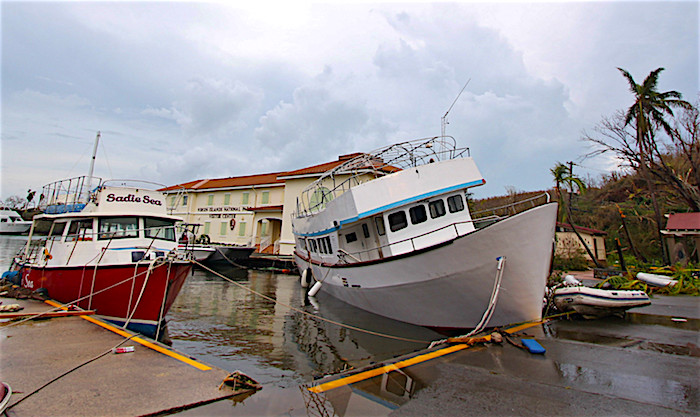
There was Betsy and Donna, Hugo and Lenny, as well as Omar and Earl and many other hurricanes before Irma made a direct hit on St. John in the U.S. Virgin Islands, and after each, the rebuilding got under way. It's no different today at Virgin Islands National Park, which occupies more than half of the 20-square-mile island. And it won't happen overnight.
NASA photographs depicted the devastation wrought by Hurricane Irma, a monster of a storm with 185 mph winds, in monotone. The "before" shot of St. John showed a green, verdant island. The "after" shot was of a brown mound in the Caribbean.
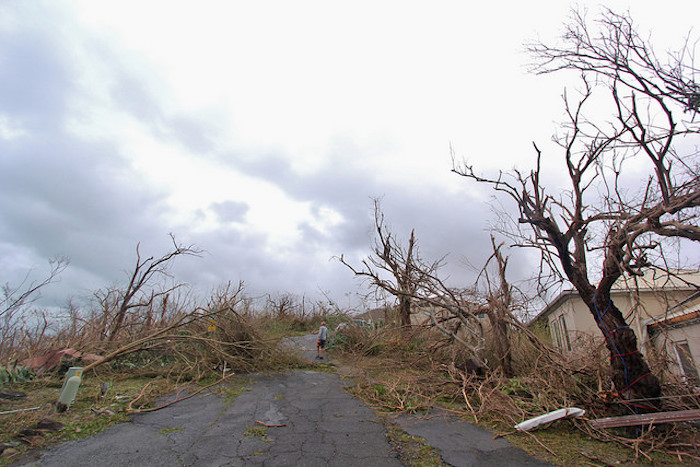
“It looks like a desert environment. The first thing when I first saw it, it reminded me of a desert," said Randy Lavasseur, who knows about deserts, having grown up in Los Angeles and worked in parks in the Southwest. “There definitely are some downed trees, that’s without a doubt. But the large majority of what we’re seeing over there, the foliage, the winds were just so violent that the foiliage was just ripped right from the tree.
"The tree’s there, and the vegetation is still alive; it’s just going to take a couple months for it actually to start regrowth, coming back and to be viable and healthy again," Mr. Lavasseur, who oversees all National Park System units in the Caribbean from his office at San Juan National Historic Site on Puerto Rico, said during a phone conversation Wednesday evening.
The Category 5 hurricane, the first of that intensity to strike St. John since Lenny in 1999 (a hurricane that did an estimated $1.6 million in damage to the national park), left St. John in tatters. Boats were tossed ashore, vehicles were knocked over and squashed under trees, roofs and entire walls were ripped from buildings.
“Unfortunately, the need is greater than anyone anticipated,” St. John Rescue, a nonprofit, stated on Facebook on Sunday. “Many St. Johnians remain missing. Homes and businesses have been destroyed, public infrastructure decimated. Nearly every wooden structure has suffered severe damage. Currently, we are in desperate need of food, water purification, fuel, generators, medical supplies, and clothing. There is a long road before us. We need your support today to aid in the months and, frankly, years of recovery ahead.”
The national park's visitor center at Cruz Bay was turned into an operations hub for both the Park Service and the island community, its generator one of the few sources of electricity on the island.
"The park is technically closed. We are not asking or advising visitors to come out at this moment. It’s not safe. And I say that on many fronts," Mr. Lavasseur said between meetings with acting National Park Service Director Michael Reynolds and Southeast Regional Director Stan Austin, who had arrived to survey the damage. "There’s only a certain amount of structures you can actually sleep in. And there’s only a certain amount of food and water and necessities for locals and rescue and recovery operations.”
Miracuously, none of the Park Service employees on St. John were injured. But the extent of damage to the park's facilities and landscapes was substantial, said the superintendent, and won't be quickly fixed.
“Several of our houses, the roofs were blown off, the windows were blown in. We have a maintenance team that’s working, as a priority, of getting those houses up and working so that we can start getting more assistance into the park to start getting the park up and running," said Mr. Lavasseur. "You have to remember, you can only put as many resources on the island as the resources are to safely operate. Meaning, we have to have safe housing for people, we have to have enough water, we have to have enough food to ensure that anybody that we’re putting on the island is safe. And so, if we overwhelm the island right now with volunteers who want to help us recover, or we put too many government personnel, we will overwhelm the resources there and it won’t be a safe recovery.
“So we’re being very measured and segmented as to how we’re going to do this. And our first priority is, let’s get core facilities up and running, and housing. Then we can start bringing on the resources safely.”

While the military and U.S. Coast Guard were rushing supplies to the Caribbean, Park Service teams were en route to St. John to make a thorough assessment of what damage was done -- to the park's physical infrastructure, its landscape, and even its marine resources. Only after that work was completed could actual recovery begin, said the superintendent. And still to be determined is where St. John stands in terms of need compared to other islands.
“As you can imagine, with 22 islands, before Irma hit Florida, 22 islands were impacted. So the amount of resources that are coming in, there’s got to be a proper distribution of that. We don’t know where St. John is within that distribution," Mr. Lavasseur said.
He declined to speculate on when the park would be ready to entertain visitors.
“We won’t have that guesstimate until we do a facility assessment That team is coming from the United States and they arrive in Puerto Rico on Friday, and we anticipate them being on St. John beginning work on Saturday," said the superintendent. "Not until they complete the assessment will we actually be able to know what damage we have. We have to look at, 'Was there damage done by roots, did we have a tree that fell and now it’s disrupting the water, do we have undercutting of the roads that now we have to close a road?' And we don’t know the totality of damage, so we really couldn't safely say what the recovery time will be without the assessment."
Also still to be determined is how the historic sugar plantation ruins on the island weathered the storm, whether coral reefs in park waters were damaged by the storm-driven seas, and the extent of damage to the Caneel Bay and Cinammon Bay concession operations.
"They definitely had a lot of damage," Mr. Lavasseur said of the concessions. "I don’t want to speak for them. We have been in communications and working together. We want to do this recovery together, and share each other's resources, what we do have left."
At Cinammon Bay, the concessionaire was able before the hurricane struck to dismantle 40 tents that are rented out to guests. Now those tents could temporarily house recovery crews, said Mr. Lavasseur.
The superintendent also pressed Director Reynolds to see that afterwards a team arrives to review the actions that were taken leading up to and through the hurricane.
"One of the things I asked the director is don’t let this be lost. Send in an 'after action' review team here to assess the decisions that I and the other superintendents made, and look at if we had the right resources in place. So for example, in the housing at Lind Point, did we properly prepare those buildings when we first put them there? They don’t have shutters on them. Why didn’t we spend the extra money two decades ago to put the shutters on?" said Mr. Lavasseur. "Would that have been a cost-effective solution, instead of losing those houses altogether? Did we board them up right? Were the doors correct?
“I want a review team to come in and look at not just the decisions that we made, but the structures that were in place and were they the right structures for the environment that we live in?”

While there's been an outpouring of support and offers from volunteers anxious to help with the park's recovery, the superintendent said it was too early for that help.
"We are honored that we are getting so many requests that want to come and help. But they also have to understand that we have to ensure that we have enough resources on the island to support the teams that are coming in to repair it," he said. "And right now we’re still in that kind of heavy assessment, before recovery. And so once we actually move into recovery, and things are safe, and we have enough facilities to bring on some help from volunteers, until that happens we can’t have any volunteers out there. But once we start having this infrastructure built, we will put in place a call center and a team that will handle all volunteer requests."
(Traveler note: That call center phone number will be posted on the Virgin Islands National Park's website when it's up and running.)
Beyond the park's borders on St. John, islanders were pulling together.
"St. John, aptly nicknamed 'Love City' for its tight, loving community, has come together in the most incredible way, demonstrating that the people are St. John’s most powerful resource," said Rebecca Reinbold, a spokeswoman for the island. "Groups of residents have come together, implementing morning community meetings to take inventory of needs and to assemble teams. Locals have spearheaded projects including shelter, evacuation, bringing in/unloading/distribution of water/food/supplies, chain sawing and clearing roads, searching for residents yet to be accounted for, restoring WiFi to Cruz Bay, and more.
"Virgin Islanders in St. Croix and that are currently stateside are organizing strong relief efforts to evacuate families with small children, pregnant women and sick individuals or those needing medical attention, as well as bringing in much-needed machinery and equipment, supplies, clothing, and more," she added. "Restaurants including The Longboard and Cruz Bay Landing have opened their kitchens and have provided over 2,000 warm meals to residents. The overwhelming network that has pulled together to provide relief is heartwarming, encouraging, and a reminder of what makes St. John such a special place."
Stories about:
Story Categories:
A copy of National Parks Traveler's financial statements may be obtained by sending a stamped, self-addressed envelope to: National Parks Traveler, P.O. Box 980452, Park City, Utah 84098. National Parks Traveler was formed in the state of Utah for the purpose of informing and educating about national parks and protected areas.
Residents of the following states may obtain a copy of our financial and additional information as stated below:
- Florida: A COPY OF THE OFFICIAL REGISTRATION AND FINANCIAL INFORMATION FOR NATIONAL PARKS TRAVELER, (REGISTRATION NO. CH 51659), MAY BE OBTAINED FROM THE DIVISION OF CONSUMER SERVICES BY CALLING 800-435-7352 OR VISITING THEIR WEBSITE. REGISTRATION DOES NOT IMPLY ENDORSEMENT, APPROVAL, OR RECOMMENDATION BY THE STATE.
- Georgia: A full and fair description of the programs and financial statement summary of National Parks Traveler is available upon request at the office and phone number indicated above.
- Maryland: Documents and information submitted under the Maryland Solicitations Act are also available, for the cost of postage and copies, from the Secretary of State, State House, Annapolis, MD 21401 (410-974-5534).
- North Carolina: Financial information about this organization and a copy of its license are available from the State Solicitation Licensing Branch at 888-830-4989 or 919-807-2214. The license is not an endorsement by the State.
- Pennsylvania: The official registration and financial information of National Parks Traveler may be obtained from the Pennsylvania Department of State by calling 800-732-0999. Registration does not imply endorsement.
- Virginia: Financial statements are available from the Virginia Department of Agriculture and Consumer Services, 102 Governor Street, Richmond, Virginia 23219.
- Washington: National Parks Traveler is registered with Washington State’s Charities Program as required by law and additional information is available by calling 800-332-4483 or visiting www.sos.wa.gov/charities, or on file at Charities Division, Office of the Secretary of State, State of Washington, Olympia, WA 98504.


National parks and their natural resources belong to you. The National Parks Traveler works to ensure you know how these essential places are being cared for.
Sign Up For Our Weekly Newsletter
Unsubscribe at any time.
INN Member

The easiest way to explore RV-friendly National Park campgrounds.

Here’s the definitive guide to National Park System campgrounds where RVers can park their rigs.
Our app is packed with RVing- specific details on more than 250 campgrounds in more than 70 national parks.
You’ll also find stories about RVing in the parks, tips helpful if you’ve just recently become an RVer, and useful planning suggestions.


Comments
I definitely feel the pain of all the Park Service employees and all the islanders that had to go through such an event and can comprehend the challenges they face. There are days where I still feel shellshocked from the wildfire event that occurred in the Great Smoky Mountain region around Gatlinburg just last year. It's a long road...
I can only hope that the NPS can keep the reefs protected, and that the oceans in and around the park don't become a dumping ground for the debris. Although, I have to admit, I am interested to see the ecological recovery of the Virgin Islands, and speculate that many of the trees on the island that were stripped of their leaves may not be dead, but will start to leaf out and green up quickly.
I think the biggest challenges the island will face will be all the toxic debris that is now everywhere. That will take years, if not decades to clean up. I just hope they put in place rules to keep it from just being dumped in the ocean and the clean up is done with the envrionment in mind (which in most disasters is the first thing neglected). Whatever happens, I think the lessons are many... Man tends to overbuild and put things in places that might be better off left in a more natural state. Recovery is a slow grind. I'm sure on an island with less natural resources, the grind goes even slower.
I visited the Virgin Islands NP last year as an excursion while on a cruise. It was a great tour with a guide. We also swam and snorkled in Trunk Bay. While it wasn't the best day of snorkling because it was windy and the sand was churned up, it was a beatiful place. I am sure it will bounce back over time. It would be cool if NP Traveler could get a laison from Friends of the Virgin Islands NP or a park employee, to periodically send you pictures and updates of the progress of clean up. Also some more before and after pictures.
I hope in the rebuild process there can be established more camping areas and affordable low-budget accomodations for visitors. I am a past volunteer worker at the Maho Bay Camp that is no longer in existence. It was such a wonderful way to experience the island -- such a loss.
We have house on St John in Fish Bay. We were very fortunate to have no i.al damage to our house. Our son rode out both Irma and Maria and is safe.
We are currently in Miami (flew from Wisconsin) waiting to fly to St Thomas-our flights keep get to g cancelled. If there are any relief organizations that might be flying from Miami, we would love to join your flight to St Thomas, bring the relief supplies that we brought along to help St High and and to help in the recovery of St John. We have a place to stay, food and water.
Any one that has information of relief flights, we would love to hear from you. 920-540-9156.
St. John Strong!