
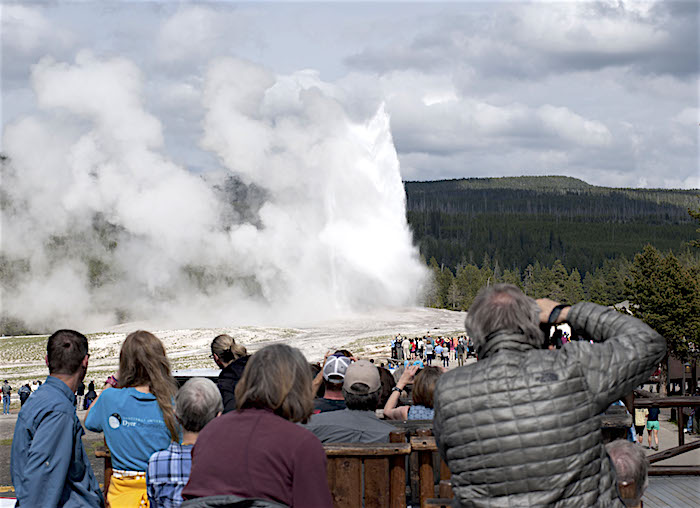
Most national parks have failed to set carrying capacities as required by the National Parks and Recreation Act of 1978, according to PEER/Patrick Cone
Editor's note: This updates with National Park Service officials declining to comment on the report.
Nearly four decades have passed since Congress directed the National Park Service to establish visitor carrying capacities for the National Park System, yet few parks have done so, according to a review by Public Employees for Environmental Responsibility.
Zion National Park officials, who lament the crowds that overrun the park at times, have embarked on a visitor use study that could lead to a carrying capacity, and other superintendents have commented about crowding. A Traveler survey of parks late last year pointed to some of the issues:
* At Zion in Utah, the shuttle service in Zion Canyon that was supposed to end in late October had to start back up to handle early November's crowds. During the Labor Day Weekend, it took some visitors 45 minutes to enter the park at Springdale, and then another 45 minutes waiting in line to board a shuttle to Zion Canyon. "And if you parked in town or you could find a place to park in town and took the shuttle bus to come to the park, it could be 45 minutes on top of that," said Superintendent Jeff Bradybaugh.
* In Acadia National Park in Maine, cruise ships that disgorge thousands of visitors during fall stops at Bar Harbor have created problems as passengers try to get to the top of Cadillac Mountain.
* In Montana, Glacier National Park managers weren't overwhelmed so much last year by greater visitation, but rather by an early spring that saw crowds heading into the park, and damaging facilities, before the seasonal ranger force was in place for the busy summer season.
* At Grand Teton National Park in Wyoming, a proposed management plan for the Moose-Wilson Road corridor to control traffic has drawn complaints from the governor.
* Great Smoky Mountains National Park Superintendent Cassius Cash has received written complaints from visitors irate that it can take five hours to drive the 11-mile loop through Cades Cove.
* At Arches National Park in Utah, crowds trying to get into the park during the 2015 Memorial Day weekend were backed up to U.S. 191, prompting the Utah Highway Patrol to temporarily close the entrance.
* At Yellowstone National Park, during the height of the 2015 summer it took some visitors up to three hours to get through the entrance at West Yellowstone, and then another hour to travel 14 miles to Madison Junction. "If you speed up the entrance station, there's no place to go, as four entrance lanes go down to one lane of traffic," said Superintendent Dan Wenk. "And then there's a bison three miles down the road. What do you do? Because if it's the first bison these people have seen, everybody thinks it's the last bison they're going to see. They all stop to take a picture."
PEER on Thursday said that "very few parks have required carrying capacities to prevent the crush of humanity from damaging natural resources or the quality of visitor experience." That despite a requirement in the National Parks and Recreation Act of 1978 that park superintendents "will identify visitor carrying capacities for managing public use. Superintendents will also identify ways to monitor for and address unacceptable impacts on park resources and visitor experiences."
Among the parks that PEER found have established some form of carrying capacity regulations are:
* Channel Islands National Park set use limits by alternative in their 2015 GMP. The preferred alternative (alternative 3) lists day use and overnight use limits for the following park areas: East Anacapa Island, Middle Anacapa Island, West Anacapa Island, East Santa Cruz Island including Scorpion Harbor and Smugglers Cove, and Santa Cruz Island’s Prisoners Harbor and Rancho del Norte.
* Dry Tortugas National Park set preliminary limits, subject to testing, of 330 people per day in Garden Key and 24-36 per day in Loggerhead Key. The proposed action (alternative C) set the maximum campground capacity to 68 campers overnight on the island, which would be regulated via a reservation system.
* Everglades National Park has a GMP that employs indicators and standards to address user capacity. The only standard that could be found in the GMP that limits the number of people in a park area is the number of people on a 15-mile loop road, waiting for a tram, in the parking or restroom area at Shark Valley (400-500 people).
* Golden Gate National Recreation Area has a GMP which also employs indicators and standards to address user capacity. On Alcatraz Island, the Golden Gate GMP sets a limit of 0-43 people per view on Michigan Ave. 90% of the time, and 0-74 people at one time on C-D St. 90% of the time. The GMP also sets limits on the encounter rate on trails to “no more than 40 encounters with other visitor groups traveling in the opposite direction, 90% of the time during park operating hours.” The number of visitors in Muir Woods National Monument is restrained by the capacity of the parking lot. In Muir Woods, no more than 18 people per view per 50-meter trail section along valley primary trails 90% of the time during park operating hours, and no more than 30 people at one time at the Pinchot Tree and Redwood Crosscut 90% of the time during park operating hours.
* Saguaro National Park utilizes indicators and standards to address user capacity. Only one standard that limits the number of people in an area could be found in their 2008 GMP: “no more than 90 people in any given month for at least 11 out of the 12 months of the year” in the Madrona Pools area.
* Zion National Park in its 2001 GMP stated it would use “preliminary carrying capacities” (i.e., 80 day hikers and 70 overnight users in the Narrows from the northern park boundary down through Orderville Canyon, and 50 people in the Left Fork of North Creek (p. 36)) until a wilderness management plan and carrying capacity studies were completed. The GMP also stated that visitor use levels are somewhat regulated by the shuttle system. The GMP also set “interim carrying capacities, pending further research, for hikers and saddle stock groups in the primitive and pristine zones.” They include hiker group size limits of 12 individuals, and saddle stock group size limit of six people per group with six saddle stock.
National Park Service officials would not respond to the report, said Thomas Crosson, who this month took over as the agency's new chief of public affairs.
At the National Parks Conservation Association, officials said the Park Service needs to take a closer look at the impacts caused by the record visitation levels.
“Many popular national parks are seeing a sharp increase in visitation, and there is no ‘one size fits all’ solution for how to handle the influx. More analysis of impacts to the parks’ resources must be done to really understand these park-specific challenges. This careful research, combined with public engagement, will be essential to help identify solutions, to ensure that visitors continue to have incredible experiences and adventures in our national parks," said Kristen Brengel, NPCA's vice president of government affairs.
PEER Executive Director Jeff Ruch said “(T)he safeguards Congress enacted to prevent national parks from being loved to death have become dead letters." He also noted that in a campaign called “Find Your Park” to promote its centennial, the Park Service is pushing to increase visitation--which in 2015 was already at an all-time high.
“Instead of ‘Find Your Park,’ this summer the challenge should be called ‘Find a Place to Park’," said Mr. Ruch in a release.
In reaching its conclusion that "almost no major national parks have carrying capacities," PEER reviewed the management plans of 59 national parks, 19 national preserves, two national reserves, 18 national recreation areas, and 10 national seashores in the park system. "Of these 108 major units, only seven have established carrying capacities and all but one of those only cover only certain areas or facilities," the group said.
The PEER analysis found that of the ten most visited national parks, only Yosemite had carrying capacities for its wilderness zones. In a 1995 plan, Grand Canyon set numeric caps on visitors to specified areas but that plan lapsed and has not been replaced. In 2001, Zion adopted “preliminary carrying capacities” which it has yet to finalize. Encapsulating this posture was the reply Yellowstone Superintendent Dan Wenk gave a reporter asking about this topic: “The words ‘carrying capacity’ will be attributed to you and not to me because they are words I don’t say.”
PEER noted that among the parks that have established carrying capacities of some fashion:
* Everglades has standards for crowding at boat launches, for road traffic, and on trails.
* In 2014, Golden Gate National Recreation Area, the second-most-visited place in the park system, promulgated a set of concrete user limits for identified “management zones” as does the management plan adopted that same year by Gulf Islands National Seashore.
“While not all parks are the same, the ability of a handful of parks to do thoughtful planning while most others do none suggests that it is not a priority in today’s Park Service,” said Mr. Ruch. “Contrary to the clear dictates of law and official policy, the Park Service appears to be evolving to the position that there can never be too many visitors – a position with which many visitors in long lines would disagree.”
Stories about:
A copy of National Parks Traveler's financial statements may be obtained by sending a stamped, self-addressed envelope to: National Parks Traveler, P.O. Box 980452, Park City, Utah 84098. National Parks Traveler was formed in the state of Utah for the purpose of informing and educating about national parks and protected areas.
Residents of the following states may obtain a copy of our financial and additional information as stated below:
- Florida: A COPY OF THE OFFICIAL REGISTRATION AND FINANCIAL INFORMATION FOR NATIONAL PARKS TRAVELER, (REGISTRATION NO. CH 51659), MAY BE OBTAINED FROM THE DIVISION OF CONSUMER SERVICES BY CALLING 800-435-7352 OR VISITING THEIR WEBSITE. REGISTRATION DOES NOT IMPLY ENDORSEMENT, APPROVAL, OR RECOMMENDATION BY THE STATE.
- Georgia: A full and fair description of the programs and financial statement summary of National Parks Traveler is available upon request at the office and phone number indicated above.
- Maryland: Documents and information submitted under the Maryland Solicitations Act are also available, for the cost of postage and copies, from the Secretary of State, State House, Annapolis, MD 21401 (410-974-5534).
- North Carolina: Financial information about this organization and a copy of its license are available from the State Solicitation Licensing Branch at 888-830-4989 or 919-807-2214. The license is not an endorsement by the State.
- Pennsylvania: The official registration and financial information of National Parks Traveler may be obtained from the Pennsylvania Department of State by calling 800-732-0999. Registration does not imply endorsement.
- Virginia: Financial statements are available from the Virginia Department of Agriculture and Consumer Services, 102 Governor Street, Richmond, Virginia 23219.
- Washington: National Parks Traveler is registered with Washington State’s Charities Program as required by law and additional information is available by calling 800-332-4483 or visiting www.sos.wa.gov/charities, or on file at Charities Division, Office of the Secretary of State, State of Washington, Olympia, WA 98504.
INN Member

The easiest way to explore RV-friendly National Park campgrounds.

Here’s the definitive guide to National Park System campgrounds where RVers can park their rigs.
Our app is packed with RVing- specific details on more than 250 campgrounds in more than 70 national parks.
You’ll also find stories about RVing in the parks, tips helpful if you’ve just recently become an RVer, and useful planning suggestions.


Comments
I have lived near Yellowstone for most of my life. I see that the influx of foreigners, tho appreciate their interest, has created the overcrowding issue as of late. Our family has had many conversations about this issue. Most Americans would, no doubt, feel it unfair that a US citizen be turned away from their own park but carloads of say Chinese get in. Is there an alternative? We thought of a lottery system for NON US citizens. The lottery system works for other systems, why not this. It is our park and our taxes pay for the roads and upkeep. It should be totally available to us.
Actually entrance fees and fees for concessionaires are a major factor of the system, so it's not so much funded by tax payers any more as it is by entrance fees from those that visit whether they be citizens or not. But I agree with your observation that there are a lot of foriegn visitors.
The nationality of visitors should not be the issue. it is the numbers and when you get to the entrance gate. If you come late, too bad.
We should create many more National Parks to spread the annual visitors over a wider array of parks, thus reducing the impact on the parks with highest visitation.
Zack, it could be argued that there are plenty of units now over which the visitation can be spread...but those parks drawing the greatest visitation -- the Yellowstones, Yosemites, Grand Canyons, Blue Ridge Parkway -- will likely continue to be the great draws no matter how many units you add.
Kurt, I would argue that the reason people travel primarily to Yellowstone, Yosemite, Grand Canyon, and the Blue Ridge Parkway is because they don't know that Bridger-Teton, Ancient Forest, Coal Mine Canyon, and High Allegheny exist within the same regions as those parks. By establishing these sites and more as National Parks and putting out another campaign like "See America First" for our unknown natural wonders we could help reduce the crowding in the parks featured on every quarter and postcard. This plan is especially important around populated areas like the east coast of San Francisco. Not to mention we could create a modern CCC to construct lodges, roads, and trails in some of these places to spark local communities. The next argument is the maintenance backlog which we could easily overcome by raising taxes on the richest 1-5% of Americans. During the Eisenhower administration the tax on these individuals was over 90% but the 1950's is the most revered time in the last century, despite the tax rate being in the 30% range now. As a millennial, a generation now larger than the baby-boomers, we are very open to the idea of higher taxes on the wealthy as well as liberal environmental policies. Selling this idea to my generation would be extremely easy, it’s just a matter of pushing for it. More Americans want to see nature than ever, so let’s give them more to see and we’ll go see all of it.
I'm with Kurt. Expanding the national park system isn't going to reduce overcrowding at the most popular parks. They remain the most popular for a reason--they are the icons of the system, and always will be. What is more, Industrial Tourism now depends on those parks. Welcome, Chinese visitors! Fly into Phoenix for a quick bus trip up to the South Rim of Grand Canyon, or into Las Vegas for an even quicker overflight. Surrounding Yellowstone, Bozeman and Billings, Montana, airports are popular, along with the airports at Jackson Hole and Salt Lake City. It's too quick and easy getting to the parks by car or airplane, and now the whole world wants to see those parks.
Come the next recession, it will slow down, and then the concessionaires, gateway communities, etc., will be complaining about the lack of visitors. Down a million visitors? Woe is us!
Meanwhile, I am so delighted the millennials are ready to raise taxes on the richest 1 to 5 percent of Americans. I delight in their so-called "liberal environmental policies," led by General Electric, Vestas, Google, etc. Those policies are only killing off the public lands. I would rather the millennials be open to common sense, which somehow seems to have escaped their generation, but then, it has escaped the baby-boomers, too. You can't keep "booming" and not pay a price far beyond anything higher taxes can repair. Now that the millennial generation is larger than the last generation of boomers, I wish the millennials luck on keeping anything of the American land.
Perhaps the millennials will rediscover the discipline of removing cars from the national parks, but to do that they will have to believe that the car itself is the problem--not what powers it, thanks to "liberal environmental policies." There again, the remaking of the national parks for 45 mph speeds (wink wink, really 60) does far more to explain the crush of visitors than the lack of reasonable, alternative parks. If you can now "visit" Yellowstone in a day, you will. And so will millions of others, then to tweet, with absolute conviction, that there is no place like it on Earth. Slow down? Ask for a wilderness experience? Throw your smart phone in the garbage can? Not a chance.
Alfred,
Supply and demand. People are demanding to get into the National Parks, but the supply of parks is too low.
Those parks are icons because we made them icons. The reason everyone knows Yellowstone and Grand Teton is because we publicized them. Almost no one visits the neighboring area Bridger because no one knows it looks like this: https://c2.staticflickr.com/4/3698/9400420631_cfaeac9120_b.jpg
Put that on a national campaign and people will go there instead. Open it to rock climbing like Yosemite and that's where people will take those cars you don't like, but of course we'd need to build a paved road to get there (not high-clearance dirt one like there is now).
As for the future recessions response, if you plan everything upon economic fear it's a good way never to make progress. "Oh no, space will becoming increasingly expensive, I guess we shouldn't land on the Moon." Stangnant thinking, fear, and lower taxes are why we're not already on Mars.
Millenials aren't focued on the environment because of companies, we're focused on it depsite of them. Companies and members of the previous generations have spoiled the earth. Logged, mined, drilled, fracked, polluted, and monetized everything you could... and it's resulted in a planet being slowly run into the ground, and heating up. Humans are also the cause of the most recent mass-extinction. We care because we're going to have to live here longer than the people who caused all this. You get to bow out and not worry about the consequences and we're unhappy with the state of the world you've given us, so creating new National Parks is a first step in reversing the mess.
And yes, there are many ways to improve the parks: institution trams like at Zion in some parks, remove the dam at Hetch Hetchy, and most importantly create new parks within a few hours drive of major cities and popular parks to disperse the visitors to the most conjexsted parks.
The private car is the problem. So is the tour bus and massive RV. Motorized vehicle and visitation limits need to be established in the front country and in the back country as well. But will local gateway communities and industrial tourism in general, both directly dependent on tourist dollars, not sabotage the career of a park official who openly argues for restrictions on cars and visitation to conserve park resources and enhance the experience of a park visit?
Once again, I'm reminded of PJ Ryan's excellent NPT article: "How Hard can it Be?" http://www.nationalparkstraveler.com/2013/02/view-overlook-how-hard-can-...
I also refer to the discussion of the legislative mandates to give the preservation of park resources priority over visitor access and use as presented in NPT by Dr. John Lemons http://www.nationalparkstraveler.com/2016/07/centennial-series-how-stron....
At present, increases in park visitation are being affected by this year's NPS Centennial, lower gasoline prices, and successful efforts to increase awareness of national parks via the NPS "Find Your Park" campaign. Awareness of parks is also being affected by the high frequency of video and photos of present and past park visits posted on social media.
But the present increase in visitation which has caused the 1970's discussion to resurface about the need in our national parks for vehicle and visitation carrying capacities, should increase even more in the near, if not so near future.
This will happen when Americans start recognizing the importance of free time in their pursuit of happiness. I anticipate that a right to free time will eventually become an important political, economic, and social issue. This will happen as more and more American workers become aware that their current meager paid vacation allotment pales so markedly in comparison to the annual leave earned by the average European worker. And, as park visitation statistics show, those Europeans do take their vacations seriously!
Of course, American Baby Boomers are already enjoying the increased travel opportunities associated with retirement.
But, how often have we read concerns about the skewed demographics of park visitors? How often have we heard the complaint that the majority of park visitors are now noticeably old and white (or old and bald)?
The issue of the lack of free time among American workers was raised today by Knoxville News-Sentinel columnist Ina Hughs: http://www.knoxnews.com/opinion/columnists/ina-hughs/taking-vacation-sho....
Owen, you already have the "right" to all the free time you want. What you really mean is the right to steal others property so you don't have to be productive.
I swear, I read these threads and find myself shaking my head in disbelief. Millenials are in the parks. I don't understand this blatantly wrong assumption that they are not! Just because they aren't retired, and don't have the leisure time that boomers currenlty enjoy, doesn't mean they aren't visiting or even engaging themselves with the parks, when they do get the time. They ARE in the backcountry, they are in the parks frontcountry too, and they are involved.
Secondly, there are only around 3 or 4 places that are not currently National Parks that can compete with the grandeur that is found in the iconic parks. The best of the best is already preserved. No offense, but the High Allegheny will never cut it compared to other places already preserved. I'm definitely not in favor of making parks just for the sake of doing it. And if they do go that route, I prefer they make them more like North Cascades, and skip trying to produce more urbanized parks that require industrialized tourism to boost the regional economic coffers. But, that won't happen either.
By the way, the millenials are one of the most environmentally aware generations in human history. The millenials have grown up being bombarded with media on climate change, pollution, industrial waste, etc so to state that they aren't environmentally conscious is a badly percieved notion. A good % of them also reject the car and try to live in walkable communities near their place of employment. They are definitely at odds with the boomer population that is so focused on the car. Boomers, along with the WW2 generation were the founders of the industrialized tourism phenomenon that is pretty much ingrained into the system. Only a few parks, like North Cascades have ever been setup to reject that ideology. Will the millenials and gen xers shift away from that ideology? Perhaps.
I know a few millenials that are currently hiking long distance trails and posting occasional "i'm still alive, check out this picture from the trail now that i'im back in cell phone range" and thanks to social media I can get exposed to some new areas, some that I might never get to see myself, just because the Earth is too large to see it all in one single lifetime. So, i'm tired of these stodgy types stating that millenials are not out there, because they are and just because you haven't engaged with the right ones and know their pursuits, doesn't mean they aren't out there.
Finally, I definitely am for caps. 2 years ago I went into Petrified Forest National Parks backcountry, and some of the places had caps and once the monthly cap was reached, no one could register to go back there until the next month. I wasn't able to secure a permit for that week, and that was fine, because there were other places to explore, and so my permit allowed me to venture into other areas where I had it all to myself.
Working in a park, I definitely see problems caused by automobiles as well. In the smokies, where I work, it's not hard to witness what acid deposition has done to major areas of the forest, as well as the streams. The global addiction to fossil fuels is a large portion of the problem, yet the park is overwhelmed with traffic every day, so it is a catch-22. They come to the forest to see nature because they played a secondary role in cutting down the forests and eliminating the wildlife in their backyard, and so they go out seeking this "etheral moment" that gets them in touch with their primordial senses. And yet, in their pursuit of finding that natural solace many of them are unaware what their vehicles are doing to those remaining swaths of forest. Yes, it's only a very small role they are playing, but the overall accumulation of too many people swarming the parks is having a vast and negative effect on the resources.
In the end it comes down to the brains in the NPS that have access to the science and data to stand up and cap it... But, my fear in that is that they don't make it for only the wealthy to enjoy, and so lotteries, and first-come first serve should be the main basis behind the caps. Also, hopefully a bigger movement is made from the populace itself to screw industrial tourism for the hideous scourge it has become in our National Parks. It truly is out of control...
It should be noted that the back up onto the State Highway was caused because Arches does have a visitor limit based on number of vehicles. Once that limit is reached no car enters the park until one leaves. One result is a iine of cars waiting to get into the park. Canyonlands has a similar limit but due to its more remote location does not cause the same back up onto a state highway.
This is one problem with visitor capacity limits. What happens to the multitude of people who show up at often remote gates once the limit is reached? The only workable solution would be to start "selling" entry passes ahead of time on line. This of course has its own problems and costs.
All parks are seeing a massive growth in late and early season visitors. Due in part to the aging population which are still free to travel after schools start. However, the Grand Canyon was slammed unexpectedly last year and again this year by visits from college students on spring break. From the article it appears Glacier had a similar experience.
The review by PEER and Traveler looked primarily at whether parks have produced visitor carrying capacity plans. Plans are an important first step, but the MUCH more important thing is whether parks have implemented their visitor carrying capacity plans. That is where the rubber meets the road. A plan that is not implemented is worthless.
The prime example of this is Arches National Park; that was the first national park to attempt to implement visitor carrying capacity as mandated by law.
The NPS has long had a problem letting too many visitors into developed areas. Parks naturally want to accommodate the teeming hordes, even when it means decreasing the quality of the visitor experience or increasing resource impacts. It is hard to draw the line and exclude visitors, exclude their customers.
Finally Congress (in the 1978 National Parks and Recreation Act) told the NPS that the parks had to start managing for carrying capacity; parks had to draw the line. Parks had to figure out what kind of visitor experience they wanted to provide, and what kind of resource conditions they wanted to provide (that is the NPS interpretation, not the literal language of the legislation), and then the parks had to manage for those conditions. Even if that meant turning away visitors.
When the NPS prepared the 1989 Arches GMP, the National Parks and Conservation Association (NPCA) commented (as the NPS knew they would) that the NPS had failed to comply with the provisions of the 1978 National Parks and Recreation Act. So the NPS did what it typically did at that time, it added a provision in the Final GMP that committed to preparing a visitor carrying capacity plan.
NPCA kept pushing (and supporting) the NPS to figure out how to develop a carrying capacity framework. Eventually the NPS put together a team to develop a carrying capacity framework (VERP) to implement the 1978 law.
The NPS developed that carrying capacity framework at Arches, especially at Delicate Arch / Wolfe Ranch. The NPS chose Arches because it was a small contained park with a recent GMP, and an excellent management team that was interested in the problem.
The NPS pulled together a great team and brought in two of the best consultants in the field. The NPS did it right. The NPS developed a scientifically sound plan that worked for the park, and that could be implemented using available resources.
The VERP implementation plan for Arches was signed by the superintendent in 1995. The plan said that the park found that visitor use was already a bit too high at several popular areas to protect the desired visitor experience. That is, social crowding conditions were already outside standard. So in the plan, the park said that conditions would be brought within standard by reducing trailhead parking. In addition, monitoring would be undertaken to see if that initial management action would be enough to bring conditions within standard. If not, then further actions would be necessary.
The plan recognized that the days of accommodating every visitor were over; the focus now was on maintaining at least the minimum visitor experience and resource condition that were committing to. It was a sea change.
For the Wolfe Ranch parking area (trailhead for Delicate Arch), the plan said that parking would be limited to the 75 striped parking spaces currently provided. Impromptu overflow parking on the sides of the road and in unlined spaces in the parking area would be eliminated through the use of barriers, signs, and ticketing of violators. The park prepared a Transportation Implementation Plan in 2006 that reaffirmed the carrying capacity limits set in the 1995 plan.
Fast forward to 2014. It was as if the management team at Arches had changed and forgotten all about this social crowding carrying capacity and visitor experience stuff. The 1995 plan was still an official signed plan. If PEER or Traveler had come looking, they would have found it sitting on the shelf. But the park was no longer implementing it; that was the critical difference.
Instead, the park was focused on their parking problem issue; how to handle the ever increasing teeming hordes. So they prepared a site plan EA to deal with that issue. Among other things, they wanted to more than double the Wolfe Ranch parking area by adding an additional 82 parking spaces. That would allow a huge increase in social and natural impacts way above the standards set in the 1995 plan.
The park had long since abandoned their commitment to protect the visitor experience. I’m sure that the park still cared about the visitor experience. But they have abandoned the VERP social crowding standards that they used to monitor and manage for. Those were the written standards that the park committed to in a signed plan. But that was just an old plan on a shelf.
When the Delicate Arch / Wolfe Ranch Site Plan EA was sent out for public input in March 2014, the park received five comments that related to carrying capacity. The park’s responses to all five of those comments were way off the mark. They were without substance, essentially non-responsive. They ranged from government double-speak to almost deceptive. It sounded like the park had made up its mind about what it wanted to do, and it was going ahead regardless.
In November 2014, the Regional Director determined that there would be no significant environmental impact to the environment (including impact to the visitor experience) by more than doubling the number of parking spaces and greatly increasing the acceptable level of crowding for the visitor experience.
I am sure that this site plan / EA and these responses were written by park employees who had only the best of intentions. I have real empathy for the park. I can imagine being in their position and being focused on the need to accommodate the ever increasing number of visitors who come to Delicate Arch / Wolfe Ranch. That is truly customer service, and that is one of the things that the NPS is supposed to be about.
But Congress told the NPS in 1978 that it had another mandate: it had to start managing for carrying capacity; it had to draw the line. It had to figure out what kind of visitor experience it wanted to provide and what kind of resource conditions it wanted to provide, and then it had to manage for those conditions. Even if that meant turning away visitors.
Arches made those hard decisions in the 1995 VERP implementation plan. The park told the public what standards they would use for the minimum acceptable visitor experience and for the minimum acceptable measure of resource protection. The park said trust us; we won’t let conditions deteriorate below this point. That is what carrying capacity is in the National Park Service.
The issue in 2014 was that Arches felt that it could just walk away from the social crowding indicators and standards that were required by the 1989 GMP in accordance with law, established in the 1995 VERP implementation plan, and reaffirmed by the 2006 Transportation Implementation Plan.
When I worked for the National Park Service, I felt that when we committed to standards in our planning documents, that was an agreement we were making with the public. We were telling them that we would maintain their parks to at least that minimum standard.
At its heart, carrying capacity is about making an agreement with the public. Drawing a clear line in the sand and promising to keep it. That line is built on trust. At Arches in 1995, the park drew a very clear line. But in 2014, Arches casually shredded that line in full view of the public, as if it were nothing. As if the NPS commitment counted for nothing. That felt like a betrayal of a public trust.
Arches National Park was the birthplace of carrying capacity in the National Park Service. It was the place where the NPS got everything right. It was the place where carrying capacity had the best chance to succeed.
If this can happen at Arches, especially at Delicate Arch, then carrying capacity in the NPS truly has no teeth whatsoever. It is a paper tiger.
Just looking at whether parks have produced visitor carrying capacity plans does not tell you much. Arches still has their 1995 signed carrying capacity sitting on the shelf.
I was in Arches before the real visitor season started this year and it was already full. Full of CARS.
I asked several people about the idea of some kind of public transport system and was met with a stock supply of answers explaining why it was impossible.
Impossible? Or just very, very difficult?
Expensive? Yes. But what are the alternatives?
We need to remember that there can be a very fine line between REASONS and EXCUSES. Based on what I heard in April, right now the balance is on the side of excuses.