
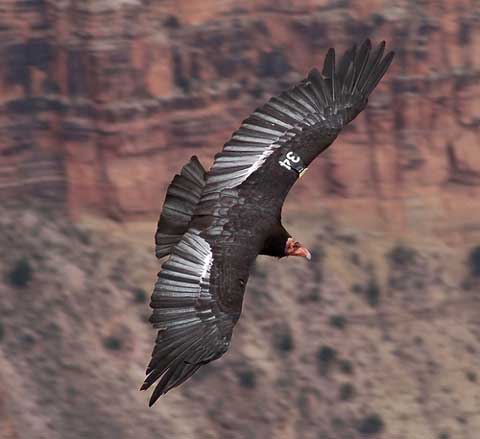
An adult California Condor soars beneath Pt. Sublime at Grand Canyon National Park's North Rim. Photo by DesertVu via Flickr.
Grand Canyon National Park is a place that is synonymous with "big," and as the year draws to a close, it's nice to be able to look back at some good news about sightings at the park of some very big—and very rare—birds.
The Grand Canyon area is home to a small population of the largest flying land birds in North America. California condors can have a wingspan of nine and one-half feet and adults weigh up to 22 pounds. That's about a third larger than the wingspan of a Golden Eagle. Unfortunately, size doesn't always mean survival, and there are believed to be only 324 of the birds anywhere on the planet today.
That makes them among the rarest birds in the world, and 68 of them live in northern Arizona and Southern Utah. This year has brought some great news for Grand Canyon condor watchers—two new chicks were successfully hatched in the wild, and both have fledged and been observed taking their first short flights this past fall.
This brings the number of free-flying condors raised in the wild in northern Arizona up to nine—three of them from the same breeding pair at Grand Canyon.
An update from the park earlier this month notes that both fledglings were doing well as of their last sightings. Their parents are seen from time to time flying below or occasionally above the south rim, but the rest of the condors are spending their time mostly on the North Kaibab National Forest, up in southern Utah, or in the Vermilion Cliffs area north of the Grand Canyon.
Although they previously ranged from Canada to Mexico, shooting, poisoning from lead and DDT, egg collecting, and general habitat degradation began to take a heavy toll on condor populations in the 1800s. Since the birds are scavengers, feeding on dead animals, they are especially susceptible to lead poisoning from ammunition fragments in wildlife carcasses.
Between the mid-1880s and 1924, there were scattered reports of condors in Arizona, with the last sighting near the town of Williams in 1924. By 1982, the total population had dwindled to just 22 birds in California. The only hope of avoiding extinction seemed to be captive breeding of the birds, followed by reintroduction of captive-bred condors in 1992 in California, and in 1996 in Arizona. The establishment of the second geographically separate condor population in Arizona offers insurance against loss of the species through a single catastrophic event, and return condors to an additional portion of their historic range.
Although the birds have a long way to go to ensure their survival, great progress has been made in the past two decades. The recovery project is an excellent example of cooperation among government agencies and private conservation groups, including the U.S. Fish and Wildlife Service, Arizona Game and Fish Department, Utah Department of Natural Resources, the Phoenix, Los Angeles and San Diego Zoos, the Hualapai Tribe, the Navajo Nation, Glen Canyon National Recreation Area, Grand Canyon National Park, Kaibab National Forest, and The Peregrine Fund.
If you're visiting Grand Canyon, keep your eyes open for these impressive birds. You're most likely to spot them during warmer weather, from April to September. Don't be surprised to see them from easily accessed areas on both the North and South Rim.
Additional information about the California Condor Recovery Program in Arizona is available on the websites for the Arizona Game and Fish Department and The Peregrine Fund.
Story Categories:
A copy of National Parks Traveler's financial statements may be obtained by sending a stamped, self-addressed envelope to: National Parks Traveler, P.O. Box 980452, Park City, Utah 84098. National Parks Traveler was formed in the state of Utah for the purpose of informing and educating about national parks and protected areas.
Residents of the following states may obtain a copy of our financial and additional information as stated below:
- Florida: A COPY OF THE OFFICIAL REGISTRATION AND FINANCIAL INFORMATION FOR NATIONAL PARKS TRAVELER, (REGISTRATION NO. CH 51659), MAY BE OBTAINED FROM THE DIVISION OF CONSUMER SERVICES BY CALLING 800-435-7352 OR VISITING THEIR WEBSITE. REGISTRATION DOES NOT IMPLY ENDORSEMENT, APPROVAL, OR RECOMMENDATION BY THE STATE.
- Georgia: A full and fair description of the programs and financial statement summary of National Parks Traveler is available upon request at the office and phone number indicated above.
- Maryland: Documents and information submitted under the Maryland Solicitations Act are also available, for the cost of postage and copies, from the Secretary of State, State House, Annapolis, MD 21401 (410-974-5534).
- North Carolina: Financial information about this organization and a copy of its license are available from the State Solicitation Licensing Branch at 888-830-4989 or 919-807-2214. The license is not an endorsement by the State.
- Pennsylvania: The official registration and financial information of National Parks Traveler may be obtained from the Pennsylvania Department of State by calling 800-732-0999. Registration does not imply endorsement.
- Virginia: Financial statements are available from the Virginia Department of Agriculture and Consumer Services, 102 Governor Street, Richmond, Virginia 23219.
- Washington: National Parks Traveler is registered with Washington State’s Charities Program as required by law and additional information is available by calling 800-332-4483 or visiting www.sos.wa.gov/charities, or on file at Charities Division, Office of the Secretary of State, State of Washington, Olympia, WA 98504.


National parks and their natural resources belong to you. The National Parks Traveler works to ensure you know how these essential places are being cared for.
Sign Up For Our Weekly Newsletter
Unsubscribe at any time.
INN Member

The easiest way to explore RV-friendly National Park campgrounds.

Here’s the definitive guide to National Park System campgrounds where RVers can park their rigs.
Our app is packed with RVing- specific details on more than 250 campgrounds in more than 70 national parks.
You’ll also find stories about RVing in the parks, tips helpful if you’ve just recently become an RVer, and useful planning suggestions.


Comments
This evening around 5 to 5:30 pm,As my daughter in law and I were driving in West Jordan ,Utah I Looked up in the sky at the dark clouds forming and saw a massive pure black bird.It was flying at a high elevation and slowly descending.As it glided down slowly it would flap and then glide more.I was shocked at the size and looked around at the traffic but I seemed to be the only one that noticed it.I was not close enough to see it but it was huge and we wondered if there were condors in the area.It had to have had a wingspan of nearly 10 feet or so.It was the size of a small aircraft,I was just wondering if anyone else in this area has seen the same thing,My daughter in law says nearly 10 years ago she was outside at night and saw something very similar
io am concerned about a current prospected wind farm that is slated to go in on perrin ranch, with 62 of 405foot high wind turbine towers .this is located close to red lake hwy. 64 to the grand canyon . about 40-45 miles south of canyon. i understand that back i 1925 condors were spotted in williams which is even further to the south than these wind turbines. Doesn't this pose a possible threat to their survival?
i am very concerned about projects like this going in an area so close to a National Park.
thank you, John Lee
I was at the Canyon in Pheonix the north rim on 13th August 2011. The condors were flying over us, at times there were 5 at a time they were so close we could see their feathers. It sure was an experience to be remembered.
My wife and I were visiting the grand Canyon on May 3, 2012. We were coming from Phoenix and so were walking the Rim Trail on the South Rim of the Grand Canyon when this large bird flew overhead. I wasn't sure what it was so I decided to check on the web for Grand Canyon Birds. I found this website and am now convinced that what we saw was the condor as pictured above. Absolutely fascinating to see and view the canyon and the majestic bird in flight as road the thermals up and around. Unforgettable experience.
They definitely catch your attention, don't they Robert?!