
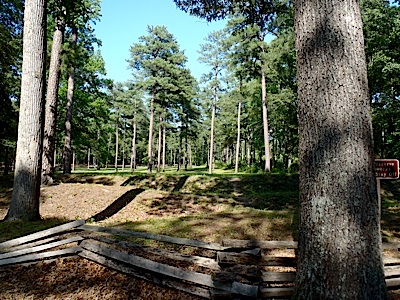
Should the National Park Service cut down trees in the Yosemite Valley to restore "historic" viewsheds, and should it clear eastern forests to recreate Civil War sight lines? Photo of tree-studded Cold Harbor Battlefield at Richmond National Battlefield Park by Kurt Repanshek.
How should national parks deal with vegetation that has grown up and, in some cases, altered landscapes or blocked views?
At Yosemite National Park, officials are debating what to do with vegetation that obscures nearly 200 scenic vistas in the Yosemite Valley and elsewhere in the park so much so that they no longer appear as they did back in 1864 when the landscape was set aside for its scenic qualities.
In 2009, park staff inventoried 181 scenic vistas in Yosemite (outside of Wilderness) and found that encroaching vegetation completely obscured about one-third of the vistas, and partially obscured over half the vistas. Vegetation encroaches on these vistas for a number of reasons, including the exclusion of American Indian traditional burning, the suppression of lightning-ignited fire, and human-initiated changes to hydrologic flows.
And in the East, many Civil War parks contain stands of forest where, in the 1860s, there were open meadows or farmlands, or troops had cut down trees and brush to open up sight lines. Many of these parks today work to remove these trees, but back in 2008 a professor from Boston College wrote to oppose the felling of trees to recreate 1860s conditions.
The logic appears glaringly cracked: if the goal is to make the battlefield look as it appeared when 165,000 soldiers met in the Gettysburg epic, then why uproot the "non-historic" trees while leaving in place the non-historic roads? And what about the 1,300 monuments?
Indeed, if trees and brush obscure viewpoints in the Yosemite Valley, what about lodges, restaurants, cafeterias, and other aspects of 20th century development?
What say you, travelers? Where should the line be drawn when protecting national park viewsheds?
Story Categories:
A copy of National Parks Traveler's financial statements may be obtained by sending a stamped, self-addressed envelope to: National Parks Traveler, P.O. Box 980452, Park City, Utah 84098. National Parks Traveler was formed in the state of Utah for the purpose of informing and educating about national parks and protected areas.
Residents of the following states may obtain a copy of our financial and additional information as stated below:
- Florida: A COPY OF THE OFFICIAL REGISTRATION AND FINANCIAL INFORMATION FOR NATIONAL PARKS TRAVELER, (REGISTRATION NO. CH 51659), MAY BE OBTAINED FROM THE DIVISION OF CONSUMER SERVICES BY CALLING 800-435-7352 OR VISITING THEIR WEBSITE. REGISTRATION DOES NOT IMPLY ENDORSEMENT, APPROVAL, OR RECOMMENDATION BY THE STATE.
- Georgia: A full and fair description of the programs and financial statement summary of National Parks Traveler is available upon request at the office and phone number indicated above.
- Maryland: Documents and information submitted under the Maryland Solicitations Act are also available, for the cost of postage and copies, from the Secretary of State, State House, Annapolis, MD 21401 (410-974-5534).
- North Carolina: Financial information about this organization and a copy of its license are available from the State Solicitation Licensing Branch at 888-830-4989 or 919-807-2214. The license is not an endorsement by the State.
- Pennsylvania: The official registration and financial information of National Parks Traveler may be obtained from the Pennsylvania Department of State by calling 800-732-0999. Registration does not imply endorsement.
- Virginia: Financial statements are available from the Virginia Department of Agriculture and Consumer Services, 102 Governor Street, Richmond, Virginia 23219.
- Washington: National Parks Traveler is registered with Washington State’s Charities Program as required by law and additional information is available by calling 800-332-4483 or visiting www.sos.wa.gov/charities, or on file at Charities Division, Office of the Secretary of State, State of Washington, Olympia, WA 98504.


National parks and their natural resources belong to you. The National Parks Traveler works to ensure you know how these essential places are being cared for.
Sign Up For Our Weekly Newsletter
Unsubscribe at any time.
INN Member

The easiest way to explore RV-friendly National Park campgrounds.

Here’s the definitive guide to National Park System campgrounds where RVers can park their rigs.
Our app is packed with RVing- specific details on more than 250 campgrounds in more than 70 national parks.
You’ll also find stories about RVing in the parks, tips helpful if you’ve just recently become an RVer, and useful planning suggestions.


Comments
The landscape of Yosemite Valley as seen by early white travelers was heavily influenced by the fire regime the native inhabitants of the valley used to clear grounds for their use. Doing nothing, most of the valley, except the immediate meadows of the Merced river and recent talus slopes under the big walls would be woods.
So as the NPS has to decide anyway, which parts of the valley should be kept open, I'm fine with using a certain historic time and trying to maintain it as guideline.
In the case of national battlefields, I think that the way that the battlefield was first preserved as a national monument is the way to keep it. In some cases, the original architecture of bridges and buildings important to the park have to be replaced, but efforts should be made to keep the orginal lines and style. After all, as time quickly passes, the fact that the battlefield became a national monument also becomes historically important. Case in point are the bridges in the Vicksburg National Military Park.
As far as National Parks go I will only reference one, The Great Smokies. I've seen scores of photos before the park was established, before the loggers came. What a beautiful place, people from far away came by wagon to camp, well before the NPS came along. Fascinating to see ladies in long, full dresses camping near Spencefield and at waterfalls. A very interesting photo of Horace Kephart shows him standing in front of several dead, lichen covered spruce trees, this is apparently not a new thing, dead trees in the forest. When I was a boy, I was first taken into the Smokies in 1958 and there were numerous views that awed and inspired and made me want that place to be taken care of. Backpacking on the AT from Russell Field, to Clingman's Dome in 1975, a great many similarly awe inspiring views were to be seen, interspersed with forest. Now, you can hike that entire stretch and catch only a few views, but for the most part, except for the severe ups and downs of the trail, you may as well be anywhere because there are no views except of the immediate, surrounding forest.
I like views. They inspire, and I imagine that they inspire newcomers to appreciate the uniquness of where they are far more than seeing the mountains from a distance, only to go into the mountains just to see more forest like you have at home.
This is not to advocate clear cutting the mountains, but there are places which can truely inspire if only you can see.
Just as an example, look at this link, at Spencefield in the Smokies in 1969. If you go there today, you won't see anything like this, unless you go over to Rockytop.
http://www.knoxnews.com/photos/galleries/2009/jun/26/scenes-search-denni...