
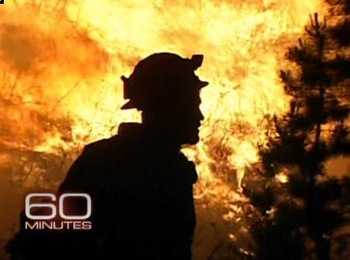
60 Minutes : The Age of the Megafire
Last night on the television program "60 Minutes", reporter Scott Pelley traveled into the burning forests of the West to find out why we've been seeing more intense fires in the last few years. As is said in the report, more land burned in 2006 than in any previously recorded year, and 2007 is currently second worst (with a couple months left to go before it's all over).
Video: 60 Minutes - The Age of Megafires (11:25)
What's going on? Well, it isn't just Climate Change, but that is probably the biggest culprit. Warmer temps mean fire season starts earlier and end later than in years past, forest undergrowth doesn't contain the same levels of moisture they once did, and once rare fires in alpine environments are now more commonplace.
As a friend pointed out recently in email, in many areas, an increase in winter and spring precipitation may produce increased growth of fine fuels. In the Southwest in particular, we're expecting an expansion of cheatgrass. In forested areas, trees are likely to come under increasing moisture stress and be more prone to insects and diseases.
When wildland firefighters encounter a particularly intractable fire, they often state that they don't expect the fire to be actually extinguished until winter weather arrives. With climate change constricting what we know as winter, that may take on new meaning.
The US Department of Energy's Lawrence Berkeley National Lab has stated,
In most cases, climate change would lead to dramatic increases in both the annual area burned by California wildfires and the number of potentially catastrophic fires -- doubling these losses in some regions.
These changes would occur despite deployment of fire suppression resources at the highest current levels, implying that climatic change could precipitate an increase in both fire suppression costs and economic losses due to wildfires.
The latest predictions suggest that global warming may also create conditions that intensify wildfire danger, by warming and drying out vegetation, and by stirring the winds that spread fires.
Climate change would cause fires to spread faster and burn more intensely in most vegetation types.
Faster fires are much harder to contain, and thus are more likely to expand into residential neighborhoods, incurring substantial damage to insured property.
Story Categories:
A copy of National Parks Traveler's financial statements may be obtained by sending a stamped, self-addressed envelope to: National Parks Traveler, P.O. Box 980452, Park City, Utah 84098. National Parks Traveler was formed in the state of Utah for the purpose of informing and educating about national parks and protected areas.
Residents of the following states may obtain a copy of our financial and additional information as stated below:
- Florida: A COPY OF THE OFFICIAL REGISTRATION AND FINANCIAL INFORMATION FOR NATIONAL PARKS TRAVELER, (REGISTRATION NO. CH 51659), MAY BE OBTAINED FROM THE DIVISION OF CONSUMER SERVICES BY CALLING 800-435-7352 OR VISITING THEIR WEBSITE. REGISTRATION DOES NOT IMPLY ENDORSEMENT, APPROVAL, OR RECOMMENDATION BY THE STATE.
- Georgia: A full and fair description of the programs and financial statement summary of National Parks Traveler is available upon request at the office and phone number indicated above.
- Maryland: Documents and information submitted under the Maryland Solicitations Act are also available, for the cost of postage and copies, from the Secretary of State, State House, Annapolis, MD 21401 (410-974-5534).
- North Carolina: Financial information about this organization and a copy of its license are available from the State Solicitation Licensing Branch at 888-830-4989 or 919-807-2214. The license is not an endorsement by the State.
- Pennsylvania: The official registration and financial information of National Parks Traveler may be obtained from the Pennsylvania Department of State by calling 800-732-0999. Registration does not imply endorsement.
- Virginia: Financial statements are available from the Virginia Department of Agriculture and Consumer Services, 102 Governor Street, Richmond, Virginia 23219.
- Washington: National Parks Traveler is registered with Washington State’s Charities Program as required by law and additional information is available by calling 800-332-4483 or visiting www.sos.wa.gov/charities, or on file at Charities Division, Office of the Secretary of State, State of Washington, Olympia, WA 98504.


National parks and their natural resources belong to you. The National Parks Traveler works to ensure you know how these essential places are being cared for.
Sign Up For Our Weekly Newsletter
Unsubscribe at any time.
INN Member

The easiest way to explore RV-friendly National Park campgrounds.

Here’s the definitive guide to National Park System campgrounds where RVers can park their rigs.
Our app is packed with RVing- specific details on more than 250 campgrounds in more than 70 national parks.
You’ll also find stories about RVing in the parks, tips helpful if you’ve just recently become an RVer, and useful planning suggestions.


Comments
Two things:
1) Get rid of Smokey the Bear
2) Fire people make a lot of money every summer....
First, I don't consider the $11-14/hr rate that the government pays qualifying as a lot of money by ANY standard.
Second, I would have guessed that the folks at Berkeley intelligent enough to lend some REAL insight that was truly significant, not something that most anyone could have predicted in the typical cause and effect scenario.
Third, granted I didn't view the video, but somewhere it should be noted that most of the Western states have been subjected to an extended period of drought over the past ten or so years, with many areas classified as "significantly" moisture deficient, or in layman's terms, bone dry. This is obviously a contributing factor, as not only are many areas "living in kindling", but the rains that the smoke-eaters relied so heavily upon for assistance less frequent than in seasons past.
Culprits have been suggested that include the usual global climatic changes to severe El Nino phenomenon, Communist satellites and increased vulcanism on the Ring of Fire. It's even been suggested that the increase in volcanic activity along the Pacific Rim is the result of global warming, which is an arguement so juvenile it doesn't even merit discussion. From what I've experienced, cheatgrass is a minor annoyance more than a major factor leading to the spread of "uncontrollable" fires, due to the fact that it combusts so rapidly and completely that, while it spreads a fire quickly, it can't sustain the spread for very long. I've investigated its possible usage as barriers or containment areas against wildfire advance, since fire can't exist without fuel and this stuff burns out quicker than your typical punk rocker. The problem is by May-June, it's dry, ugly, and propagated by those nasty little spine-covered seed pods. Bad stuff for air mattresses, tent floors and bare feet for both little critters and us bigger critters as well!
And what's Smokey got to do with anything?
Lone Hiker-
The 11-14 hour rate you quote is completely misleading. That is just the basic pay. Firefighters get hazard pay and typically overtime, which usually jacks up the rates of pay a ton as they work long hours in hazardous situations. I have friends who have purchased expensive 12K motorcycles just through working fire, on top of their normal salary. Now, to further the point, consider those compensation rates with GS-9 and GS-11 employees that go on fires... let alone the fact that they aren't doing their day to day real duties.
Additionally, drought and snits against "global warming" aside, years and years and years of fire suppression inevitably jacks up fuel load. Most ecosystems across North American really didn't evolve without fire, so combine building fuel load with drought and you have potential for increased wildfires.
I can't find it in me to find fault with the aspect of overtime pay, and Frank is wholeheartedly right in stating that these people EARN their money. You're damn right it can be lucrative, but the risks associated with the job and the physical nature of the beast only serve to lend support to the overtime payscale. These factors, and the fact that worker shortages are common lead to inflate and skew the "average" income ratio. How many of us would jump at the opportunity to join their ranks? I'm fully aware of the seasonal aspect of the job, but in most of the nation, construction workers are "seasonal" as well, and their basic pay rate is enough to make you cry, without considerations for overtime.
The fire suppression tactics and techniques that were, and is many cases still are practiced are the result of our ignorant attitude towards the environment. A good house-cleaning serves to revitalize the ecosystem, not destroy it as we once believed. Leaving nature to itself would be the most proper course of action to self-contain the intensity of the fires.
Beamis, last year when I lived in southern Utah, as Kurt may well substantiate, I believe there were something in the neighborhood of 18 fires between June and August, of which only 2 qualified as man-made in origin. One was set by drunken teenagers whose "bonfire" got out of control, the other was pure arson. I'm aware of the dry thunderstorm phenomenon and the resulting devastation that can be traced directly to their doorstep. But I still wouldn't start going off on Smokey.
Sorry about that sir. Guess I should refer back to the list once in a while when responding. The Smokey reference was actually directed slightly above you, back to Frank and Anon. My error, and apology.
I remember the commercials.......and the "Only You" slogan. I still think the intent was good, as obviously only we can save ourselves from ourselves. Nature, being the bitch that She is, as Haunted Hiker confirmed, can and will do as She pleases, and good luck to anyone trying to prevent her from competion of her appointed task. Overgrown undergrowth (?) not withstanding, the inception of lightning induced fires is beyond the scope of our ability to control. The intensity of said fires, that's another matter completely. That's why the Native's practiced prescribed burns in the first place, to limit the rage of the fires. But as we all know, they were determined to be "ignorant savages", so how could we possibly learn anything from a people SO inferior to the Great White European tribes?
I, like Beamis, am no expert on the subject. All I can attest to is what I have personally witnessed. I have had camping trips affected by lightning-induced fires on the North Rim as recently as 2006, and was unfortunately part of the group to be unceremoniusly evicted from the park. Upon my return a week later, during an escorted passage along Hwy. 67, the "controlled burn" made for a rare opportunity for amatuer footage of how the park attempted to contain the spread, but how they were unable to prevent the periodic "crowning" event which is the most devastating portion of any fire. After a long conversation with some of those involved and with the rangers, I was made to believe that the "controlled" aspect was a regular practice, as it pertains to this location. That being the case, maybe Frank can lend a bit more insight as to why this practice is a sporadic event instead of a regular habit within the scope of the parks. It appeared to work well in the Kaibab National Forest, although some additional investigation led me to one particularly egg-on-the-face event back in the 90's that cost the same area a few thousand acres, that most agreed was the result of general incompetence by fire management personnel. But hey, nobody's perfect!
Again, just one more item...
"more land burned in 2006 than in any previously recorded year". Bear in mind that this "any previously recorded year" qualifier translates into a pretty small body of work, and as previously stated, I'm big on sample size. I don't buy into the media ploy of utilizing stunning titles to grasp the public eye. Before I label anything the "Age of .......", I want historical backing. Drought can be evidenced by studies on tree rings, among other things. Floods leave tell-tale signs, as do boom-times for growth. And even fires leave scorch-marks on whatever they leave behind, but I know of no historical research project ever conducted that sought to measure scope, intensity, frequency, or the other factors of previous burns, floods or drought. The reason is that as of yet the instrumentation to accurately define how much rain fell, how hot the fires were, and how much flooded exactly what region simply don't exist. Specific to drought conditions, even if you could measure how much rain fell, there is no historical precedent or measuring stick that allows for competent comparisons and accurate dissemination of the data that you've gathered. That's why I get such a kick out of the "Hundred Years Storm" dooms-dayers. Our weather records ony go back about 135 years, and they make the "Hundred Years" statment. It just can't be substantiated. Maybe that's why they feel safe with these preposterous statements. The best source of these data (specific to fire damage and water rates) would have been through intensive studies of long-lived trees in old-growth forests. Unfortunately, much of that information has been forever lost to the logging industry, and thier own particular brand of environmental mismanagement practices. Most assuredly, the acreage burning is significant. But that IS what forested regions are prone to periodically.
I think your beliefs regarding the burial ceremonies are pretty secure. Thanks for the added info. But these communities who are against periodic smoke inhalation have no high ground, moral or otherwise. It reminds me of people who purchase homes near airports then complain about the noise, or those who choose to live in disaster prone regions then expect federal bail-outs when flooding or the like occurs. In terms of those in the fire regions, my advice to them would be to pick the intelligent lesser of two evils. Smoke every few years, or losing your precious belongings in a devastating inferno. Sounds like a no-brainer to me, but what do I know?
I don't know if you know it BUT many of the crew members are laid off each winter. They don't make much money and rank is slow to come. A family member of mine having been with the USFS as a sawyer for about 9 years, he will not jump to a local fire station for more money because he just doesn't feel right being paid for standing around. He is a loyal person and he worries about his crew member's. During the fire season he is away from his family and usually has to "Spike-Out" (Sleeps on the ground) hikes miles to get to the fire and lives on MRE's. he does this because he likes his job. There are still those that would rather work with their hands than move papers from one building to the next and cry about making "ONLY $18 dollars an hour" In the winter season they DO projects such as thinning out the brush to be burned. They don't always burn, they also have and use "Chippers" Being a sawyer he also has to risk his life falling dangerous trees called "Snags" that are rotten and diseased to keep them from falling on the general public that use the forests for recreation. While in Sequoia a few years ago the the USFS was burning between the redwoods to keep them healthy. Go to your nearest USFS Hotshot station and see for yourselves what they do. It might add a little insight to your perceptions that they DON'T earn their money. You may have been influenced by seeing your local firefightes waxing their trucks and taking in $50,000 + a year and having a business "On the Side"