
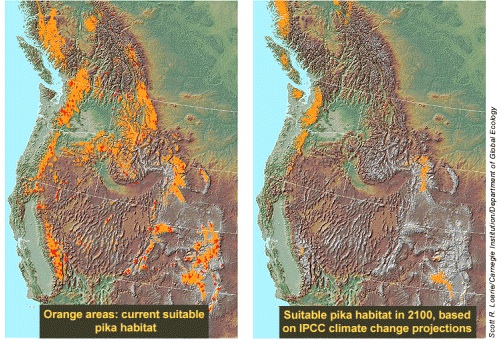
Pika habitat already is in decline due to a warming climate, and it could shrink precipitously by 2100. Graphic by Carnegie Institution, Department of Global Ecology.
Editor's note: Among the various missions shouldered by the Student Conservation Association is putting high school and college students out in the field to work on conservation issues that can range from tracking grizzly bears to teaching environmental education. Mara L. MacKinnon spent the past summer at the SCA's Yosemite National Park field station collecting data on the diminutive pika and how it is being affected by climate change. This is her report, reprinted with permission from the SCA.
During my six-month internship with the Student Conservation Association, I had the opportunity to collect data for a field study on the habitat effects of climate change. Our crew of four searched for pikas while backpacking along the rocky slopes of California’s Eastern Sierra Nevada. We learned to identify the tiny American pika (Ochotonoa princeps) by its adorable snowball shape and distinctive squeaky call.
We also came to understand several other traits of the pika that could make this elusive alpine mammal an important ally in the movement to stop climate change.
The pika’s high-altitude habitat is at great risk from global warming. Adapted to cold, alpine environments, pikas can die from just a few hours of exposure to temperatures of 78 degrees Fahrenheit or higher. Climate change also threatens pikas by shortening the period available for them to gather food, by changing the species of plants in the alpine meadows where they feed, and by reducing the snow-pack they need to use as insulation during the winter.
There is no solid estimate of the total number of American pikas, but a study in the Great Basin mountains of Nevada and Oregon found that more than a third of documented pika populations had gone extinct over the last 100 years. There are strong signs that the rate of the pika’s disappearance has accelerated in recent years, along with the rise in global temperatures.
Relatives of the American pika in Asia and Russia are facing similarly bleak outlooks. Recent research has found that China’s Ili pika (Ochotona iliensis) has declined by nearly 50 percent due to habitat destruction caused primarily by climate change.
Faced with lethal changes to their living conditions, the American pika’s only chance for survival is to inhabit zones higher up the mountain slopes.
Erik Beever of the U.S. Geological Survey and colleagues have traced the pikas' movement to higher elevations in the Great Basin mountains. In Nevada's Ruby Mountains, for example, they found that pikas, recorded at 7,792 feet in 1956, were rare below 9,000 feet by the 1990s.
"At the current rate, pikas could pop off the top of the highest peaks in the Basin within 100 years," Beever and his colleagues write.
If we do not take action quickly to slow global climate change and protect the pikas’ habitat, this unique species will likely face extinction, with enormous numbers of other species to follow.
In 2007, the Center for Biological Diversity petitioned and — after a court appeal — succeeded in nominating the pika for protection under the federal Endangered Species Act (ESA). If the pika is listed, it will become the first mammal in the continental United States to be added to the list as a direct result of global warming.
Why is this significant? The ESA, to date, remains one of the strongest environmental laws in the United States. The “endangered” designation supports legal actions, like setting aside areas deemed to be “critical habitat” for a species’ survival.
Under the ESA, federal agencies are prohibited from funding, authorizing or carrying out acts that “destroy or adversely modify” critical habitats. The hope is that the pika’s presence on the Endangered Species List would force the federal government into taking action to reduce national emissions of greenhouse gases.
Even though the polar bear was listed as a threatened species under the ESA in May of 2008, it prompted no national action to reduce greenhouse gas emissions. Despite the role of these pollutants in the polar bear’s decline, the Bush administration’s Department of the Interior exempted greenhouse gas emissions from being targeted for increased regulation.
Where the mighty polar bear did not succeed, the little pika may be just the creature that we need. Unlike the polar bear, the pika would likely be listed as endangered (rather than threatened) and its habitat range encompasses more than one U.S. state.
These differences, along with political changes brought by the Obama administration, make the pika a better bet as a catalyst for emissions reduction.
The decision on the American pika’s endangered species status is due from the U.S. Fish and Wildlife Service in February 2010.
For ways to help the pika and the myriad other species imperiled by rising temperatures, check out the activist links on the Center for Biological Diversity website. [For information on getting involved with conservation research and field positions, across the country, please visit SCA's website internships listings.]
The tiny American pika may be a big ally to the movement against climate change.
SCA intern Sara MacKinnon of Bisbee, Arizona, is passionate about halting the effects of climate change on wildlife and the environment. At age 23, she has already volunteered or interned in Buenos Aires, Argentina; Naco Sonora, Mexico; British Columbia, Canada; and most recently California where, through the Student Conservation Association, she served as an ecological science technician intern at the USGS Yosemite Field Station. She has a bachelor’s of arts degree in economics, with a minor in environmental studies.
Story Categories:
A copy of National Parks Traveler's financial statements may be obtained by sending a stamped, self-addressed envelope to: National Parks Traveler, P.O. Box 980452, Park City, Utah 84098. National Parks Traveler was formed in the state of Utah for the purpose of informing and educating about national parks and protected areas.
Residents of the following states may obtain a copy of our financial and additional information as stated below:
- Florida: A COPY OF THE OFFICIAL REGISTRATION AND FINANCIAL INFORMATION FOR NATIONAL PARKS TRAVELER, (REGISTRATION NO. CH 51659), MAY BE OBTAINED FROM THE DIVISION OF CONSUMER SERVICES BY CALLING 800-435-7352 OR VISITING THEIR WEBSITE. REGISTRATION DOES NOT IMPLY ENDORSEMENT, APPROVAL, OR RECOMMENDATION BY THE STATE.
- Georgia: A full and fair description of the programs and financial statement summary of National Parks Traveler is available upon request at the office and phone number indicated above.
- Maryland: Documents and information submitted under the Maryland Solicitations Act are also available, for the cost of postage and copies, from the Secretary of State, State House, Annapolis, MD 21401 (410-974-5534).
- North Carolina: Financial information about this organization and a copy of its license are available from the State Solicitation Licensing Branch at 888-830-4989 or 919-807-2214. The license is not an endorsement by the State.
- Pennsylvania: The official registration and financial information of National Parks Traveler may be obtained from the Pennsylvania Department of State by calling 800-732-0999. Registration does not imply endorsement.
- Virginia: Financial statements are available from the Virginia Department of Agriculture and Consumer Services, 102 Governor Street, Richmond, Virginia 23219.
- Washington: National Parks Traveler is registered with Washington State’s Charities Program as required by law and additional information is available by calling 800-332-4483 or visiting www.sos.wa.gov/charities, or on file at Charities Division, Office of the Secretary of State, State of Washington, Olympia, WA 98504.


National parks and their natural resources belong to you. The National Parks Traveler works to ensure you know how these essential places are being cared for.
Sign Up For Our Weekly Newsletter
Unsubscribe at any time.
INN Member

The easiest way to explore RV-friendly National Park campgrounds.

Here’s the definitive guide to National Park System campgrounds where RVers can park their rigs.
Our app is packed with RVing- specific details on more than 250 campgrounds in more than 70 national parks.
You’ll also find stories about RVing in the parks, tips helpful if you’ve just recently become an RVer, and useful planning suggestions.


Comments
Great article and great timing. Let's hope Copenhagen is watching.
This article talks about ' global warming', but doesn't talk about other species that are related to pika in regard to total population health. Take for example the pikas predators...what are they. Bird(eagles?), bears, cougers,...and how did/do they pertain to these furry little creatures, because some of them aren't there anymore (because of man). I kinda think you need to look at the whole picture of the diversity in this area. We have seen how whole populations of mountain sheep have been wiped out by pneumonia. Are you gonna relate that to 'warming'? I want to believe the science, but in light of the recent news....I'm not convinced.
Dave, you raise a good point when you ask about the entire bioweb. Unfortunately, we're all volunteers trying to juggle as much as we can, and so we can't always delve completely and thoroughly through each and every issue.
That said, let me give you an example that I think I can answer some of your questions. That would be the mountain yellow-legged frog of the Sierra. This little critter has vanished from 90 percent of its native habitat due to an array of factors. Non-native trout are the latest culprit ecologists are pointing to, as the introduction of these fish into naturally barren lakes in Sequoia and Kings Canyon national parks led to a staggering decline in frog populations. Once some lakes were cleared of the trout on a test case, frog populations rebounded. In some instances, lakes that held fewer than 200 frogs in 2001 saw populations explode to 14,000 tadpoles and 3,600 adults three years later after most of the trout were removed.
However, the challenges to the mountain yellow-legged frog are more complicated than simply removing non-native trout from frog habitat. An ongoing concern comes from chemical pollutants, such as fertilizers and pesticides that could be blown from California’s Central Valley into ponds and lakes inhabited by the frogs.
Climate change is also likely to exert pressure on these already-stressed amphibians both because of direct effects and because it could exacerbate other stressors. Climate change predictions for the region suggest altered precipitation patterns that will lead to less snowpack in the Sierra Nevada, a development that would be dire for the frogs. Less precipitation means already shallow lakes could evaporate and streams dependent on runoff from snowmelt could shrink or perhaps vanish, leaving the amphibians high and dry. The trout make frogs even more vulnerable to shrinking and warming lakes by excluding them from many of the larger lakes that would provide a refuge during dry years. The combined effects of non-native trout and drying lakes pose a severe threat because tadpoles need a year-round water source for their first two to four years to survive, and high egg production depends on above-average snowpack.
One of the country's top experts when it comes to these frogs is Dr. Roland Knapp. He told me he considers the frog to be a "keystone" species in the Sierra because of the role it plays -- snakes, birds, and mammals, as well as fish, all view the frogs as prey. Taken that way, you can see how this little critter does indeed play a key role in the diversity of the area.
Kurt, excellent points and good response. My last remembrance of the Yosemite's yellow-legged frog was back in the early 1980's while hiking up to Cathedral Peaks. I haven't seen the little critter since...perhaps global warming started to take it's toll then in specie decimation in the high Sierra's.