
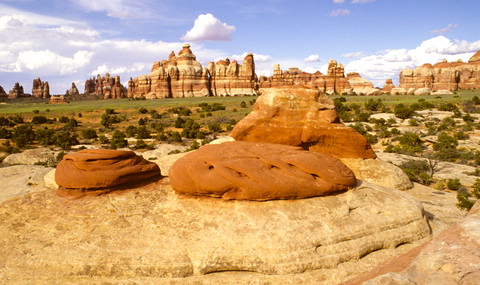
What role do we, as a society, want our national parks to play? Chesler Park, Canyonlands National Park. Kurt Repanshek photo.
Are national parks no longer for the people? Have environmental groups succeeded in legally creating roadblocks to prevent their enjoyment? An Ohio man believes so. But what do you think?
Perhaps the biggest problem in our parks system goes back to the '70s when the focus of park management went from visitors experience balanced with conservation to predominantly environmental/wildlife management. This shift also brought in "top-down, one-size-fits-all" management of our parks with far more focus on the environment than the visitors. Simply put, the parks are no longer for people.
Dennis Gray, of Dayton, Ohio, wrote that in response to a New York Times columnist's suggestion that all the national parks need to boost visitation is a high-profile booster, such as First Lady Michelle Obama.
Here's part of what that columnist, Timothy Egan, wrote: The parks need Obama-era branding. So, the first family should go ahead and spend that week at Martha’s Vineyard in August, playing scrabble with Hillary and Bill, clamming with Spike Lee. But it would not take much for Michelle and her brood to visit the people’s land. Maybe an overnight in Acadia, the first national park east of the Mississippi.
And here's the opening of Mr. Gray's response: Timothy Egan's blog, "We Need Michelle Obama to Rescue National Parks," makes some good points about the declining visitation to our national parks and seashores. Unfortunately, he terribly misses the mark about the cause of and solution to this problem.
Is Mr. Gray right? Have environmental and conservation groups essentially locked up the parks for wildlife and preservation to the detriment of human recreation? Here are some examples he cites to illustrate his contention: When you ban rock climbing from Devils Tower National Monument, does visitation go up or down? When you ban snowmobiles from all parts of Yellowstone National Park, does visitation go up or down? When you close off miles of the best beaches in Cape Hatteras National Seashore Recreational Area, does visitation go up or down?
From Mr. Gray's viewpoint, all national parks can't be managed under the same set of guidelines. Each superintendent, he says, should have autonomy "in the management of each park that would allow it to better reflect the unique history, character, and natural settings of each, as well as the historic lifestyles of the people who live there."
"Our parks are becoming museums, roped off expanses with 'Don't touch' or 'People stay out' signs all over them," he contends.
Here's a larger section of his response to the Times columnist:
This centralized bureaucratic management has also made the parks system more malleable to the whims of special interest groups through litigation. The desire of these groups is to make our national parks more like our national wildlife refuge system, run by the U.S. Fish and Wildlife Service. As this shift has been forced on the National Park Service, its managers have had to redirect their money and resources away from visiting guests to wildlife management. Accordingly the campgrounds, visitation centers, and other infrastructure have fallen into decay.
And they wonder why visitation is down?
If people can't get out and actually experience the great outdoors, how can they ever learn to appreciate it?
What's really interesting is that the original supporters of our parks system were hunters, fishermen, skiers, and other outdoor recreation enthusiasts. They not only supported the parks as a way to conserve spaces for their activities as a concept decades before today’s environmentalists, but they have also supported the parks financially through their user fees, license fees, and surtaxes paid on the sporting equipment used in their endeavors. These recreational groups have long favored reasonable conservation, balanced with the needs of the visitors -- the sensible belief that there is plenty of space for all types of activities. Today these are the very people the environmentalists wish to ban as part of their own narrow-minded, preservationist views of the purpose of our park system.
These environmental groups -- such as Defenders of Wildlife, National Audubon Society, and the World Wildlife Federation -- contribute little if anything monetarily toward the operation of our parks, but will spend millions in legal fees to force the Park Service’s hand on management issues. Even worse, in many of these lawsuits, the Park Service has to reimburse these groups their legal fees, more money that could have gone toward the operation of our parks.
Now, I wouldn't agree entirely with Mr. Egan, nor entirely with Mr. Gray. While it'd be great exposure for the national parks to have the First Family hiking up Cadillac Mountain or taking in Old Faithful or floating the Colorado River through Grand Canyon National Park, that's not the key to energizing Americans in the parks. If that's all it took, why didn't First Lady Laura Bush's hikes in the parks, or President Clinton's support of the parks (remember how his administration stopped the New World Mine from going in next door to Yellowstone?), or even President Bush's attempted bolstering of the parks through his Centennial Initiative generate a rise among Americans?
As for Devil's Tower, true, it's off-limits to climbers for a short period in summer to pay reverence to Native American beliefs. And there has been more than a little pressure to limit snowmobile access to Yellowstone due to resource damage, and off-road-vehicle access to Cape Hatteras and even Cape Cod national seashores during certain seasons to protect nesting shorebirds and sea turtles. But really, the number of climbers, snowmobilers, and ORV enthusiasts who look to the national parks for recreation are minuscule, and lifting these restrictions won't send park visitation skyrocketing.
As for groups such as Defenders of Wildlife, the Audubon Society, and the World Wildlife Federation, (and don't forget the National Parks Conservation Association, The Wilderness Society, and the Natural Resource Defense Council), these are special-interest groups just as are the Blue Ribbon Coalition, the International Snowmobile Manufacturers Association, and the International Mountain Bicycling Association, and all these have their own agendas for how national parks should be managed.
As for superintendents and autonomy, they and regional directors actually do have a great deal of latitude, but politics -- and lawsuits -- often force their hands.
The overriding question that we as a society have to reach some consensus over is how we want the National Park System managed, and not just for today but for tomorrow. Do we value flora and fauna that are finding it harder and harder to survive outside national parks due to increasing urbanization and fragmentation of habitat? Would we rather have the parks turned into visitor-centric recreational playgrounds where we don't worry about the needs of plants and animals or the landscapes themselves?
And really, haven't we already created a system by which different public lands are managed for different purposes? After all, the U.S. Forest Service and U.S. Bureau of Land Management long have managed their landscapes for multiple use, for both the birder and the dirt biker, for the cross-country skier and the snowmobiler, for the hiker and mountain biker. Shouldn't the National Park System continue to be managed with an emphasis on conservation and preservation, as well as enjoyment ... but with limits on what forms of recreation should be allowed?
Going a step further, does the level of national park visitation even matter? Shouldn't it suffice that we protect these unique places -- the landscapes, the culture, the history -- and all they harbor so future generations can appreciate and understand them by visiting them, if they desire, rather than reading a book or watching Ken Burns' documentary and so having their imaginations piqued but left unfulfilled because those responsible for sound stewardship in the past failed and these landscapes are no more?
Story Categories:
A copy of National Parks Traveler's financial statements may be obtained by sending a stamped, self-addressed envelope to: National Parks Traveler, P.O. Box 980452, Park City, Utah 84098. National Parks Traveler was formed in the state of Utah for the purpose of informing and educating about national parks and protected areas.
Residents of the following states may obtain a copy of our financial and additional information as stated below:
- Florida: A COPY OF THE OFFICIAL REGISTRATION AND FINANCIAL INFORMATION FOR NATIONAL PARKS TRAVELER, (REGISTRATION NO. CH 51659), MAY BE OBTAINED FROM THE DIVISION OF CONSUMER SERVICES BY CALLING 800-435-7352 OR VISITING THEIR WEBSITE. REGISTRATION DOES NOT IMPLY ENDORSEMENT, APPROVAL, OR RECOMMENDATION BY THE STATE.
- Georgia: A full and fair description of the programs and financial statement summary of National Parks Traveler is available upon request at the office and phone number indicated above.
- Maryland: Documents and information submitted under the Maryland Solicitations Act are also available, for the cost of postage and copies, from the Secretary of State, State House, Annapolis, MD 21401 (410-974-5534).
- North Carolina: Financial information about this organization and a copy of its license are available from the State Solicitation Licensing Branch at 888-830-4989 or 919-807-2214. The license is not an endorsement by the State.
- Pennsylvania: The official registration and financial information of National Parks Traveler may be obtained from the Pennsylvania Department of State by calling 800-732-0999. Registration does not imply endorsement.
- Virginia: Financial statements are available from the Virginia Department of Agriculture and Consumer Services, 102 Governor Street, Richmond, Virginia 23219.
- Washington: National Parks Traveler is registered with Washington State’s Charities Program as required by law and additional information is available by calling 800-332-4483 or visiting www.sos.wa.gov/charities, or on file at Charities Division, Office of the Secretary of State, State of Washington, Olympia, WA 98504.

Comments
A sure way to evaporate common sense is to mix politics and money and I agree with Mr. Gray.
I'd advise a review of the designation of National Park versus National Forest.
When I see four wheel drive vehicles spinning down the Cape Hatteras National Seashore, over bird and turtle nests, a part of me-- a not-so-small part of me--wretches with disdain for the obvious lack of humanity and mission of the national park. My 40+ years of experience has taught me that humans are in fact the ultimate destroyer of nature. The NPS serves to preserve and protect designated lands for future generations (of people as well as wildlife) and if that means a portion of the beach is no longer accessible for driving, so be it.
Perhaps different tactics on the part of the NPS are appropriate. However, in the face of eloquent and intelligent pleas for preservation, one still witnesses a blatant disregard for the land and its inhabitants. Does this not lead to an overwhelming disparagement for "fellow homo sapiens"? I believe the mission of the NPS in fact prohibits it from being "encouraging" of "human contact with" certainly the "entirety of its holdings".
Kurt, has this exactly right. I have pictures of climbers on Devil's tower. The reason people want to snow mobile in Yellowstone rather than Ohio is because of the wildlife and scenery they might encounter. Mr Gray needs to realize that the area is for everyone, and that means (take care of it). The Obama's sailing in Cape Hatteras or horseback riding in Yellowstone, or even hiking Half Dome would show a responsible visit that preserves our park for everyone.
"museums roped off" ?? In the past year and a half, my family has visited over 50 National Parks. In that time we have:
taken rock climbing classes in Joshua Tree
kayaked in caves at Channel Islands
ridden bikes all through Acadia
hiked all around Rocky Mountain
watched a sea turtle release at North Padre Island
canoed through Big Thicket
water skied in Lake Powell
walked to Rainbow Bridge
watched fireworks at Mount Rushmore
toured Tall Grass Prairie
gone on many hikes in undeveloped caves in Carlsbad Caverns
watched a full moon in White Sands
went windsurfing at North Padre Island
hiked in Grand Canyon
walked miles of pristine seashore in Cumberland Island NS
gone rafting in Dinosaur
gone jeeping in Canyonlands
attended the wildflower festival in Cedar Breaks
visited countless sites in the DC area
and visited countless smaller National Parks where we have hiked, attended ranger programs, walked through museums and enjoyed history, scenery and wildlife. What part of this is a "museum not to be touched"?
In addition, I have watched people throw coins in thermal pools in Yellowstone, through trash in canyons, climb fences "because the picture will be better 10 inches closer", walk off trails destroying cryptobiotic soil, pick HUGE bouquets of wildflowers, pet wildlife, feed wildlife, and the list goes on and on. No wonder we have to keep other parts of the parks roped off...
I believe the National Parks offer a huge variety of ways to enjoy and experience our parks. A few rules and regulations to try and preserve our parks? Ok with me...
I think the premise is nonsense. The parks are a preservation system, not a recreation system, especially not a motorized recreation system.
Visitation is down because people's tastes have changed, not because of bans on snowmobiles.
Anonymous' post above mine is spot-on.
================================================
My travels through the National Park System: americaincontext.com
As a frequent visitor to national park units, including national monuments, seashores, and recreation areas, especially here in California, I have always found the park staff to be very helpful and welcoming to visitors. Remember, people visit the parks to experience the natural qualities. They should not be administered as amusement parks. There are beaches near where I live that are closed at certain times of year to accomodate the nesting/breeding needs of birds and seals/sea lions. I have no problem with this. We humans need to realize that this world belongs to all species, not just our own.
I worked one Summer in 06 as a volunteer in Yosemite NP, for the most part the people working there are very nice and helpful, however I did find a lot of the Paid Rangers, if they had it their way would be happy if they could block the roads off and allow no one into the park. It would make their jobs much easier. Afterall then they would not have to do traffic stops on people doing 60 in 35 speed zones, they would be able to relax instead of having to scrape someones body off of the rocks at the foot of a cliff, they would not have to put down a bear that in the process of defending her young did away with an offending tourist.
It's like the one lady that asked me what did we do with the bears at night? When I said nothing, she replied don't you lock them up at night? Get real people this is not a Disney Movie.
The article would seem to imply that park managers are encouraged and rewarded when it comes to restricting visitor access and activities. That is rarely the case. Park managers who attempt to protect park resources and values, in part, by more closely managing visitor uses frequently face strong political and bureaucratic pressures to be more lenient. Properly managed parks should allow visitors 100 years in the future to see and experience the same resources and settings that gives today's visitors so much pleasure.
To quote Kurt Repanshek:
"The overriding question that we as a society have to reach some consensus over is how we want the National Park System managed, and not just for today but for tomorrow. Do we value flora and fauna that are finding it harder and harder to survive outside national parks due to increasing urbanization and fragmentation of habitat? Would we rather have the parks turned into visitor-centric recreational playgrounds where we don't worry about the needs of plants and animals or the landscapes themselves?"
The wording of these two possible alternatives de facto leaves only one choice. A less obviously biased choice of words such as "multiple use management" would lead to a more honest, open conversation about the real issues, rather than sidetracking the debate with the straw man of "recreational playgrounds." Personally I do prefer a middle ground weighted toward conservation, but the one-sided nature of this question is unnecessary and unhealthy.
...and the immediately following paragraph from KR:
"And really, haven't we already created a system by which different public lands are managed for different purposes? After all, the U.S. Forest Service and U.S. Bureau of Land Management long have managed their landscapes for multiple use, for both the birder and the dirt biker, for the cross-country skier and the snowmobiler, for the hiker and mountain biker. Shouldn't the National Park System continue to be managed with an emphasis on conservation and preservation, as well as enjoyment ... but with limits on what forms of recreation should be allowed?"
This paragraph actually points out the advantages of each approach, and therefore is much more persuasive.
The idea of replacing cars in Zion Park with the tram car system was a dollar short and a day late if you ask me. I'm sorry it happened after my days of visitation to that park ended. I never found the saturation of visitors to that park to be enjoyable. I remember once when my "window of opportunity" to visit Angel's Landing passed me by. It was around 8am and had I stopped to chat with some hikers just before the final climb, I was quickly overtaken by a busload of french women that were right behind me. I stood to the side making room as about 50 women hiked by, grateful that I wasn't going to share that precarious precipe with all of them, plus the hikers I'd already seen go up! It would have been like a crowded bar, except there was a 1000' drop off on all sides! Many of the hikers were young, inexperienced, and ill mannered in hikers etiquette. It was unsafe in the extreme.
Same deal when I went to the south rim of the Grand Canyon. Absolute pandemonium on the hiking trails. Way overcrowded trails with the occasional mule pack going by making you have to suddenly squeeze against the side of the already too narrow trail... hundreds of feet straight down if anyone lost their footing. Many of the female hikers were wearing high heels!
Anytime you're letting that many of the general public into a confined area at the same time, you are going to have huge traffic management problems, just as if you're at a parade, the zoo, etc. That many people are like a herd of ill-mannered cattle. I'm happy to see that they've turned Park visitation into a highly profitable venture, but they should manage visitor traffic as well as the visitor/wildlife interaction. There are lots of accidents waiting to happen on those trails.
I love that sign Frank! But what do you do about the people who forget to read signs while on vacation?
Ranger Holly
http://web.me.com/hollyberry
National Parks were established to preserve the natural and cultural resources they have to offer. They are not all things for all people. They are not amusement parks. They were not established for the enjoyment of the people at the risk of harming their natural resources. If you do not care about the natural and cultural resources of a particular park and will not enjoy and respect it, don't go !
These wonderful, diverse ecosystems deserve to be protected whether visitation is up or down. That is why they were established.......to be saved for those of us who DO love and respect them !
As an adult without kids, I feel an obligation to get involved and help a kid understand our natural world and learn to protect and respect it. If we all made that effort, maybe a few would leave their video games and cellphones long enough to see what Mother Nature has to enjoy and teach us.
Beamis, whenever you rail on, I do get the same message, and certainly your distain for people trying to do their job, but I never get a picture of how you think things should work if YOU had your way. You say you believe in preservation, and in parks. So how would it work, if you were Emperor of the North, and could make it go your way? What would people do on Monday?
Most of the lessons Rangers and other park people learn from, come -- not as you picture it -- but from what actually happens day in and day out, or happened over time, at this or that park, with this or that action by park management. It would actually be welcome if Rangers got more training, but in fact most park people don't take the time they should for training, because they are too busy. (not a good excuse, but true) Most park people are these very practical people who don't have much use for bureaucracy. Park rangers are forever pointing out how lawyer-driven Director's Orders undermine sensible management on the front line in a real park. Practical people. There IS, of course, much regret when some part of the park experience is lost, on those occasions when management let some adverse action go on, that in the end impaired the park experience. Park people REMEMBER and talk about when they should have stepped in but didn't. Those experiences, good and not good, are then applied to future enforcing protection or encouraging park use.
Park people are always talking to each other about how to be more welcoming, and there is a lot of criticism among peers for rangers who do not like people, or act like they do not like people. Most park people, overwhelmingly, are hugely gratified by how much most of the public really enjoy themselves at the park. It keeps most park rangers going, the joy of the visitor.
It is true that some of the superintendents are not very politically skilled, and in their public explanations while hide behind what the regulation says, or some higher-up policy, but the reason for that political style is the way public officials get creamed in America today whenever they are open and clear. There are lawyers everywhere, and a lot of angry ranters who love to litigate. Read the papers.
Ray Bane is right about the pressure on any ranger who wants to confront human impact on the park. At Ray Bane's old park I saw a front-line ranger merely try to enforce a permit condition against a film company in which they promised not to get too close to the bears, and that guy's chief ranger -- the guy who probably negotiated the permit -- rebuked the front line ranger as a zealot, and to chill out. Superintendent's who try to protect beaches in recreation areas really do get sliced and diced. Even in the end if the agency supports the restriction, that superintendent realizes his/her intervention was not deeply appreciated by Higher Authority.
Parks are there, not just for preservation, but so people can enjoy and learn from unimpared wild, scenic or historic places. It is a wonderful idea, and most of the visitors find the park people pretty wonderful, too. Part of that time, in that grey area, that means there can be tensions over over use, and how to prevent it, and the human beings needed to protect the park and the human beings, with all their variety and vastly different levels of experience, who visit the park. I remember being startled to learn that my own wife, who I think is pretty sensitive and law abiding, was approached once by a ranger who said he'd seen her picking some wild flowers. He was not heavy handed, but pointed out others came to the park to enjoy those flowers, and it would not take many people picking 'em before the whole scene would be altered. For a moment, she was defensive, but almost immediately grateful that she better understood how to behave in a park. She appreciated the 'intervention,' and I am not sure you could have a gentler intervention, other than letting anything go.
You can bring your incipient anger to characterize rangers as hostile, but it is just not so. It does get boring, it lacks all nuance.
Thinking through in a collaborative way the right way to protect and experience the parks needs to be a continual and earnest process. Constantly blaming the rangers seems pretty silly.
I disagree that we need more visitors to our parks. They are overrun as it is, at least the popular ones and at least in the summer. What we do need is more interest in our parks from young people. With the number of visitors, most of whom are city people who know very little about how to behave in the outdoors and around wildlife, the switch in emphasis toward preservation is probably a good thing. Park professionals have learned, in many cases the hard way, that if you let people go unattended into certain sensitive areas ancient artifacts will become souvineers, beautiful rock walls will be covered with graffiti and trash will be strewn around. They have discovered that if you allow people to hike into bear rich areas, people will feed and tease them, hike without taking proper precautions and get too close in the name of a picture; resulting in maulings and dead bears. Etc.
While nearly anyone who has spent more than a short vacation in our parks probably can site instances where they wish a ranger wasn't there ("So I'm 80 yards instead of 100!! He's not paying the least bit of attention to me, and my car is right there!!! If he looks my way, I'll back up!), the fact is that most rangers do a great job of balancing resource protection and visitor enjoyment. After all, they are overwhelmed, have no idea if you are an outdoorsperson who has spent his (her) life in the wilds, or a city slicker; and they are understaffed.
I would suggest visiting at a slower time of the year, when things are a lot more relaxed.
D-2--
You are too polite to Beamis. He is mostly wrong. Most park people are the opposite of what he claims they are: they are polite, usually well-informed, and have the visitor's back most of the time. I almost laughed out loud when he talked about young rangers coming out of training "gulags". What planet does he live on? As you point out, there's not much training going on anywhere other than the bare minimum that is required to meet certification standards. Park employees, including rangers, are not much different than any one else except they work in really nice places and, in the vast majority of the cases, try hard to help park visitors understand what they are seeing and to have a good time in the park. There are exceptions, as you point out; maybe Beamis has run into every one of them. But his "draconian" law enforcement people and "radical environmental" managers are not the ones I meet when I go to parks.
Rick Smith
It's been my experience recently that the National Parks are at the brink of capacity with visitors. The off-limits areas may seem excessive, but are needed because the sheer numbers of people who would trample them if if they were open is too much for some ecosystems.
Frank C, I have also been to parks where the rangers are like that, but that is a small majority. It does take a while for an interpretation ranger to really learn their skills. There are some parks that are considered 'starter parks' where they hire people that are just out of college and starting their careers. There you're going to get the younger people who haven't quite grown up yet. I used to get very frustrated when I worked at Mesa Verde due to those 'stupid' visitors that would climb all over the walls and even the one person who peed on the cliff dwelling. It took a long time to overcome that. But I've also noticed no matter where I go, customer service is lacking entirely in the younger people. What happened between my generation and this one? I went into a grocery store the other day and the clerk never even looked at me. She just kept right on talking to her friend about her latest sexual conquest.
Ranger Holly
http://web.me.com/hollyberry
d-2 and Rick -
Thanks for your perspective - which is certainly in line with my 30 years in the parks.
Are all employees perfect? Of course not - in parks, or anywhere else - and I recognize the workplace has changed in the years since I retired. I suspect employees in any job that involves public contact vent or joke among their peers about situations they encounter. Even so, Frank_C and Beamis seem to have hung out with a different set of employees than I did in eight parks, large and small. I'm glad my experience was much more positive than theirs.
d-2 said, "Parks are there, not just for preservation, but so people can enjoy and learn from unimpaired wild, scenic or historic places. It is a wonderful idea, and most of the visitors find the park people pretty wonderful, too."
I heartily second that view, and take it a step further. Despite the inevitable challenges, long hours and occasional negative experiences, most park people I worked with found the majority of visitors to be "pretty wonderful," too. If you don't find real satisfaction in helping visitors enjoy some of the best places on the planet, you're in the wrong job.
It the rules were designed to maximize visitation now, the experience 10 generations hence would be trashed. We understand what protecting for the long haul means much better now than some decades ago.
And I agree that tastes have changed. A national forest near where I live has decided that to get more people to use their campgrounds, they are going to bring in wifi and cell coverage because their surveys show that the inability to text message is keeping young people away. In the mean time, some of the more rustic campgrounds without flush toilets will get closed.
And I'm not surprised if attitudes in Yosemite Valley get a bit warped. It doesn't need more visitation, at least during peak season. any ranger who got the job to enjoy the wilds can hardly help from developing an attitude if their jobs ends up managing traffic gridlock and a pall of smoke and pollution.
To Jim Burnett
THANK YOU! Your post was refreshing and encouraging to read!!
" At Ray Bane's old park I saw a front-line ranger merely try to enforce a permit condition against a film company in which they promised not to get too close to the bears," d-2.
While serving at Katmai I had a commercial filming company request permission to film the bears of Brooks River from a unique perspective. They wished to put two photographers in wet suits and scuba gear film the bears from underwater while the bears were feeding on migrating salmon. The idea was to have the photographers swim downstream with the current from the midstream falls to the mouth. Guess how I responded.
"....the overall perspective that I have gleaned is one where the average tourist is seen as a burden and a threat rather than a partner in preservation...."
Beamis, that is probably because the "average" tourist IS more of a threat or burden than a partner in preservation! Come on; the average tourist, no matter how they view themselves, and no matter how concerned they may be about conservation issues, knows little and understands less about being in the outdoors and the issues facing the parks. Park rules (and laws) are routinely ignored. Common sense is thrown out the window. It's "cute" to feed the bear and her cubs, and get a picture of Joey in front of the bison. It seemed like a good idea at the time to make a wish and toss a penny into the Morning Glory Pool. Heck, this Spring a couple of yahoos decided it would be a kick to urinate in Old Faithful. And it's just fine to chase a deer and its fawn, which had been napping peacefully, for a mile or more through the forest, just to get a poorly exposed snapshot of two rear ends.
Is it any wonder that some rangers get frustrated?
Having said that, I HAVE run into one of these guys having a bad day before. Once I inadvertantly approached an animal too closely. I didn't even know it was there, in the trees, until a ranger yelled at me, "Hey, a**hole!!" And, "I told you before to move back!" Now I had just arrived and had not been told anything, and I told him so. He apologized, but of course the damage had been done. I knew that he was frustrated; I knew that he was probably having a bad day. But I have worked with the public most of my life, and I know that this is not how you deal with frustration. Nevertheless, I did not blame the entire National Park Service because this guy was having a bad day.
Do guys like that need to be fired, transfered or reassigned? Absolutely! But we also need to recognize the amount of stupidity, ignorance and apathy that they see every day, especially during tourist season; and realize that they are human beings.
Our parks are underfunded and undermanned, and morale is at an all time low (an issue that, hopefully, will be addressed by the new Park Service Director); yet overall, I believe, most rangers do an admirable job that most of us could not handle.
I think part of this owes to the fact that, unlike other federal land-management agencies, NPS not only manages land but also historical and recreational places. It's a lot easier to make a visitor experience out of an old house than it is out of a precious landscape. But my point is that NPS manages a great variety of places, and how you manage the Klondike Gold Rush museum in Seattle obviously has little to do with how you manage the national park an hour away. So the NPS is split between managing certain places for visitation and recreation, and others more for preservation. That doesn't mean you need more agencies to manage different ways, but it does call for a recognition that each unit in the system is different and has different management needs.
That said - although we live in a democracy, it is the job of our government to specialize in managing our resources. We could put every management question to a referendum, but that defeats the purpose of having our government protect these places. Yes there are a lot of people who value their own recreation desires over long-term conservation of the land and its species. But I'd like to think the job of the park service is to balance these two things and to think long-term as well as short term. Yellowstone doesn't belong to snowmobilers or anyone else. If at some point it gets to the point where any visitation threatens Yellowstone, so be it. The person writes "If people can't get out and actually experience the great outdoors, how can they ever learn to appreciate it?" Well if you can only appreciate the outdoors on your own terms, then I don't think you are ever learning to appreciate it anyway. The goal should be to experience the parks on their terms, not our own.
Finally, the fact that resources have been devoted toward conservation and away from recreation only shows that more is needed to fund the parks. It makes perfect sense that if you are short on cash, you use it to preserve the things that can't be brought back once they are gone. Visitors centers and campgrounds can always be rebuilt - our most delicate and vulnerable natural resources cannot.
"....She just kept right on talking to her friend about her latest sexual conquest. ....."
Ohhh! Details. Details!!
The ranger I dealt with was not a kid, nor is Yellowstone a "starter park"; it just illustrates that anyone can get frustrated and have a bad day.
"What happened between my generation and this one?" I remember asking my dad what was wrong with todays kids before he passed a few years ago. He was in his eighties at the time. His response was, "Maybe it's not today's kids who have changed; maybe it's today's parents!" Interesting.
Frank C--
My "elevated status" with the NPS started with ll seasons as a seasonal ranger in Yellowstone. So, I was not quite as elevated as you infer that I was.
I am sure that on some days, I wondered about the stupidity of park visitors or became fed up with their throwing litter or harrassing wildlife. I think that is probably the nature of public service. But, most park employees I know put those thoughts away when dealing with the very next visitor. I worked in some highly visited parks--Yellowstone, Yosemite, Everglades, Grand Canyon, Carlsbad Caverns, and Guadalupe Mountains. There were very few times that I saw an interaction between a park employee and a visitor that did not represent what I would call high quality visitor service. Again, that number of parks is miniscule compared to the 391 park areas in the System. So, you may have seen something different. But, I still believe that what you report is a tiny minority of the tens of thousands of visitor contacts that occur every day across the System.
Rick Smith
I am a newcomer to this forum but feel compelled to address this thread. I was certainly not a person in an elevated position or posture. I came to the USNPS from the oil fields of southeastern New Mexico and West Texas. In my experience starting out as a GS-5 subject to furlough I found the average NPS employee to be well read, strong of spirit, willing to go the extra mile for people in need, to risk their lives, sometimes on a daily basis, to rescue others and to serve well the great National Park System and the people to whom that system belongs. Certainly in any field of endeavor there are people who are less than stellar examples of the human race but to use those people as examples of the entire culture is to diminish yourself and everyone else. As Bob Dylan once pointed out in a song: there will always be people “who see themselves walking around with nobody else" and he adds “if you'll let me be in your dream, I'll let you be in mine”, which what I believe the great majority of NPS employees do, let people be in the great dream of the Parks, Monuments and all the other areas for which they are responsible.
(I have taken some liberties with the Dylan quote from “Talkin’ World War Three Blues”)
Kurt writes "we as a society have to reach some consensus over is how we want the National Park System managed, and not just for today but for tomorrow."
I believe we already have a process for doing so. Each Park is charged with preparing a General Management Plan, which takes several years and very extensive public input, both in meetings and in writing. The GMP is a consensus document.
Alas, that does not prevent special interest groups from filing lawsuits when the GMP is implemented. Here at Olympic NP, one group has advocated closure of 8 of the Park's 11 entrances, and vows to file suit if one entrance (Dosewallips) is not closed permanently. Despite a 71% drop in backcountry visitation since it washed out.
Loss of access = loss in visitation.
You people really amaze me. Mr. Gray was simply stating if you were to apply more restrictions to certain specific park areas that visitation would go down. This little comment created the Poke your chest out and fight in lots of people including the author who states "As for Devil's Tower, true, it's off-limits to climbers for a short period in summer to pay reverence to Native American beliefs. And there has been more than a little pressure to limit snowmobile access to Yellowstone due to resource damage, and off-road-vehicle access to Cape Hatteras and even Cape Cod national seashores during certain seasons to protect nesting shorebirds and sea turtles. But really, the number of climbers, snowmobilers, and ORV enthusiasts who look to the national parks for recreation are minuscule, and lifting these restrictions won't send park visitation skyrocketing." I too have visited several National Parks and that is exactly what they were designed for "Visiting". There will never be a total agreement between any large group of people on how to handle the management of our national parks. You have the groups who only want you to walk in and walk out, some want to drive through on their way to somewhere else, some want to enjoy alternative transportation to get aroung the parks, and then there are groups who want to see people completely banned all together. The differences in these groups is that they really do not have any care about learning about other groups thoughts. Well that is too bad, because the person who started this thing said it all and placed his statement on a sign at the entrance to Yellowstone "FOR THE BENEFIT AND ENJOYMENT OF THE PEOPLE." Many will argue and launch lawsuits to announce this means that this group or that are meant to only enjoy the park. What it really means is that any group can enjoy the park and if you wish not to be around the other groups then join in with the Special Interest groups and file a lawsuit against the park to insure you further limit the funding for management of the same areas you claim to want to enjoy.
On a personal note those who file lawsuits to get people out of the parks are the ENEMY and all those who enjoy steeping a foot, wheel, ski, raft, etc... in a park need to band together and insure we have access to these wonderful areas. We can deal with how and what we use for access later, but first we need to have access to discuss first.
>>those who file lawsuits to get people out of the parks are the ENEMY and all those who enjoy steeping a foot, wheel, ski, raft, etc... in a park need to band together and insure we have access to these wonderful areas. We can deal with how and what we use for access later, but first we need to have access to discuss first.<<
Matthew, can you point to a lawsuit "to get people out of the parks"? I'm familiar with lawsuits aimed at blocking specific uses that impact the environment and park resources, (ie ORVs, personal watercraft, snowmobiles) but can't recall any "to get people out of the parks."
The current debate hinges exactly on dealing with "how and what we use for access," not providing access.
Kurt,
I find Matthew's response to be pretty incoherent. I am not sure what he's getting at to be honest. To be fair, I'll admit that the type of people who would like to allow very high impact activities on the parks are probably people I might prefer to have out of the parks all together. But I can't recall any lawsuit either aimed at preventing access per se.
There is a guy on Youtube whose videos I enjoy. He currently lives in a remote canyon in New Mexico, if I understand correctly. Check out his Going Ferral series of videos for advice on a "loophole" on how to live on federal lands indefinitely. In any case, he has an interesting take on national parks, which may or may not be his version of extreme sarcasm (he appears to be pretty far left politically, just to clarify):
http://elmerfudd.us/dp/nps.htm
Umm, no videos at that site, MikeD. Got another link?
Wasn't the original intention of the formation of national parks so that these wild places could remain undamaged by human intervention? These places used to be open and anyone could venture in to destroy whatever they wanted. This behavior needed to be stopped, so the NPS was founded.
There needs to be a balance between conservation and pleasure. I noticed that most people in this discussion seem to be frequenting the parks on the western half of the US. So, maybe I just have a different perspective because I have grown up next to the Great Smoky Mountain National Park. I have been told that the eastern parks are much more lax and where you can go and what you can do in the park. Anyway, I have seen many people acting stupidly in the GSMNP. People leave food out around camp sites and are upset when the black bears forage through camp! If someone is injured by a bear, it has to be tracked and euthanized. Wouldn't a better solution be to educate people about the park before they enter?
I know this seems a bit strenous, but what if everyone had to get a pass to enter the park? The reguirements for getting this pass would be passing a day long course on the delicate ecosystems in the park and how human involvement can be minimized. Surely the problem is not that people just do not care.
This page has had a lot of bashing on the younger generations. It is true that most people in my age group (I am 23) only venture into the park when family members require them to or when they want to perform illegal activities in the park. If a requirement to get in the park is a course on ecosystem management and conservation of our natural resources, it would cut down on the number of people in the park (which needs to be done), would educate people, and would decrease the wear and tear on the park.
Unfortunatly, it has gotten to the point where the parks need to closed for a time to allow the land to heal. It is sad that drastic actions need to be taken, but our national parks are falling apart at an exponential rate.
The GSMNP used to be know for the smoking mountains, but they are starting to produce less of their own haze and are now only smoky because of all the cars driving around the park.
If people can't learn to appreciate the park for what it is, they should not be allowed to enjoy it at all.
John Lison
I'm an NPS volunteer, working my third summer tour of duty in my third year since retiring from active employment. I have always loved the National Parks and visited whenever I could over the past 50+ years. Now , I generally spend 21 weeks a year as a VIP ( a volunteer in the Parks). I've worked a different Park for each of my three years as a volunteer and hope to work many more until old age renders me unable to continue to do so.
Many of the above posters either are unaware or have ignored the DUAL mission under which the NPS administers the National Treasures known as the National Park System. The Organic Service Act of the NPS requires the NPS " to promote and regulate the use of the .....national parks... which purpose is to conserve the scenery and natural and historic objects and the wildlife therein AND to provide for the enjoyment of the same in such manner and by such means as will leave them unimpaired for the enjoyment of future generations."
Thus a difficult and often controversial balance is required of the NPS. Certainly there are many different views as people generally see the world differently but my opinion from the front line, is that the NPS does an excellent job of walking what is very difficult line to determine. The Interpretive side of the NPS ( the part of the Service which deals with visitors and of which I am a part) works very hard to assure that the public enjoys every opportunity to experience and enjoy the Parks. The Law Enforcement side works very hard to assure that our visitors , while enjoying the Parks, follow the rules to assure that our Grandchildren's grandchildren are also able to enjoy the Parks as we are able to do.
It may interest those who bemoan staffing levels within the Parks to note that there are 139,000 of us volunteers who go out and actually work along side the 20,000 paid employees of the NPS. I have no idea how many visitors I've interacted with over the past several years but firmly believe that 99% of the visitors to the Parks are wonderful but the other 1% occupies most of the discussion. Just as there are some less than enthusiatic NPS personnel , there are some real bonehead visitors. However, I don't find those to be among our foreign visitors but rather among some folks that wouldn't be happy about what the NPS did whatever it decided to do. As some may know , the NPS polls the public each year, unit by unit, and uses the results to improve upon direction and execution of its mission. Those poll results indicate a very high level of customer satisfaction.
John Lison--
Thanks for your insightful comments. I will be returning to Yellowstone next week to serve as a volunteer in the Ranger Museum at Norris Jct.. I too find the vast majority of visitors to be inquisitive and respectful of their parks. And, the ranger staff--both protection and interpretation--that I have come in contact with as a volunteer are corteous, friendly, and helpful. I felt the same way during my career as an NPS employee. There are boneheads as visitors and as employees. But they are a miniscule minority.
Rick Smith
"does the level of national park visitation even matter? Shouldn't it suffice that we protect these unique places"
I couldn't agree more.
I agree with Dennis Gray's characterization of the NPS as a very "top-down" organization, but think it's too simplistic to attribute the visitation decline of the past two decades to environmental groups or the much needed increased emphasis on resource management. Congress has become the most powerful "special interest group", changing the agency into the National 'Pork' Service by reducing operational funding, while adding too many new units and emphasizing expensive, attention-getting projects over true maintenance of existing facilities.
This has too often evolved a selfish type of manager more concerned with pleasing the pecking order above them than truly serving the public or the parks, Here's a simplified little parable to summarize how the Park Service management really operated during my career. Say you're the Buildings & Utilities Foreman, responsible for fifty outhouses. The surest path to promotion to Facility Manager or Chief of 'Maintenance' in this top-heavy outfit has been to only clean and restock toilet paper in half of them, while diverting money toward building more outhouses. Remember the half million dollar marble & slate outrage that got so much publicity some years back? This sort of thing is a much greater factor behind Gray's "deteriorating facilities" and the so-called maintenance backlog than environmentalism.
I'm pretty familiar with many of the western parks and worked in four of them. As a visitor, I encountered a few grumpy employees having bad days, but the vast majority did a good job at public contact. Considering that one is likely to encounter a hastily trained seasonal or volunteer, most are cheerful and helpful, if not always well-informed. I did notice a strong tendency in the parks I worked in for permanent employees to avoid the public as much as possible, unlike Parks Canada, where even supervisors regularly spent time at the visitor center front desks.
Despite this superficial appearance of serving people well, there is often a kind of institutionalized contempt for the public and a discounting of their input. A common opinion I heard repeatedly is that the Park Service has to manage for the "lowest common denominator" because the average visitor is an idiot. For example, I recently tried to report a forest fire near the Mount Rainier boundary and was told "Oh, we know about that, it's actually twenty miles south of the park." I knew the exact location and elevation of the new fire and persevered until I thought I had finally gotten through. Waking up the next day with a bad feeling, I called the adjoining USFS office and was told it was the first they'd heard of it. I had a similar experience trying to report a grizzly sighting a decade earlier. (Yes, they're here!) It was necessary to go through the FOIA office in "the lesser Washington" just to get copies of Rainier's annual budget and organization chart. They appear to think they're the CIA and that is none of the public's business. It seems to me this information should be on every park's website.
I don't think this arrogance and paternalism is being taught in schools; it is more often learned internally from old hands in BS sessions. This attitude is not just limited to the public. In many parks, the usually better educated 'rangers' resent and look down on the maintenance staff, often rural locals who are sometimes more highly paid because their wages are tied to the regional union scale. Often these locals are more knowledgeable about their parks than managers who transfer every few years in order to get promoted.
Most rank & file NPS employees and some supervisors I worked alongside in the field were incredibly concientious and dedicated. Unfortunately, petty corruption and irregular hiring and promotion practices by managers were quite common as well. I had roommates in NPS housing who were the sons of high-ranking Interior Department nabobs. For years at Olympic, seasonal laborers were hired from a student hiring authority list that only the children and friends of maintenance supervisors seemed to know about. A fellow seasonal at Rainier was promoted to upper management over a few years after pulling our drunken superintendent out of the ditch a couple times. That super later suddenly retired because of sexual harrassment charges by an employee. Management fubars were always covered up as much as possible, or blamed on the public and external causes, while critics and whistleblowers were routinely punished and purged. Favoritism regarding contracts and concessions were apparent, even from the ranks. Such experiences convinced me that more serious corruption probably existed and still exists behind closed management doors.
I wouldn't go so far as Frank C and Beamis, but my experience was that the National Park Service is a much more deeply flawed agency than the true believers think. Jon Jarvis had an excellent reputation here in the Northwest and I remain hopeful he can begin to restore integrity to NPS management after being confirmed as Director.