

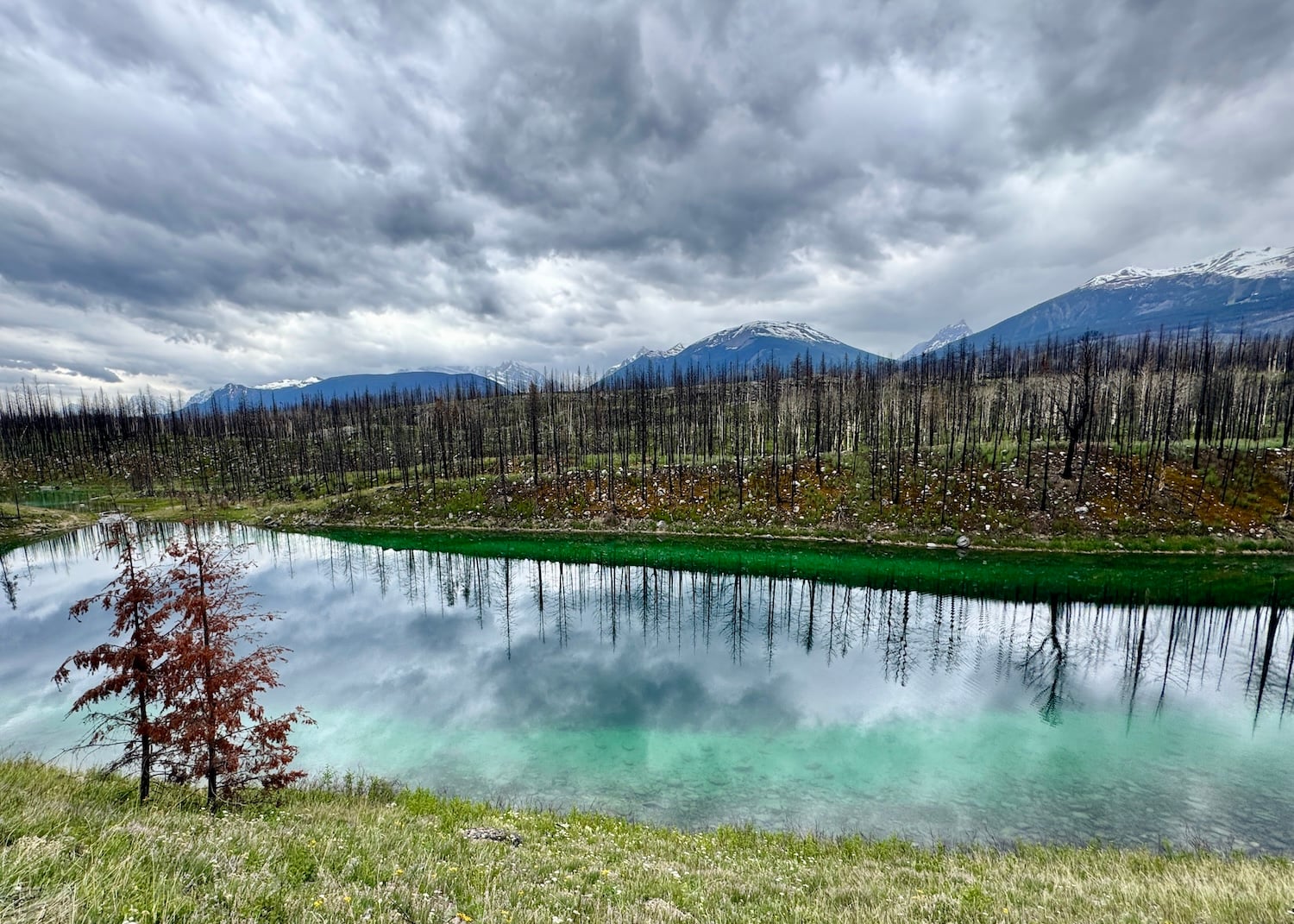
Just steps into a newly reopened trail that passes five turquoise lakes along a fire-ravaged landscape, a mother and son have veered off the path for a closer look at a charred tree stump.
By ignoring signs that say “Stay on trail. Let the land recover,” they’re inadvertently trampling new growth and making it vulnerable to invasive species.
“Would you mind staying on the trail,” asks Jennifer Dubois, the Jasper National Park visitor experience product development officer who spearheaded the trail renewal. “Here we’re just really concerned about non-native vegetation.”

It’s coming up on two years since a historic wildfire ignited by lightning strikes tore through 80,000 acres of Jasper here in Alberta’s Rocky Mountains, forcing 5,000 residents and 20,000 tourists to evacuate and destroying about 30 per cent of the townsite.
Locals started returning home about a month later, and the tight-knit community and park have been slowly rebuilding. On May 23, the popular Valley of the Five Lakes trail finally reopened to great fanfare and today Dubois is going to walk some of it with me.
This is grizzly and black bear country so we’ve got bear spray for a two-hour journey to see a wetland bridge, realigned trail section with new ridgeline views, stone staircase, improved signage, cedar railings to keep people away from sensitive areas, and new rest areas with benches and picnic tables made from salvaged timber.

There’s a neat trailhead outhouse with an adult change table. Right after that there’s an invasive species boot-brushing station to get rid of seeds of invasive plants like Canada thistle and spotted knapweed that might be hidden in our footwear.
We’ve studied the new trail map and plan to walk the easy, 1.8-kilometre Wetland Way and connect with the moderate, 5.4-kilometre Emerald Circuit. We’ll skip the 7.7-kilometre Valley Loop because it isn’t fully open.
“Because the fire did happen to affect some of our premier locations,” Dubois says, “it’s given us an opportunity to focus on our efforts on addressing some deficiencies, we’ll say.”

A lone hiker spots her dark green Parks Canada uniform and stops to ask questions and share his thoughts.
“For me it was positive,” Jonathan Farr says. “The views are way better. It’s so lush in here. I mean it’s lush and sparse — it’s kind of contrasted, right? But yeah, I thought it was really cool. I’ve been coming since I was a little kid so I thought it was kind of neat to have a different experience. I haven’t done this trail in a long time.”
“It’s like an entirely different landscape,” Dubois agrees.

Parks Canada left the fire-scarred area alone for a season to see how the landscape would recover and how the water would move. Next it did an inventory and assessment to see how much infrastructure was destroyed.
“Then there was all the hazard trail cleaning,” recalls Dubois. “This whole trail network and area would have been just a total shintangle of pine and aspen that were destroyed in the fire.”
This iconic hike once attracted 500 to 900 people a day, but it was also notorious for steep, rocky, rooty and eroded areas.

As we walk, I learn that the trail team lessened the grade to make Wetland Way mobility friendly. We stop on a short bridge over a creek that's flanked by two beaver lodges before admiring benches made from reclaimed wood from the fire.
Progressing onto Emerald Circuit (named for the color of the lakes), we climb a hill featuring seemingly unnecessary wooden fencing.
“This was an area that people liked to shortcut, so we put in a nice set of switchbacks and this cedar fence to keep people from going straight up through the grass and continually eroding that,” Dubois confides.
She brought in Parks Canada’s trail advisor Michel Blais in May 2025 to reimagine this trail network. After the plan passed an impact assessment, the trail crew started construction last fall and finished this spring.

At a fork in the trail where a loop starts, Dubois turns right.
“I’m a creature of habit so I just tend to go counterclockwise,” she says. “I think it’s beautiful either way. It means you have to come up this kind of a steep climb at the end, so either way you’re going to have to come up and down.”
Turning right is also the quicker way to get to two of her favorite features.

Hiking along a new ridge, we look down across a valley at the old trail.
“See where it’s all eroded?” Dubois asks. “It was right through the trees there, and into the swamp. So it was always muddy and yucky and steep. So happy to be done with that one.”
The reimagined trail makes better use of ridges so hikers can stay dry and get better views. Parks staff realized that wildlife like bear and elk like to travel in the lower valley so “it also gives us a little bit more natural separation for movement.”

We come to a spot where it feels like the trail is going to lead us over a cliff — until a gorgeous stone staircase is revealed.
“This used to be a nasty, really challenging, steep, eroded piece of trail and our trail crew leader Nick Moore is a rock mason and so he did these stairs,” says Dubois.
“All the rocks were helicoptered in. He found a nice place in the park where he could quarry them from and did all the hand chiselling and then placed these carefully and built up this beautiful sort of winding staircase. It’s one of our favorite features.”

Finally, the trail’s five beautiful turquoise lakes start to come into view.
Jasper's lakes and rivers have just been grouped into three zones with different rules for water activities. These five small lakes are part of a water recreation zone where you can swim, snorkel, paddle and fish.
But to guard against aquatic invasive species — specifically things like invasive mussels and whirling disease — people must clean, drain and dry their watercraft and gear for at least 48 hours before using it elsewhere.
On this June day, though, I only spot two people sitting and quietly admiring Fifth Lake’s beauty.

We cross a second bridge, and then where Fourth Lake meets Third Lake, pause at a pair of Parks Canada’s red chairs.
The iconic Adirondack chairs are made from 100 per cent recycled plastic saved from landfills and can be found at 200 scenic and hidden spots across the country. People share their experiences on social media using the hashtag #ShareTheChair.
Jasper has seven sets spread over its 2.7 million acres. This set is on the newly renamed Picnic Point near three picnic tables made by the trail crew from more of that reclaimed, fire-ravaged timber.
The chairs were here before the fire and returned to the same spot so regulars can do before/after shots. “Some people may not be aware of the fire and may just want that experience,” Dubois allows. “I’m happy to see people use them.”
Strolling by wild onions, fireweed, northwestern wildrye and Yellow corydalis — all lovely plants that have flourished since the fire — talk turns to the Jasper EcoQuest invasive plant bookmark.
A collaboration between Tourism Jasper and Parks Canada, the bookmark shows people what 11 invasives look like and asks them to upload 10 geotagged plant photos (invasive or otherwise) to the iNaturalist app.
Then they can spin a prize wheel and know they’ve potentially alerted the park to plants that need to be removed. I won performance socks for my citizen science efforts.
Before heading off to check on a trail crew, Dubois stresses that “a huge team effort went into the reimagining and then the reopening of the Valley of the Five” and calls it “a huge success.”
People have always been drawn here to see the turquoise water, but now they can witness post-fire beauty and renewal as well.
“This is one you can do many times,” Dubois predicts. “It’s achievable for a lot of people.”

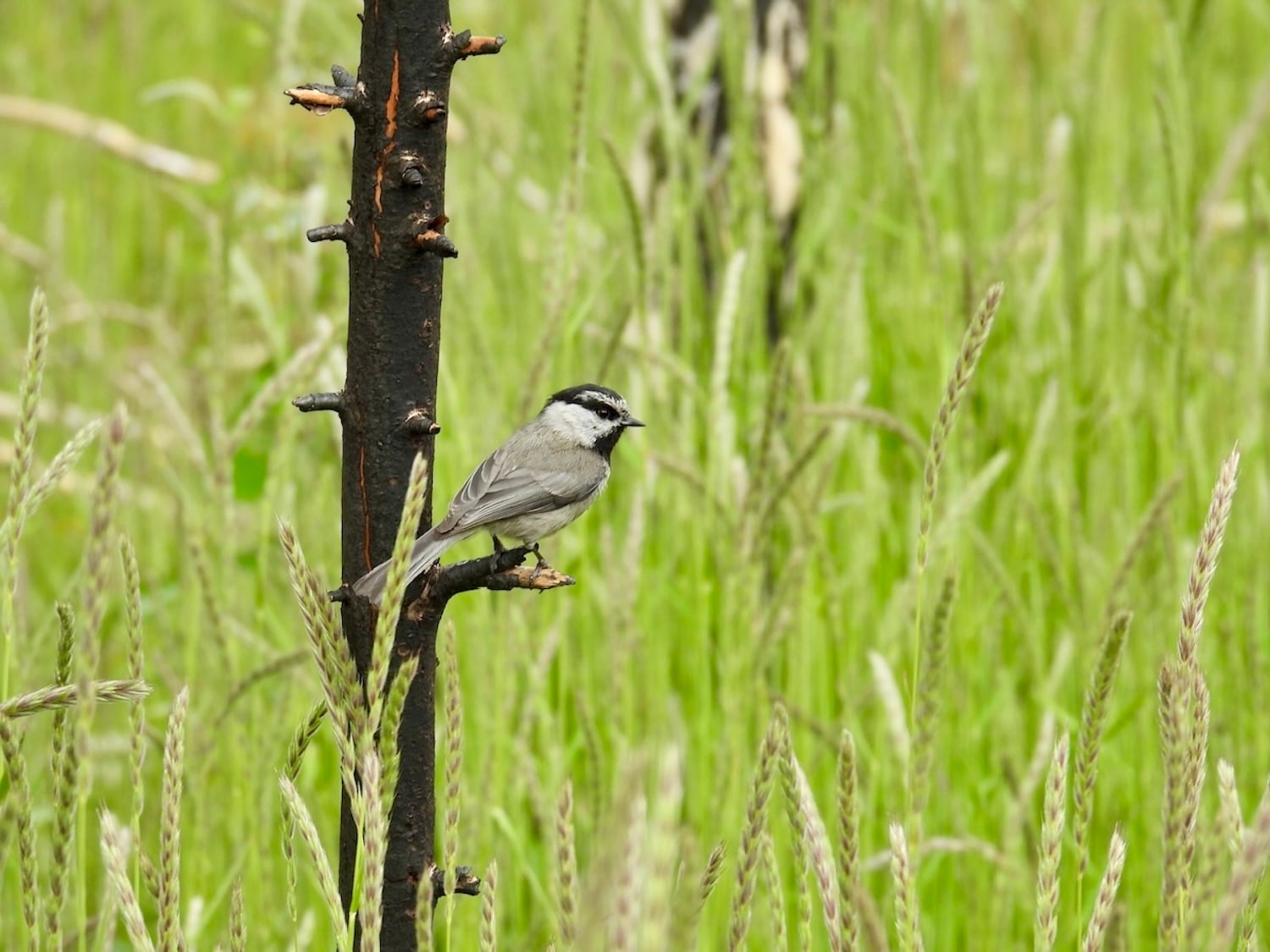
Alone for the final leg of the trail, I linger to photograph Mountain chickadees and Black-backed woodpeckers flitting among charred trees. The wildfire created open sightlines that make it much easier to spot wildlife, and I stay on high alert for bears or equally dangerous cow elk with calves.
I spot wildlife cameras and trail counters attached to charred trees and wonder what they will reveal. As always, I wonder what everyone else is seeing and thinking as they hike.
The parking lot is full of people coming and going, and while those unfamiliar with national park etiquette walk right by the boot-brushing station, I stop to rid my footwear of any dangerous new hitchhikers before moving on.

Stories about:
Story Categories:
A copy of National Parks Traveler's financial statements may be obtained by sending a stamped, self-addressed envelope to: National Parks Traveler, P.O. Box 980452, Park City, Utah 84098. National Parks Traveler was formed in the state of Utah for the purpose of informing and educating about national parks and protected areas.
Residents of the following states may obtain a copy of our financial and additional information as stated below:
- Florida: A COPY OF THE OFFICIAL REGISTRATION AND FINANCIAL INFORMATION FOR NATIONAL PARKS TRAVELER, (REGISTRATION NO. CH 51659), MAY BE OBTAINED FROM THE DIVISION OF CONSUMER SERVICES BY CALLING 800-435-7352 OR VISITING THEIR WEBSITE. REGISTRATION DOES NOT IMPLY ENDORSEMENT, APPROVAL, OR RECOMMENDATION BY THE STATE.
- Georgia: A full and fair description of the programs and financial statement summary of National Parks Traveler is available upon request at the office and phone number indicated above.
- Maryland: Documents and information submitted under the Maryland Solicitations Act are also available, for the cost of postage and copies, from the Secretary of State, State House, Annapolis, MD 21401 (410-974-5534).
- North Carolina: Financial information about this organization and a copy of its license are available from the State Solicitation Licensing Branch at 888-830-4989 or 919-807-2214. The license is not an endorsement by the State.
- Pennsylvania: The official registration and financial information of National Parks Traveler may be obtained from the Pennsylvania Department of State by calling 800-732-0999. Registration does not imply endorsement.
- Virginia: Financial statements are available from the Virginia Department of Agriculture and Consumer Services, 102 Governor Street, Richmond, Virginia 23219.
- Washington: National Parks Traveler is registered with Washington State’s Charities Program as required by law and additional information is available by calling 800-332-4483 or visiting www.sos.wa.gov/charities, or on file at Charities Division, Office of the Secretary of State, State of Washington, Olympia, WA 98504.
INN Member

The easiest way to explore RV-friendly National Park campgrounds.

Here’s the definitive guide to National Park System campgrounds where RVers can park their rigs.
Our app is packed with RVing- specific details on more than 250 campgrounds in more than 70 national parks.
You’ll also find stories about RVing in the parks, tips helpful if you’ve just recently become an RVer, and useful planning suggestions.

