

How many of you have ever watched Steven Spielberg’s Close Encounters of the Third Kind? If you have, you’ll have noticed a a very distinct rock formation heavily featured in the movie. Established September 24, 1906, Devils Tower National Monument in Wyoming is not only the first national monument created, but it’s also the first national monument to protect a unique geological feature.
Soaring 867 feet (264 meters) from base to summit, Devils Tower is the largest example of columnar jointing in the world. Formed from an igneous rock known as phonolite porphyry, some of these columns are 10 feet (3 meters) wide.
How did Devils Tower get its name?
During an 1875 expedition through the area led by Colonel Richard Irving Dodge, the translator interpreted the Native Americans’ name for this structure as "Bad God’s Tower" or similar, which later became "Devils Tower.” It’s suspected this is a mistranslation of the Native American word “bear” to “bad god.” Local tribes consider this landmark sacred and traditionally call it Bear Lodge.

Four hypotheses are posited for how Devils Tower formed:
According to Park Staff
The simplest explanation is that Devils Tower is a stock – a small intrusive body formed by magma which cooled underground and was later exposed by erosion (Figure 1). In 1907, scientists Darton and O’Hara decided that Devils Tower must be an eroded remnant of a laccolith. A laccolith is a large, mushroom-shaped mass of igneous rock which intrudes between the layers of sedimentary rocks but does not reach the surface. This produces a rounded bulge in the sedimentary layers above the intrusion (Figure 2). This idea was quite popular in the early 1900s when numerous studies were done on a number of laccoliths in the American southwest.
Other ideas have suggested that Devils Tower is a volcanic plug or that it is the neck of an extinct volcano (Figure 3). The limited evidence of volcanic activity (volcanic ash, lava fows, or volcanic debris) in the area creates doubt that the Tower was part of a volcanic system. It is possible that this material may simply have eroded away. In 2015, geologist Prokop Závada and his colleagues proposed their own hypothesis for the formation of the Tower. They compared it to a similar butte formation in the Czech Republic. Their hypothesis suggests that the Tower is the result of a maar-diatreme volcano (Figure 4). These form when magma encounters groundwater beneath the Earth’s surface. The super-heated water becomes steam. This steam expands explosively creating a crater on the surface. The crater fills with lava which cools and solidifies into a dome structure. Erosion wears away portions of the dome to create the Tower as we see it today.
The concept of erosion exposing the Tower is common to all of its modern formation theories. Ironically, the erosion which exposed the Tower also erased the evidence needed to determine which theory of Devils Tower’s formation is the correct one.
You can read more about this national monument’s geology in greater detail by opening online or downloading the NPS Devils Tower National Monument Geologic Resource Evaluation Report.
Driving Interstate 90 to or from Moorcroft and even at a distance, you’ll see the national monument’s impressive namesake jutting high above the surrounding landscape. Devils Tower is in a somewhat remote part of Wyoming and there is only one road into or out of the park (Wyoming Highway 24). There is no public transportation (bus or trail) into the park.

If you intend to fly and then drive to Devils Tower, the nearest commercial airport is Northeast Wyoming Regional Airport (GCC) in Gillette, located about 1.5 hours (roughly 60 miles) away. For a widerr choice of airlines, the larger Rapid City Regional Airport (RAP) in South Dakota is the next closest option, approximately 110–115 miles (2 hours) away. Bell Fourche and Spearfish, South Dakota, and Sundance, Wyoming, are the closest communities for lodging, groceries, dining, gasoline, and EV chargers.
Once you are in the park, what can you do?
The first thing you should do to orient yourself to the park is stop at the visitor center. In addition to getting your questions answered by park staff, there are restrooms, WiFi, a bookstore/gift shop, and exhibits.
If you feel like taking a hike, there are trails for all fitness levels from easy to strenuous, with roundtrip distances ranging from 1.5–4.9 miles (2.4-8 kilometers). The most popular trail, of course, is the 1.8-mile (2.9-kilometer) out-and-back Tower Trail, which can get quite crowded. Your best bet is to hike this trail very early in the morning or much later in the evening.
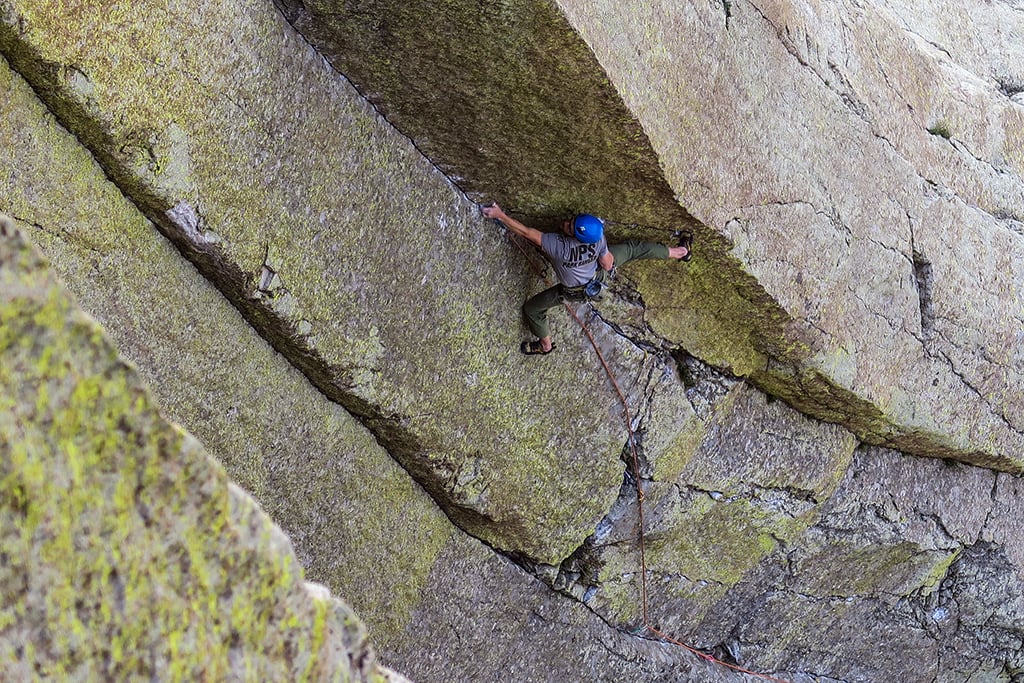
Devils Tower just begs for climbing, doesn’t it? It’s right there, smack dab in the landscape, soaring skyward and acting as a beacon for climbers.

According to Park Staff:
Hundreds of parallel cracks divide Devils Tower into large hexagonal columns. These features make it one of the finest traditional crack climbing areas in North America. The cracks vary in length and width: some are wide enough to fit your entire body, others barely have room for your fingers; the longest crack extends nearly 400 feet [122 meters] upwards.
Technical difficulty ratings range from 5.7 to 5.13; many modern climbers consider the oldest routes (Durrance and Wiessner) harder than their original ratings. The majority of routes at the Tower are not bolt protected and require the appropriate selection of camming devices or other temporary anchors. The few bolted face climbs that exist were established in the 1980s and 1990s; the condition of some bolts reflect that era.
For more information on climbing in the park and to view the regulations, click on the climbing link above.

Stay up past your bedtime and view (or photograph) the night sky. Because of this national monument’s remote location, the light pollution is minimal to none. Park Staff recommend the following locations as great for stargazing:
Joyner Ridge Parking Lot and Trail - Turn left onto a gravel road before you reach the Devils Tower Visitor Center to reach the parking lot and trailhead. This area provides one of the best views of the Tower, and with very little light pollution
Circle of Sacred Smoke Sculpture and Picnic Area - Turn left at the park administration building and proceed to the picnic area. With few trees, the night sky opens up over Devils Tower.
The park also offers ranger-led night sky programs throughout the year. Check out the calendar to find out what may be on offer during your visit.
Bring your telephoto lens or use your smartphone's telephoto setting to photograph the wildlife and wildflowers you will see during your exploration of the park. It's entirely possible you might run across one or more of the 40 species of mammals, including the North American porcupine, and 160 species of birds.

Depending upon the time of year you visit, you will encounter all sorts of wildflowers, too.

Thinking about spending a night at Devils Tower? There is no brick-and-mortar in-park lodging within the park, but the Devils Tower Lodge is located just outside of the park’s northern boundary. The Devils Tower KOA is also nearby and offers tent and RV sites in addition to cabins. The towns of Hulett, Sundance, and Moorcroft in Wyoming, and Spearfish in South Dakota offer a range of lodging choices
If you’d rather pitch a tent or park your RV beneath the stars, Bell Fourche River Campground is open around May 16 – October 14 and offers 45-sites (43 of which are pull-through sites with room for RVs up to 35 feet) including four ADA-accessible sites and three tent-only group sites, each of which can accommodate up to 20 people. All campsites are first-come, first-served. Standard sites are $20 per night, and group sites are $30 per night.

Because parking in this national monument is limited with some spaces difficult for maneuvering an RV or vehicle-trailer combination, the park offers a webpage to help you figure out the best lot and spot for parking.
Featured In The National Parks Traveler
A Hell Of A Place: The Devil's Role In National Park Place Names
Our forefathers were fiendish, hellish, you might even say devilish. Need proof? Look at the maps and the names of many of the places we visit. And then ask yourself, “Why in the Hell are so many places in our Western national parks named after the infernal demon, and his lair?”
To read more of this article, head over to this page.
Musings From Devils Tower National Monument
One of the first thoughts I had upon rolling through the gate at Devils Tower was that Teddy certainly got it right when he used the Antiquities Act to designate this tall stump of rock as America’s first national monument.
If I could be sure that it would always be this way, I think I could live forever in the campground at Devils Tower here in northeastern Wyoming and be perfectly happy. This day contained blue sky dotted with a few spongy, fair weather cumulus clouds, a gentle breeze, and no biting flies. It’s uncrowded, too. A quiet oasis that apparently rarely fills to its small capacity save for a week or so when the Harleys gather in early August at nearby Sturgis, South Dakota.
To read more of this article, head over to this page.
Traveler’s Choice For: Geology, photography, climbing, night skies
Stories about:
Story Categories:
A copy of National Parks Traveler's financial statements may be obtained by sending a stamped, self-addressed envelope to: National Parks Traveler, P.O. Box 980452, Park City, Utah 84098. National Parks Traveler was formed in the state of Utah for the purpose of informing and educating about national parks and protected areas.
Residents of the following states may obtain a copy of our financial and additional information as stated below:
- Florida: A COPY OF THE OFFICIAL REGISTRATION AND FINANCIAL INFORMATION FOR NATIONAL PARKS TRAVELER, (REGISTRATION NO. CH 51659), MAY BE OBTAINED FROM THE DIVISION OF CONSUMER SERVICES BY CALLING 800-435-7352 OR VISITING THEIR WEBSITE. REGISTRATION DOES NOT IMPLY ENDORSEMENT, APPROVAL, OR RECOMMENDATION BY THE STATE.
- Georgia: A full and fair description of the programs and financial statement summary of National Parks Traveler is available upon request at the office and phone number indicated above.
- Maryland: Documents and information submitted under the Maryland Solicitations Act are also available, for the cost of postage and copies, from the Secretary of State, State House, Annapolis, MD 21401 (410-974-5534).
- North Carolina: Financial information about this organization and a copy of its license are available from the State Solicitation Licensing Branch at 888-830-4989 or 919-807-2214. The license is not an endorsement by the State.
- Pennsylvania: The official registration and financial information of National Parks Traveler may be obtained from the Pennsylvania Department of State by calling 800-732-0999. Registration does not imply endorsement.
- Virginia: Financial statements are available from the Virginia Department of Agriculture and Consumer Services, 102 Governor Street, Richmond, Virginia 23219.
- Washington: National Parks Traveler is registered with Washington State’s Charities Program as required by law and additional information is available by calling 800-332-4483 or visiting www.sos.wa.gov/charities, or on file at Charities Division, Office of the Secretary of State, State of Washington, Olympia, WA 98504.
INN Member

The easiest way to explore RV-friendly National Park campgrounds.

Here’s the definitive guide to National Park System campgrounds where RVers can park their rigs.
Our app is packed with RVing- specific details on more than 250 campgrounds in more than 70 national parks.
You’ll also find stories about RVing in the parks, tips helpful if you’ve just recently become an RVer, and useful planning suggestions.

