
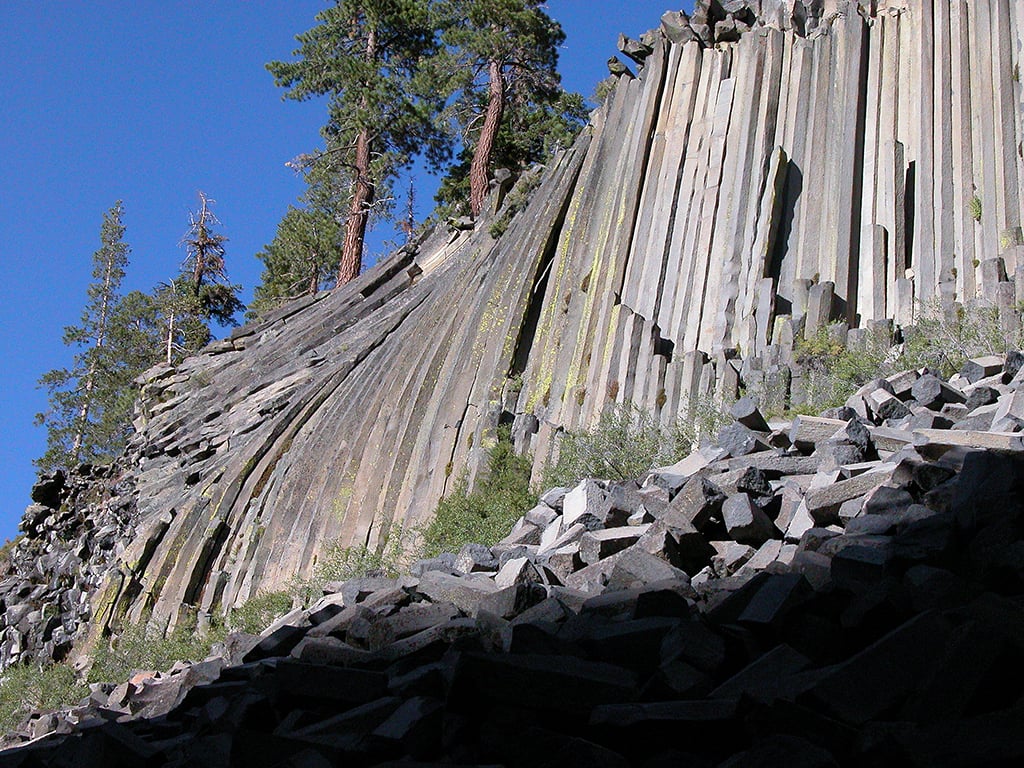
In 1911, by presidential proclamation, Devils Postpile National Monument in California was created. This national monument protects and preserves what is considered one of the world's finest examples of columnar basalts. These columns measure approximately 3.5 feet (1.1 meters) in diameter and reach as high as 60 feet (18.3 meters) into the sky. Looking at this formation with your own eyes, you might think these basalt pillars look like what the early North Fork Mono Traders though they were: lumber turned into rock.
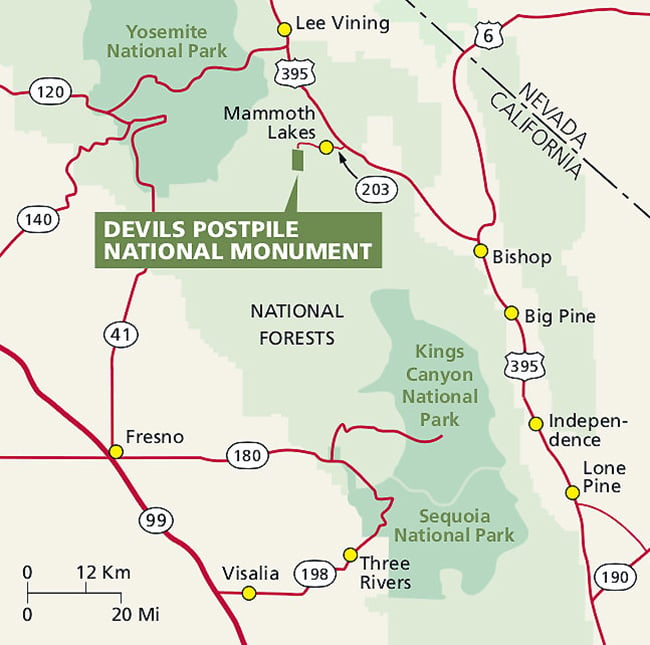
Located about an hour’s drive south and west of Lee Vining California (a convenient gateway town to Yosemite National Park), Devils Postpile National Monument is right next door to Mammoth Mountain Ski Resort, where you can ski and snowboard during the winter and mountain bike in summer. If you are hiking either the John Muir Trail or the Pacific Crest Trail, you’ll hike through this monument because both long-distance trails merge into a single trail passing through this park.
Although small in area (approximately 1.25 square miles/3.24 square kilometers), Devils Postpile National Monument is rich in history. For thousands of years, Native Americans have traversed the region, harvesting its resources for sustenance and trade. Exploration of the landscape by white Europeans didn’t occur until the 1800s, when nomadic Sheepherders named this landscape “The Devil’s Woodpile.”
At one time, Devils Postpile was even included within the boundaries of Yosemite National Park, until people began to realize the commercial promise of mining, timber, and grazing opportunities and subsequently removed this bit of land from the park.
You can learn more about the history of the area by reading Nature and History on the Sierra Crest: Devils Postpile and the Mammoth Lakes Sierra.
Just what is columnar basalt? How does it form?

According to the National Park Service:
Columnar jointing is most commonly found in basaltic lava flows, but it also occurs in lava flows of other compositions, pyroclastic flow deposits (ignimbrites), in some lava domes, volcanic necks, and even in some shallow intrusions.
Devils Postpile National Monument and Devils Tower National Monument contain the best-known examples of columnar jointing in the United States. Devils Postpile NM [national monument] in California was established primarily for the spectacular columnar jointed lava flow that makes up the heart of this small national monument.
Columnar jointing is produced by cooling of lava flows, ash-flow tuffs, and other bodies of magma or lava. Cooling causes contraction which in turn causes fracturing. Fractures propagate from the top and bottom of flows inward towards the center.
The predominantly hexagonal pattern arises because contractional stress is most efficiently relieved by three fractures that intersect at angles of 120 degrees, which in turn creates six-sided polygons. Columns are oriented perpendicular to the main cooling surfaces of lava flows and other igneous bodies.
Elements of fire and ice combined to create this national monument. Scientists estimate Devils Postpile formed about 100,000 years ago, when a lava vent began spewing hot basaltic lava into the Reds Meadow Valley near present-day Upper Soda Springs, a few miles north of the monument.
Glaciers flowed into the area around 65,000 years ago, polishing the hexagonal tops of these columns to a satiny sheen while leaving striations (scratches) in these same rocks indicating the direction of glacier movement. Google puts it best, saying the tops of the basalt columns look “like a tiled, geometric patio polished by glaciers.”

You can read more about the geology of this national monument here, or download and read the National Park Service’s Geologic Resources Inventory Report for an even more detailed geologic description.
In addition to the basalt columns, you’ll see other spectacular geology, including a lava cliff from which plunges 101-foot-tall Rainbow Falls, the highest waterfall on the Middle Fork of the San Joaquin River.

Spend a day in this park and you’ll view more than geology. There is hiking, fishing, and biking available here. Within this national monument are three trails (Devils Postpile, Rainbow Falls, Minaret Falls) with additional trails in the Ansel Adams Wilderness leading to views of meadows, lakes, and the San Joaquin River.
If you feel like testing your angling skills, the San Joaquin River is where you can fish for rainbow, brown, golden, and brook trout. From April to November, the river offers great fly-fishing opportunities.

Bring your camera with you, not only to capture the unique columnar jointing of Devils Postpile itself (you can hike a trail to the top of this formation), but also to photograph the wildflowers in bloom mid-June through mid-July, and any of the 135 species of wildlife living within or passing through the park, including squirrels, bears, coyotes, deer, songbirds, and birds of prey.

Bring your horse and do a little horseback riding here or reserve a commercial pack trip through the Reds Meadow Pack Station located outside the monument.
According to Park Staff:
The trail from the ranger station to Devils Postpile is not open to stock use, but there are several other options. There is no stock trailer parking at Devils Postpile National Monument, but visitors may use the Rainbow Falls, Agnew Meadows, or Reds Meadow parking areas. View a complete list of horse and stock use regulations.
Although bicycling is generally not permitted in the Reds Meadow Valley nor anywhere in Devils Postpile National Monument, you can cycle along the 13-mile (21 kilometers) Reds Meadow Road as well as Starkweather Trail, which is located within the park. Starkweather Trail is also popular with hikers, so bicycling this trail is not allowed until the shuttles are done for the day.
Bicycling outside the monument is a different story. Mammoth Mountain offers over 80 miles (129 kilometers) of singletrack trails ranging from beginner to advanced downhill.
Speaking of shuttle buses, it is mandatory to take the shuttle for day use into the national monument between mid-June and early September, with some exceptions. Tickets are $15 for adults and $7 for children ages 3-15. Buses run from 7:30 a.m. – 7:00 p.m. and you can catch one at the Mammoth Mountain Adventure Center. Reservations are encouraged.
What are the exceptions to riding the shuttle? You don’t need to take a shuttle if you:
- Arrive before 7:00 am or after 7:00 pm
- Are staying overnight at the Reds Meadow Resort or at any designated campground in the valley. Backpackers must use the shuttle system.
- Have a cartop boat or inflated float tube for use on valley lakes (there are no boat launches in the valley)
- Are towing a livestock trailer and intend to use livestock on valley trails
- Display a handicap placard or plates
- Hunters transporting weapons or game
- Arrive outside of shuttle bus operating hours or seasons
The operating season for Devils Postpile National Monument is June to October, after which the Red Meadows Valley closes to vehicles. This doesn’t mean you can’t enjoy some winter fun like backcountry skiing or snowshoeing. You can even snowmobile on Reds Meadow Road, although some spots are not suitable for novices.
Research your trip ahead of time, keeping an eye on weather and avalanche forecasts. Check with the Eastern Sierra Avalanche Center for updated reports throughout the winter.
Considering spending more than a single day in this park? While there is no brick-and-mortar lodging in Devils Postpile National Monument, Reds Meadow Resort and Packstation provides rustic cabins, bunks, and other amenities.
If you’d rather pitch a tent or park your RV directly beneath the stars, there are six campgrounds in the valley, including one at Devils Postpile. Many lodging options are also available in the town of Mammoth Lakes, 13 miles from the park.
Spend a day at Devils Postpile National Monument, then take a side trip to other nearby attractions such as Mono Lakes (43.6 miles/70 kilometers northeast), Yosemite National Park (53.3 miles/56 kilometers northeast to the Tioga Pass Entrance), and Manzanar National Historic Site (103 miles/166 kilometers southeast).
Traveler’s Choice For: Geology, photography, fly-fishing
Stories about:
Story Categories:
A copy of National Parks Traveler's financial statements may be obtained by sending a stamped, self-addressed envelope to: National Parks Traveler, P.O. Box 980452, Park City, Utah 84098. National Parks Traveler was formed in the state of Utah for the purpose of informing and educating about national parks and protected areas.
Residents of the following states may obtain a copy of our financial and additional information as stated below:
- Florida: A COPY OF THE OFFICIAL REGISTRATION AND FINANCIAL INFORMATION FOR NATIONAL PARKS TRAVELER, (REGISTRATION NO. CH 51659), MAY BE OBTAINED FROM THE DIVISION OF CONSUMER SERVICES BY CALLING 800-435-7352 OR VISITING THEIR WEBSITE. REGISTRATION DOES NOT IMPLY ENDORSEMENT, APPROVAL, OR RECOMMENDATION BY THE STATE.
- Georgia: A full and fair description of the programs and financial statement summary of National Parks Traveler is available upon request at the office and phone number indicated above.
- Maryland: Documents and information submitted under the Maryland Solicitations Act are also available, for the cost of postage and copies, from the Secretary of State, State House, Annapolis, MD 21401 (410-974-5534).
- North Carolina: Financial information about this organization and a copy of its license are available from the State Solicitation Licensing Branch at 888-830-4989 or 919-807-2214. The license is not an endorsement by the State.
- Pennsylvania: The official registration and financial information of National Parks Traveler may be obtained from the Pennsylvania Department of State by calling 800-732-0999. Registration does not imply endorsement.
- Virginia: Financial statements are available from the Virginia Department of Agriculture and Consumer Services, 102 Governor Street, Richmond, Virginia 23219.
- Washington: National Parks Traveler is registered with Washington State’s Charities Program as required by law and additional information is available by calling 800-332-4483 or visiting www.sos.wa.gov/charities, or on file at Charities Division, Office of the Secretary of State, State of Washington, Olympia, WA 98504.
INN Member

The easiest way to explore RV-friendly National Park campgrounds.

Here’s the definitive guide to National Park System campgrounds where RVers can park their rigs.
Our app is packed with RVing- specific details on more than 250 campgrounds in more than 70 national parks.
You’ll also find stories about RVing in the parks, tips helpful if you’ve just recently become an RVer, and useful planning suggestions.

