
He was alone. He was unheeded, happy, and near to the wild heart of life. James Joyce
Now I see the secret of making the best persons. It is to grow in the open air, and to eat and sleep with the earth -- Walt Whitman
Today, April 12th, my son, Stratton Matteson, would have been 29 years old. He died February 24th of this year in a massive avalanche while backcountry snowboarding near Joffree Peak Provincial Park in southwest British Columbia.
The day he died was perfect, as close to heaven as it could be. He woke up to a golden sunrise on the peaks. He and his buddy dug a pit to examine the snow conditions and concluded it was safe to snowboard. He paused near the summit to photograph the surrounding mountains that disappeared into the distance. He did a near-perfect run down the slope and radioed to his partner to come on down.
His friend took a couple of turns, and the entire mountainside gave way, and the snow came down on Stratton. He was recording the run on his phone. The phone was damaged in the snowslide, but technicians were able to download the contents.
What we saw in those last moments were dozens of photos he took, from the top of the ridge, mountain upon mountain in every direction. Deep blue sky. And a perfect sheet of snow below. He was no doubt jubilant.
Some people dream about going to heaven after they die. But for Stratton, every day he was alive, he was in heaven. He always raved about the beauty of the mountains. He always mentioned how grateful he was to be able to watch sunsets or sunrises in wild places.
Backcountry snowboarding for him wasn’t just about getting a quick jolt of adrenaline. It was his way of feeling fully alive. It was about grace and love. And grace does not come easy.

Every climb up a mountain was a commitment, and every descent was a dance with the mountain—a chance to feel completely in the moment.
After one of his numerous trips, he would call me on his way home to tell me about the beauty of the place. The giant red fir trees he might hike through on the way up. The way the sun shone on the peaks or the infinite stars at night. He was always grateful to have had another trip in the mountains.
Stratton’s mother and I took him on his first backpack trip in the mountains of Olympic National Park when he was about two weeks old. From that day forward, we continuously made trips into wildlands across the country. Canoeing lakes in the Adirondacks, x-c skiing in Yellowstone, backpacking into the Grand Canyon, hiking trails in Yosemite, hiking on glaciers in the Canadian Rockies, and pack rafting rivers in Alaska’s Arctic, and many more adventures. During his life, he had visited and experienced hundreds of parks and wildlands across the continent.
He started snowboarding when he was nine after we moved to Vermont. At first, like for many people, snowboarding was about speed, sense of competency, and skill.
By the time he was in his twenties, he began to realize that human impacts were changing the planet’s climate. At some point, he decided to use his bike as his main mode of transportation, for everything from going to the local grocery store to pedaling to trailheads with all his camping and snowboarding gear.
From a base in Bend, Oregon, he would ride his bike 40–100 miles one-way to a starting point, then hike or ski to the slopes of the high, glaciated peaks visible from town. Seeing him peddling up a road in a blizzard, with a bike loaded down with all his gear, was a common feature in Central Oregon.
Self-propelling himself to the trailheads made him feel more connected to the land, and reducing his own carbon footprint. He once rode from the Sierra Nevada of California to the Canadian border, climbing most of the higher peaks along the way to snowboard from their summits.
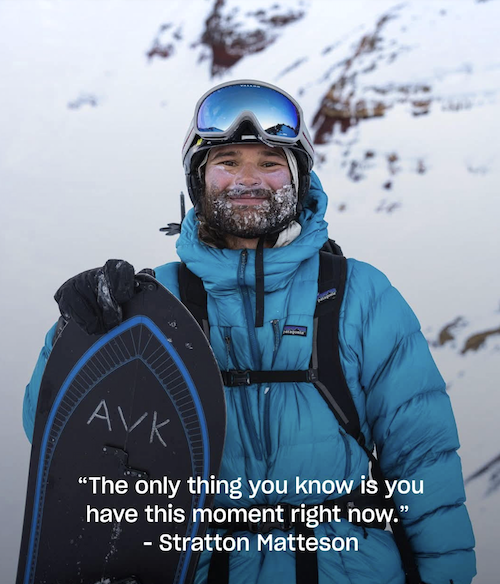
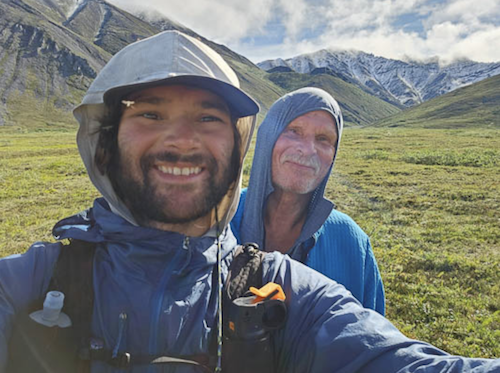
Just before he left Bend on his last big adventure, he sent me a proposal that he hoped to find funding to create videos promoting the need for more protection of parks and wilderness areas. He felt he needed to give something back to the planet and wanted to work towards preserving the beautiful wild landscapes that fed his soul.
His lifelong immersion in wildlands affected his personality. He had an aura of joy and playfulness about him. He looked people straight in the eye because he was totally aware and confident about his place in life.
He made a transition in values and purpose, seeing beyond our own interests and feeling part of a greater whole. And as long as we protect and preserve such places, there is hope that anyone can come to similar realizations.
Not everyone will find heaven on Earth in the wild as he did. But I feel we must provide such places. He recognized that parks and wilderness are essential for maintaining ecosystems and wildlife. But he also knew from firsthand experience that immersion in such places can lead to contentment and joy.
He died way too young, but he learned something in his years that most people never realize—how to live a life on one’s own terms and fully engaged in the dance of life.
A copy of National Parks Traveler's financial statements may be obtained by sending a stamped, self-addressed envelope to: National Parks Traveler, P.O. Box 980452, Park City, Utah 84098. National Parks Traveler was formed in the state of Utah for the purpose of informing and educating about national parks and protected areas.
Residents of the following states may obtain a copy of our financial and additional information as stated below:
- Florida: A COPY OF THE OFFICIAL REGISTRATION AND FINANCIAL INFORMATION FOR NATIONAL PARKS TRAVELER, (REGISTRATION NO. CH 51659), MAY BE OBTAINED FROM THE DIVISION OF CONSUMER SERVICES BY CALLING 800-435-7352 OR VISITING THEIR WEBSITE. REGISTRATION DOES NOT IMPLY ENDORSEMENT, APPROVAL, OR RECOMMENDATION BY THE STATE.
- Georgia: A full and fair description of the programs and financial statement summary of National Parks Traveler is available upon request at the office and phone number indicated above.
- Maryland: Documents and information submitted under the Maryland Solicitations Act are also available, for the cost of postage and copies, from the Secretary of State, State House, Annapolis, MD 21401 (410-974-5534).
- North Carolina: Financial information about this organization and a copy of its license are available from the State Solicitation Licensing Branch at 888-830-4989 or 919-807-2214. The license is not an endorsement by the State.
- Pennsylvania: The official registration and financial information of National Parks Traveler may be obtained from the Pennsylvania Department of State by calling 800-732-0999. Registration does not imply endorsement.
- Virginia: Financial statements are available from the Virginia Department of Agriculture and Consumer Services, 102 Governor Street, Richmond, Virginia 23219.
- Washington: National Parks Traveler is registered with Washington State’s Charities Program as required by law and additional information is available by calling 800-332-4483 or visiting www.sos.wa.gov/charities, or on file at Charities Division, Office of the Secretary of State, State of Washington, Olympia, WA 98504.
INN Member

The easiest way to explore RV-friendly National Park campgrounds.

Here’s the definitive guide to National Park System campgrounds where RVers can park their rigs.
Our app is packed with RVing- specific details on more than 250 campgrounds in more than 70 national parks.
You’ll also find stories about RVing in the parks, tips helpful if you’ve just recently become an RVer, and useful planning suggestions.

