
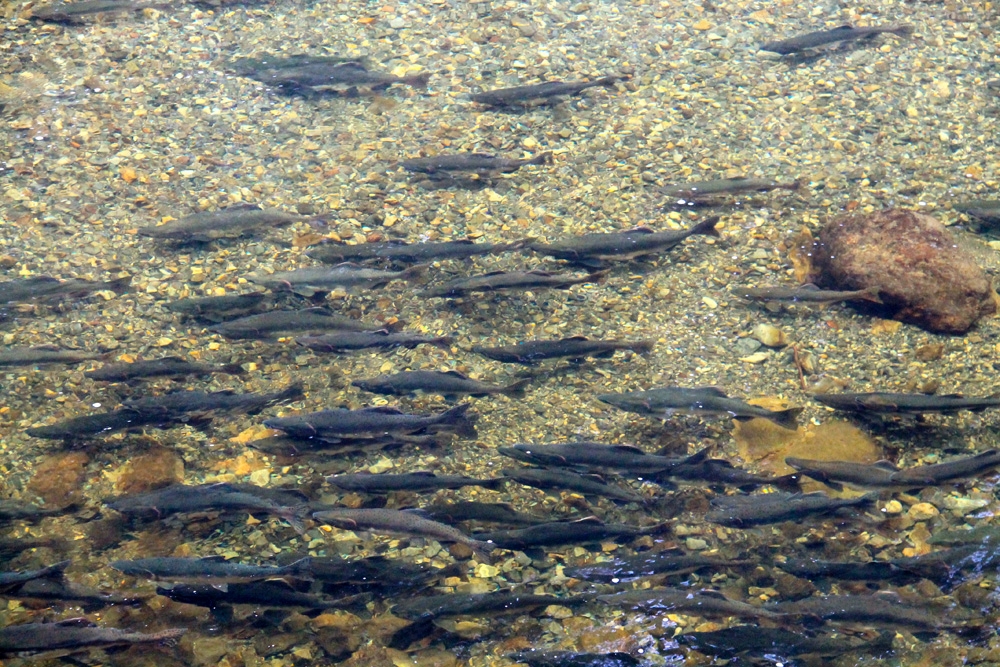
At the Indian River in Sitka National Historical Park in Alaska, researchers have found that in recent decades, annual abundances of native pink salmon have increased dramatically. Scientists are racing to discover whether the numbers are a warning sign for the river or a return to a natural range.
A 2026 study notes that since 1980, pink salmon abundance has increased from several thousand to regularly exceeding 100,000 fish annually. Moreover, there are indications that the duration of pink salmon spawning, formerly limited to August and September, now regularly spans July through October.
The study says that large salmon runs can put other aquatic species at risk by depleting in-stream dissolved oxygen concentrations. The risk is especially high when the runs coincide with periods of low river flows or warm temperatures. For example, a large pink salmon run in 2013 led to a 37-day period in which dissolved oxygen concentrations in the Indian River were well below the threshold required for healthy physiological function in most freshwater species.
The recent, highly abundant runs may be influenced by the operations of a nearby hatchery, which releases millions of pink salmon annually. Alternatively, high salmon densities in the river may be naturally occurring phenomena, influenced by variation in stream conditions, ocean productivity, predation intensity, and commercial harvests, among other factors.
The researchers note that at Sitka National Historical Park, the possibility of hatchery pink salmon straying into the Indian River is particularly high. The not-for-profit Sitka Sound Science Center operates a hatchery immediately adjacent to the park boundary, less than a mile from the Indian River estuary, and the closer a hatchery is to a stream, the greater the chance hatchery fish will stray into it. Sitka Sound Science Center’s hatchery has been in operation since 1975, a timeline that coincides with the increases in Indian River pink salmon abundances observed in the 1980s.
Surveying efforts in the Indian River have noted high numbers of stray pink salmon from the hatchery, but these rates vary. For example, in 2015, hatchery strays made up approximately 33 percent of all individuals pink salmon sampled, while in 2011 hatchery strays represented less than 5 percent. This makes it more difficult to place the cause of the increased abundance on the hatchery.
The researchers note that while hatchery salmon may be contributing to the abundance of pink salmon observed in recent decades, it is also possible that the relatively low numbers of spawning pink salmon observed before 1980 may have been historically atypical, and current densities are within the natural range.
The National Park Service plans to continue exploring these questions through more research studies. In 2023, the agency entered into a partnership with U.S. Geological Survey and the University of Washington to evaluate Indian River pink salmon populations in the context of the broader region.
The study notes that using statistical modeling, it is possible to estimate the annual abundance of pink salmon in the Indian River and to compare those estimates to pink salmon abundance in neighboring streams. The project will also explore the Indian River system in greater detail, with the goal of identifying what if any measurable impact hatchery releases have on abundances of spawning pink salmon entering the stream each year.
Stories about:
Story Categories:
A copy of National Parks Traveler's financial statements may be obtained by sending a stamped, self-addressed envelope to: National Parks Traveler, P.O. Box 980452, Park City, Utah 84098. National Parks Traveler was formed in the state of Utah for the purpose of informing and educating about national parks and protected areas.
Residents of the following states may obtain a copy of our financial and additional information as stated below:
- Florida: A COPY OF THE OFFICIAL REGISTRATION AND FINANCIAL INFORMATION FOR NATIONAL PARKS TRAVELER, (REGISTRATION NO. CH 51659), MAY BE OBTAINED FROM THE DIVISION OF CONSUMER SERVICES BY CALLING 800-435-7352 OR VISITING THEIR WEBSITE. REGISTRATION DOES NOT IMPLY ENDORSEMENT, APPROVAL, OR RECOMMENDATION BY THE STATE.
- Georgia: A full and fair description of the programs and financial statement summary of National Parks Traveler is available upon request at the office and phone number indicated above.
- Maryland: Documents and information submitted under the Maryland Solicitations Act are also available, for the cost of postage and copies, from the Secretary of State, State House, Annapolis, MD 21401 (410-974-5534).
- North Carolina: Financial information about this organization and a copy of its license are available from the State Solicitation Licensing Branch at 888-830-4989 or 919-807-2214. The license is not an endorsement by the State.
- Pennsylvania: The official registration and financial information of National Parks Traveler may be obtained from the Pennsylvania Department of State by calling 800-732-0999. Registration does not imply endorsement.
- Virginia: Financial statements are available from the Virginia Department of Agriculture and Consumer Services, 102 Governor Street, Richmond, Virginia 23219.
- Washington: National Parks Traveler is registered with Washington State’s Charities Program as required by law and additional information is available by calling 800-332-4483 or visiting www.sos.wa.gov/charities, or on file at Charities Division, Office of the Secretary of State, State of Washington, Olympia, WA 98504.


National parks and their natural resources belong to you. The National Parks Traveler works to ensure you know how these essential places are being cared for.
Sign Up For Our Weekly Newsletter
Unsubscribe at any time.
INN Member

The easiest way to explore RV-friendly National Park campgrounds.

Here’s the definitive guide to National Park System campgrounds where RVers can park their rigs.
Our app is packed with RVing- specific details on more than 250 campgrounds in more than 70 national parks.
You’ll also find stories about RVing in the parks, tips helpful if you’ve just recently become an RVer, and useful planning suggestions.

