
Twenty-five years ago, the Comprehensive Everglades Restoration Plan (CERP) came to be, an aggressive endeavor by the state of Florida and the federal government to collaboratively mount what's viewed as the greatest environmental restoration effort the world has seen.
Authorized by Congress in 2000, the goal of CERP is to restore the natural flows of the "river of grass" that starts at Lake Okeechobee in central Florida, meanders through Big Cypress National Preserve and Everglades National Park, and ends off the state's southern tip in Florida Bay.
In light of the state and federal governments' collaboration on this effort, and their funding of some $20 billion so far to make it succeed, their presence at the annual Everglades Coalition Conference is standard. Except for this year's 41st annual conference, held late last week in Naples, Florida.
A week before the conference was to open representatives for both the state and Interior Department notified organizers that they would not be attending, a decision that sent the organizers scrambling to rework panel discussions that had been intended to include state and federal perspectives.
Roughly 650 miles to the north, Friends of Congaree Swamp was hosting its annual scientific symposium in Columbia, South Carolina, at the same time. It, too, was required to do so without National Park Service representatives, as the agency's staff was told to focus on visitor needs at Congaree National Park and not participate in scientific symposiums.
It would have been both interesting and helpful to get the opinions of Interior officials (which include National Park Service personnel) when it comes to progress under CERP and risks to Congaree National Park from industrial processes beyond the park's boundaries and what can be done.
These are just two recent examples that underscore that Interior Secretary Doug Burgum's approach to managing the United States' rich natural resources evidently has little room for science that guides the federal land-management agencies' stewardship of those lands and waters. Which is unfortunate, as understanding natural processes is key to maintaining healthy ecosystems.
"Parks are living laboratories where scientists ask questions and conduct research. Scientists observe and experiment. They learn from interactions of plants and animals in their natural environment," the National Park Service states on its web pages. "The National Park Service preserves the places and stories of discovery and uses what we learn through science to manage our natural and cultural resources."
Burgum's disregard of science is no great surprise, as he sees public lands as cash cows for the federal government, not natural laboratories that can improve biodiversity and human health or reflect climate-change impacts.
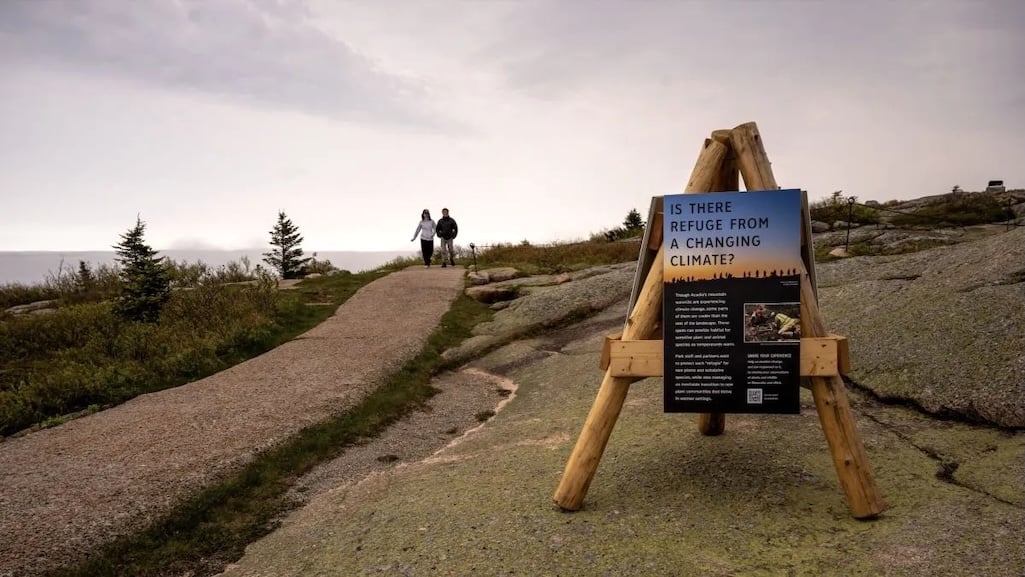
Last year Interior ordered the removal of signs at Acadia National Park in Maine that discussed climate change, and in recent weeks the department has ordered the removal of interpretive materials at Fort Sumter and Fort Moultrie National Historical Park, Glacier National Park, and Muir Woods National Monument that explain aspects of climate change when it comes to sea-level rise and melting glaciers. That sparked outrage at the National Parks Conservation Association.
“With each passing year of inaction, the ocean grows closer to swallowing priceless history that defines our nation. Sea level rise is devastating many of our national parks, and the decisions we make today will have implications for generations of park visitors to come," said Kristen Brengel, the group's senior vice president for government affairs. "Censoring climate science at national parks is a disservice to the American people, who deserve to learn the truth about the dire threat facing the places they know and love most.
"... For years, National Park Service staff have been raising the alarm about the threat sea level rise poses to Fort Sumter. They have worked tirelessly to protect this priceless place, where the first shots of America’s Civil War rang out, from destruction," added Brengel. "Protecting Fort Sumter from sea level rise is part of the Park Service’s mission, and the administration continues to undermine that mission. To censor and erase sound science at the park is a deep insult to the Park Service’s hard work and legislative mandate."
Among the signs removed in September from Acadia was one that asked whether there might be a refuge from climate change?
“Thanks to President Donald Trump, Interior is ensuring that the American people are no longer being fed the lies of the delusional Green New Scam,” Interior spokesperson Aubrie Spady told The Maine Monitor when asked about the signs' removal, referring to unsuccessful efforts in Congress to pass a package of environmental proposals. “The content was taken down because this administration believes in only administering facts based on real science to the American public, not brainless fear-mongering rhetoric used to steal taxpayer dollars.”
Stories about:
Story Categories:
A copy of National Parks Traveler's financial statements may be obtained by sending a stamped, self-addressed envelope to: National Parks Traveler, P.O. Box 980452, Park City, Utah 84098. National Parks Traveler was formed in the state of Utah for the purpose of informing and educating about national parks and protected areas.
Residents of the following states may obtain a copy of our financial and additional information as stated below:
- Florida: A COPY OF THE OFFICIAL REGISTRATION AND FINANCIAL INFORMATION FOR NATIONAL PARKS TRAVELER, (REGISTRATION NO. CH 51659), MAY BE OBTAINED FROM THE DIVISION OF CONSUMER SERVICES BY CALLING 800-435-7352 OR VISITING THEIR WEBSITE. REGISTRATION DOES NOT IMPLY ENDORSEMENT, APPROVAL, OR RECOMMENDATION BY THE STATE.
- Georgia: A full and fair description of the programs and financial statement summary of National Parks Traveler is available upon request at the office and phone number indicated above.
- Maryland: Documents and information submitted under the Maryland Solicitations Act are also available, for the cost of postage and copies, from the Secretary of State, State House, Annapolis, MD 21401 (410-974-5534).
- North Carolina: Financial information about this organization and a copy of its license are available from the State Solicitation Licensing Branch at 888-830-4989 or 919-807-2214. The license is not an endorsement by the State.
- Pennsylvania: The official registration and financial information of National Parks Traveler may be obtained from the Pennsylvania Department of State by calling 800-732-0999. Registration does not imply endorsement.
- Virginia: Financial statements are available from the Virginia Department of Agriculture and Consumer Services, 102 Governor Street, Richmond, Virginia 23219.
- Washington: National Parks Traveler is registered with Washington State’s Charities Program as required by law and additional information is available by calling 800-332-4483 or visiting www.sos.wa.gov/charities, or on file at Charities Division, Office of the Secretary of State, State of Washington, Olympia, WA 98504.
INN Member

The easiest way to explore RV-friendly National Park campgrounds.

Here’s the definitive guide to National Park System campgrounds where RVers can park their rigs.
Our app is packed with RVing- specific details on more than 250 campgrounds in more than 70 national parks.
You’ll also find stories about RVing in the parks, tips helpful if you’ve just recently become an RVer, and useful planning suggestions.

