
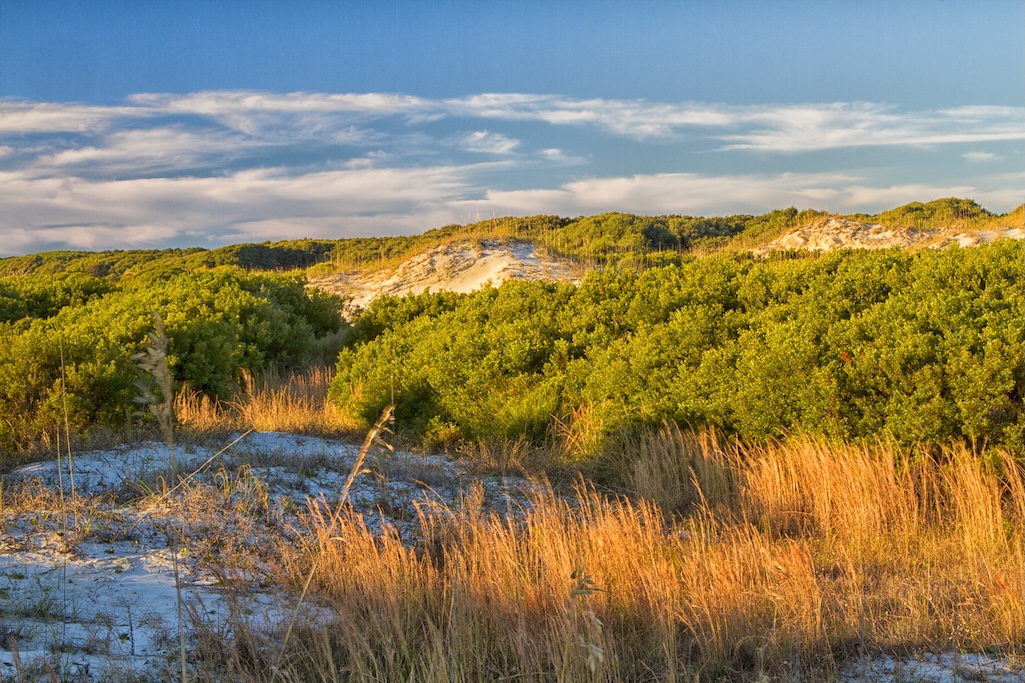
More than a dozen organizations have raised concerns about the National Park Service's visitor management plans at Cumberland Island National Seashore, saying they put at risk "the qualities that make the seashore worth visiting."
At issue is the draft Visitor Use Management Plan (VUMP) the Park Service developed after years of considering how best to manage visitation to the barrier island off the south Georgia coast. The public comment period ended Saturday.
The national seashore protects the largest undeveloped barrier island on the East Coast, one with roughly 20,000 acres of official and potential wilderness, 18 miles of protected beaches, threatened and endangered species, and maritime forests and salt marshes.
Since the 1980s the Park Service has limited daily visitation to Cumberland Island to 300 a day. Under the VUMP, however, the agency wants to more than double that limit, to 700 or more. The plan also would allow "motorized boat access to Wilderness and Potential Wilderness campsites (Brick Hill, Toonahowie);” allow bike and e-bike use of administrative roads in the Cumberland Island Wilderness; increase camping capacity from 220 per night to more than 300; build a retail facility selling health, safety, and essential camping items and merchandise; offer motorized boat tours, and; expand a ferry service capable to carrying 100 passengers a day to the Plum Orchard dock.
As the Traveler has noted, the plan also proposes a significant increase in commercial services to be authorized in the park’s wilderness area, despite The Wilderness Act’s restriction of commercial activity under Section 4(d)(5) of the act to those determined to be necessary and appropriate for realizing the recreational or other wilderness purposes of the area. The Park Service lacks a standardized method for doing an “extent necessary” determination, but the VUMP all-but declares (See Appendix F of the VUMP) that any activity which furthers any of the purposes of wilderness to be necessary.
Comments (attached below) on the draft VUMP submitted by the Southern Environmental Law Center in behalf of groups ranging from the Coalition to Protect America's National Parks and the National Parks Conservation Association to Birds Georgia and the Center for a Sustainable Coast say the groups "fully support the Park Service’s goal of providing thoughtful visitor access to the Seashore consistent with its authorizing legislation. To visit the seashore is to love it, and to love it is to protect it. However, visitor access should not be at the expense of the qualities that make the seashore worth visiting."
The groups voiced worries over:
- The planned daily visitor cap increase to 700;
- An increase the number of bicycles, including e-Bikes, for rent or delivery to 100 a day;
- Numerous new facilities and commercial services—including a camp store, bath house, two pavilions, new campsites, on-island bicycle rentals, kayak rentals, motorized boat tours, expanded vehicle tours, photography tours, and fishing tours;
- Detrimental impacts to the seashore's wilderness from increased use;
- No proposed protections "for the overused South End Beach area";
- Negative impacts to shorebirds from a proposal to build a bath house, campsite, pavilion and path in the interdune area near Nightingale Beach, and;
- Lack of a plan to educate the public about the dire state of the feral horse population on the seashore or plans to reduce the size of the herd., and;
The letter also asked that the Park Service "ensure the VUMP complies with all relevant laws and regulations, including the National Environmental Policy Act, Endangered Species Act, and the Park Service’s own regulations."
"For these reasons, we encourage the Park Service to revisit the proposed VUMP, conduct the additional analysis and evaluation recommended above, and continue to work with the public to develop a plan that appropriately prioritizes the Park Service’s legislative mandate to preserve the Seashore in its undeveloped state," the groups said.
Signing the letter were:
Allegheny-Blue Ridge Alliance, Dan Shaffer
Birds Georgia, Sarah Manning
Californians for Western Wilderness, Michael J. Painter
Center for a Sustainable Coast, David Kyler
Center for Biological Diversity, Will Harlan
Coalition to Protect America’s National Parks, Emily Thompson
Environment Georgia, Jennette Gayer
Great Old Broads for Wilderness, GRITS Broadband, Julie Savage
Minnesota Division Izaak Walton League of America, John Siekmeier
National Parks Conservation Association, Eboni Preston Goddard
Standing Trees, Zack Porter
The Ocean Project, Bill Mott
Virginia Wilderness Committee, Ellen Stuart-Haëntjens
Wild Alabama, Janice Barrett
Wild Cumberland, Jessica Howell-Edwards

Stories about:
Story Categories:
A copy of National Parks Traveler's financial statements may be obtained by sending a stamped, self-addressed envelope to: National Parks Traveler, P.O. Box 980452, Park City, Utah 84098. National Parks Traveler was formed in the state of Utah for the purpose of informing and educating about national parks and protected areas.
Residents of the following states may obtain a copy of our financial and additional information as stated below:
- Florida: A COPY OF THE OFFICIAL REGISTRATION AND FINANCIAL INFORMATION FOR NATIONAL PARKS TRAVELER, (REGISTRATION NO. CH 51659), MAY BE OBTAINED FROM THE DIVISION OF CONSUMER SERVICES BY CALLING 800-435-7352 OR VISITING THEIR WEBSITE. REGISTRATION DOES NOT IMPLY ENDORSEMENT, APPROVAL, OR RECOMMENDATION BY THE STATE.
- Georgia: A full and fair description of the programs and financial statement summary of National Parks Traveler is available upon request at the office and phone number indicated above.
- Maryland: Documents and information submitted under the Maryland Solicitations Act are also available, for the cost of postage and copies, from the Secretary of State, State House, Annapolis, MD 21401 (410-974-5534).
- North Carolina: Financial information about this organization and a copy of its license are available from the State Solicitation Licensing Branch at 888-830-4989 or 919-807-2214. The license is not an endorsement by the State.
- Pennsylvania: The official registration and financial information of National Parks Traveler may be obtained from the Pennsylvania Department of State by calling 800-732-0999. Registration does not imply endorsement.
- Virginia: Financial statements are available from the Virginia Department of Agriculture and Consumer Services, 102 Governor Street, Richmond, Virginia 23219.
- Washington: National Parks Traveler is registered with Washington State’s Charities Program as required by law and additional information is available by calling 800-332-4483 or visiting www.sos.wa.gov/charities, or on file at Charities Division, Office of the Secretary of State, State of Washington, Olympia, WA 98504.


National parks and their natural resources belong to you. The National Parks Traveler works to ensure you know how these essential places are being cared for.
Sign Up For Our Weekly Newsletter
Unsubscribe at any time.
INN Member

The easiest way to explore RV-friendly National Park campgrounds.

Here’s the definitive guide to National Park System campgrounds where RVers can park their rigs.
Our app is packed with RVing- specific details on more than 250 campgrounds in more than 70 national parks.
You’ll also find stories about RVing in the parks, tips helpful if you’ve just recently become an RVer, and useful planning suggestions.

