

Hands down, the General Sherman Tree Trail at Sequoia National Park in California is the most popular hike in the park, and with good reason. It’s an easy, paved hike of approximately 0.5 miles (0.8 kilometers) one-way - most of it accessible - with plenty of giant sequoia wonders on display in addition to the Star of the Show: The General Sherman Tree. This trail and the Big Trees Trail are two of the best trails introducing visitors to giant sequoias, their environment, and their ecology.
To reach the trailhead’s main parking area, along with its overflow lot, drive six miles (9.7 kilometers) south of the Wuksachi Lodge turnoff, or three miles (4.8 kilometers) north of the Giant Forest Museum, turn onto Wolverton Road, and drive another half-mile (0.8 kilometers) to the General Sherman Tree turnoff.
Get there early in the morning to snag a parking spot closest to the restrooms and trailhead and to beat the crowds that begin congregating around 9 a.m.
For those with wheelchairs, walkers, or other mobility issues, use the accessible lot located about 0.8 miles (1.3 kilometers) further south along the Generals Highway from the Wolverton Road turnoff. The accessible parking area is easy to spot because it’s right next to the Generals Highway. Note: To park there, an accessibility placard is necessary.

If you visit during the peak summer season and don’t feel like driving, just catch a shuttle from the Giant Forest Museum to take you to the General Sherman Tree Trail.
From the main trailhead, it’s a steady descent on a paved trail with several sets of stairs down to the maze of other paved trails to and beyond the General Sherman Tree.
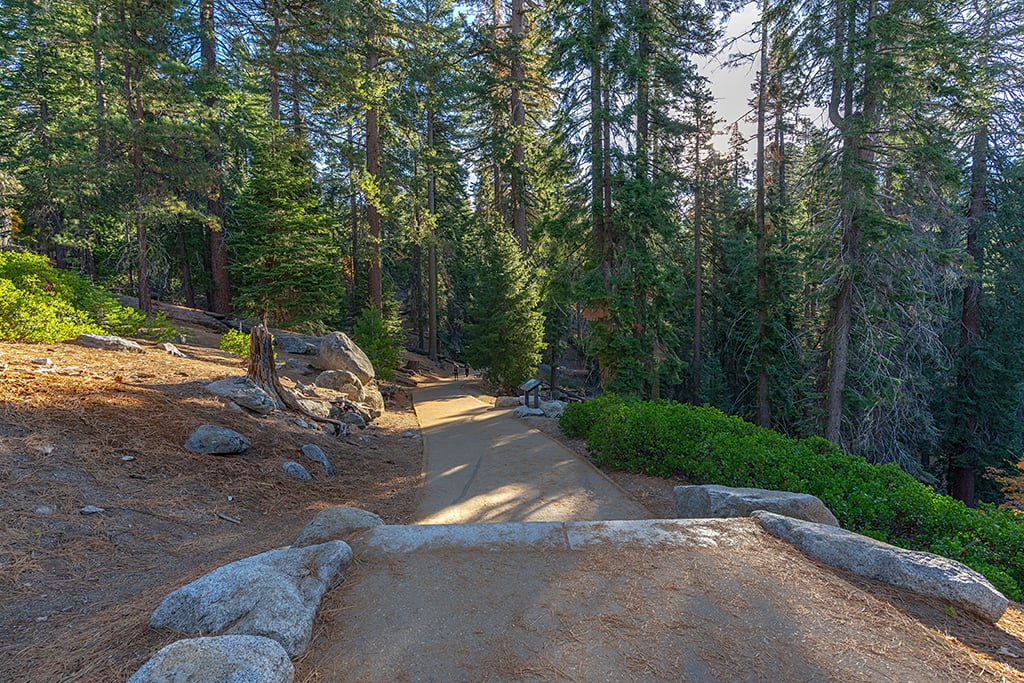
About 0.1 miles (0.16 meters) out, you’ll see a sign advising you to take it easy on this steep trail.

Do take your time and enjoy the hike. You’ll see chipmunks scampering across the trail and onto the rocks and into trees nearby. A deer might even cross your path.

Benches dot the trail – mainly for periodic resting during the trudge back up to your parked vehicle. The elevation loss hiking down is 212 feet (64.6 meters), which doesn’t seem like much until you start the return hike up.
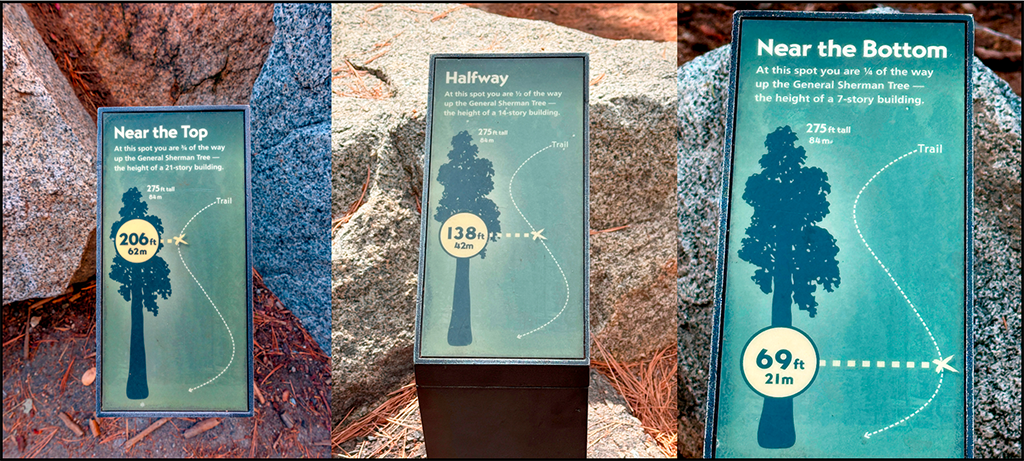
At three different spots along the trail are signs indicating your elevation with respect to the 275-foot-tall (84 meters) General Sherman Tree.
You will notice signs warning you to remain on the trail, and a thick wooden fence appears after the General Sherman Tree overlook. Note: that bricked area you walk upon when at this view area is this tree’s “footprint” - a ground-level representation of the 103-foot (31.4-meter) circumference of the tree’s base.
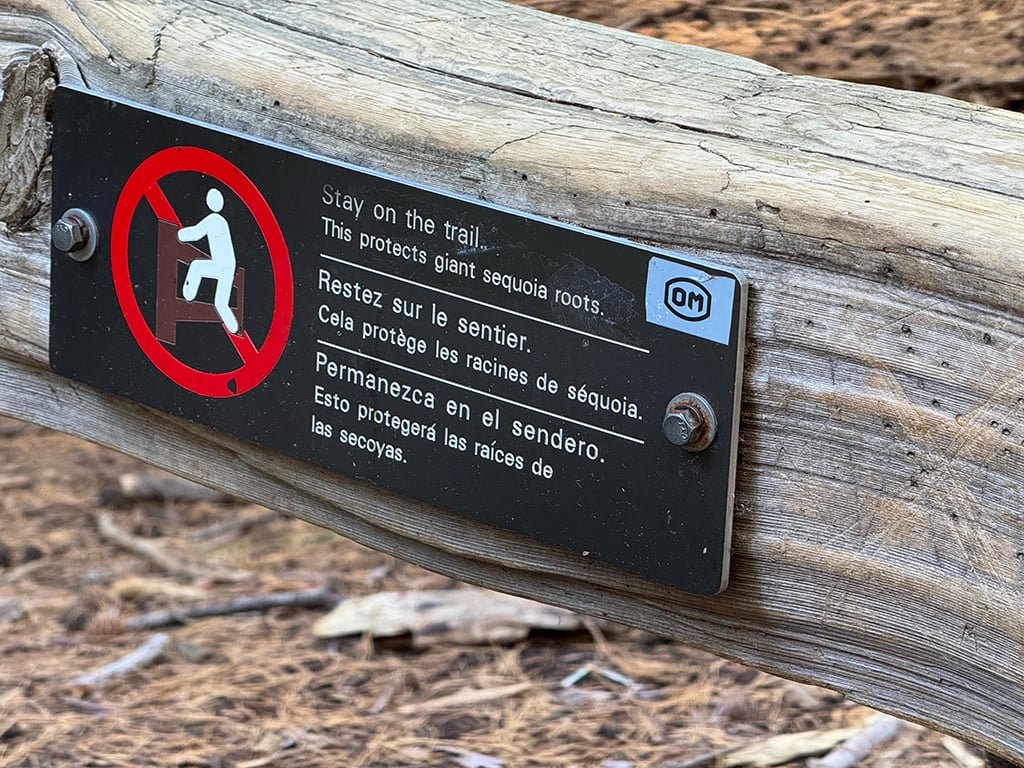
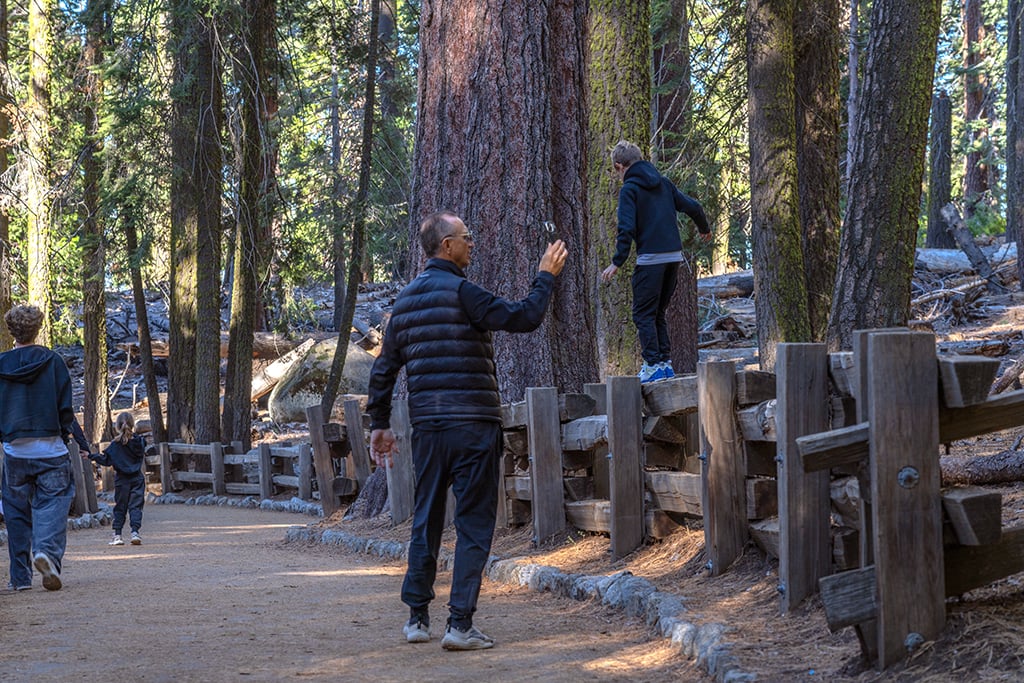
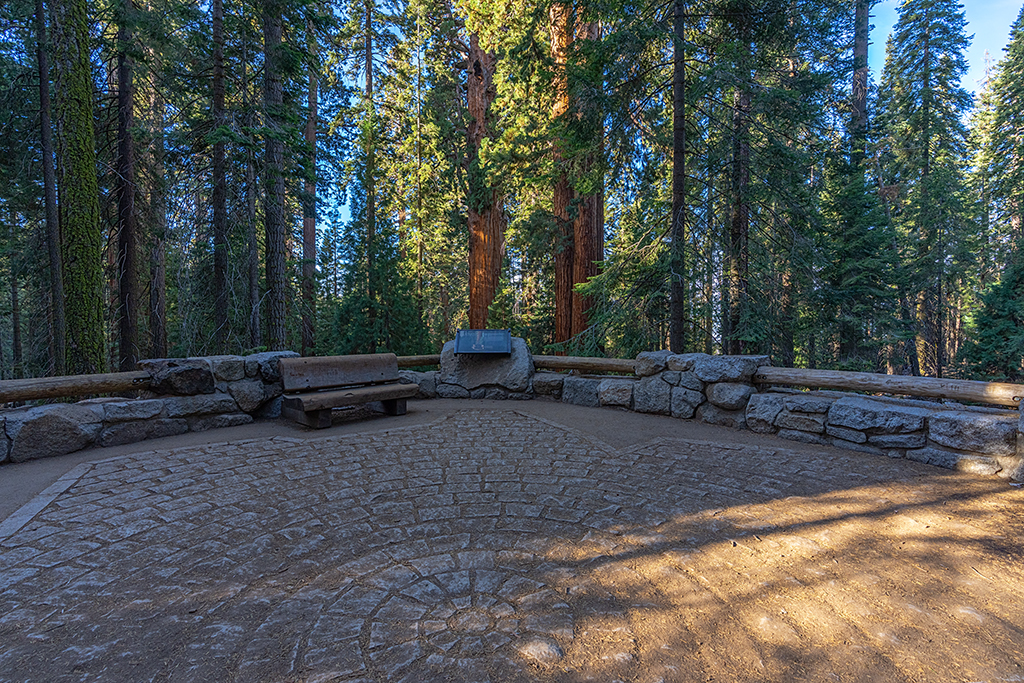
The signs warn visitors to remain on the trail and not hop the fence to get a closer view of the sequoias. Stay the course here. Once you arrive at your destination, there are a couple of giant sequoias which you can approach to feel their spongy fibrous bark and capture selfies.

Why is it so important to stay on the trail here, when you can walk right up to a giant sequoia tree in other areas within the park?
A giant sequoia tree’s roots are typically between three feet (1 meter) to six feet (1.8 meters) deep – a shallow depth for tree roots. These trees do not have a deep taproot like some conifers. Despite their shallow depth, however, sequoia roots can spread 100–150 feet (30.5-46 meters) in all directions, connecting with other sequoia roots to share nutrients.
The General Sherman Tree Trail is a high-impact area. It’s the most popular trail in the park. National Park Service visitor use data indicates an annual visitation number from the past four years of at least one million people visiting Sequoia National Park, with most, if not all, having hiked this trail. That many visitors walking off trail and onto the soil around the giant sequoias would mean soil erosion and possible damage to these shallow roots. So, it’s important to remain on the paved areas of this busy trail.
As you gaze up to the top of the General Sherman Tree, consider how fortunate it is that this sequoia monarch, the largest tree in the world by volume, still remains. Several years ago, a large wildfire created the very real threat of destruction to this and other sequoias within the Giant Forest.

According to Park Staff:
The General Sherman Tree was one of numerous giant sequoias wrapped in a protective aluminum material as the KNP Complex Fire, a lightning-caused wildfire, burned upslope toward Giant Forest in mid-September of 2021. While giant sequoias are fire-dependent and able to withstand the heat of moderate fires with their thick, insulating bark, more severe fires have damaged or killed many large sequoias in the past six years. Thus, additional precautions were taken to prevent fire from burning into tree bases and igniting vulnerable fire scars – signs of the many previous fires these trees have survived.
From the General Sherman Tree, the paved trail branches out to other trees and exhibits, such as the giant sequoia with a goose pen, where you can be a tree hugger and then stand within a "goose pen."
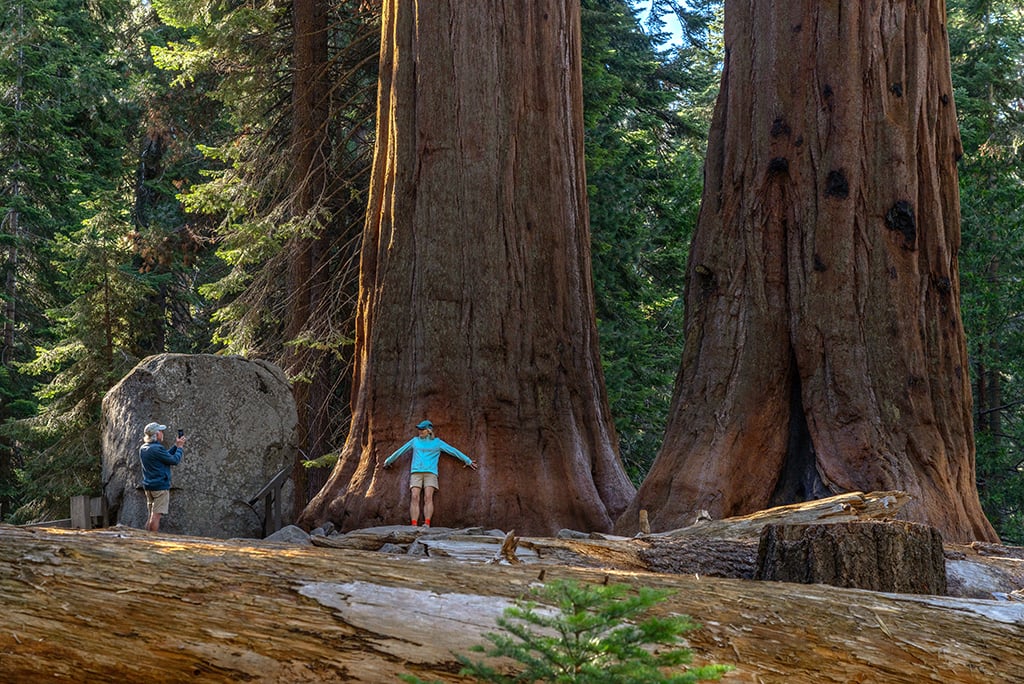

What is a “goose pen?”
A goose pen is a hollowed-out opening in a standing tree. These openings are formed when a tree is damaged by something like fire, which hollows out the central core of the trunk while the tree continues to live. Usually this opening is triangular-shaped, but not always. Settlers used these hollow openings to shelter their geese and other fowl, hence the name.
You can also stand next to and closely inspect a slab sawed from a sequoia stump, with a close-up look at the rings representing the annual growth of this 2,210-year-old tree and how periods of fire affect growth on a sequoia.

All along the paved trails here, you’ll see giant sequoias reaching toward the sky as well as other tall trees growing alongside the sequoias.

If you still have energy after hiking down and around the General Sherman Tree Trail, you can take the Congress Trail for a 2.7-mile (4.3-kilometer) side hike to explore the Giant Forest and its clusters of other giant sequoias. This trail will be described in a future Trails I’ve Hiked.
Note: Pets are not allowed on any trails in Sequoia and Kings Canyon National Parks. In developed areas, pets must be kept on a leash at all times.

Stories about:
Story Categories:
A copy of National Parks Traveler's financial statements may be obtained by sending a stamped, self-addressed envelope to: National Parks Traveler, P.O. Box 980452, Park City, Utah 84098. National Parks Traveler was formed in the state of Utah for the purpose of informing and educating about national parks and protected areas.
Residents of the following states may obtain a copy of our financial and additional information as stated below:
- Florida: A COPY OF THE OFFICIAL REGISTRATION AND FINANCIAL INFORMATION FOR NATIONAL PARKS TRAVELER, (REGISTRATION NO. CH 51659), MAY BE OBTAINED FROM THE DIVISION OF CONSUMER SERVICES BY CALLING 800-435-7352 OR VISITING THEIR WEBSITE. REGISTRATION DOES NOT IMPLY ENDORSEMENT, APPROVAL, OR RECOMMENDATION BY THE STATE.
- Georgia: A full and fair description of the programs and financial statement summary of National Parks Traveler is available upon request at the office and phone number indicated above.
- Maryland: Documents and information submitted under the Maryland Solicitations Act are also available, for the cost of postage and copies, from the Secretary of State, State House, Annapolis, MD 21401 (410-974-5534).
- North Carolina: Financial information about this organization and a copy of its license are available from the State Solicitation Licensing Branch at 888-830-4989 or 919-807-2214. The license is not an endorsement by the State.
- Pennsylvania: The official registration and financial information of National Parks Traveler may be obtained from the Pennsylvania Department of State by calling 800-732-0999. Registration does not imply endorsement.
- Virginia: Financial statements are available from the Virginia Department of Agriculture and Consumer Services, 102 Governor Street, Richmond, Virginia 23219.
- Washington: National Parks Traveler is registered with Washington State’s Charities Program as required by law and additional information is available by calling 800-332-4483 or visiting www.sos.wa.gov/charities, or on file at Charities Division, Office of the Secretary of State, State of Washington, Olympia, WA 98504.
INN Member

The easiest way to explore RV-friendly National Park campgrounds.

Here’s the definitive guide to National Park System campgrounds where RVers can park their rigs.
Our app is packed with RVing- specific details on more than 250 campgrounds in more than 70 national parks.
You’ll also find stories about RVing in the parks, tips helpful if you’ve just recently become an RVer, and useful planning suggestions.

