

When we think of Sequoia and Kings Canyon National Parks in California, we think of forests populated by huge and tall trees: giant sequoias, pines, white and red firs, and incense-cedars, to name a few. But between all these trees are large and small areas of lush, grassy wetlands with wildflowers and other plants and sometimes even ponds. These meadows – most of which may be hiked to and around - are great sites for spotting wildlife and providing water nourishment to the trees.
For instance, there’s an easy-to-moderate 1.4-mile (2.3-kilometer), partially-paved loop trail around Crescent Meadow, one of the largest meadows in Sequoia National Park.
The route to this loop trail is pretty cool in itself. The Crescent Meadow trailhead is located 2.6 miles (4.2 kilometers) from the Giant Forest Museum, at the end of the Moro Rock/Crescent Meadow Road. You can stop to hike up to the top of Moro Rock before continuing on, or you can bypass that parking area and head straight to Crescent Meadow.
Along the way, you will see such sights as the Buttress Tree, a fallen sequoia with twisted roots demonstrating the shallow root system of a sequoia tree. This tree’s base diameter is 20 feet (6.1 meters), its length is 272 feet (83 meters) and it’s estimated age prior to falling over in 1959 is 2,300 years.

You’ll also pass by a cluster of giant sequoias collectively known as the Parker Group, named for the eight members of the family of Captain James Parker. Captain Parker served in Troop B, 4th Cavalry, U. S. Army and was the Acting Superintendent of Sequoia National Park from 1893-1894.

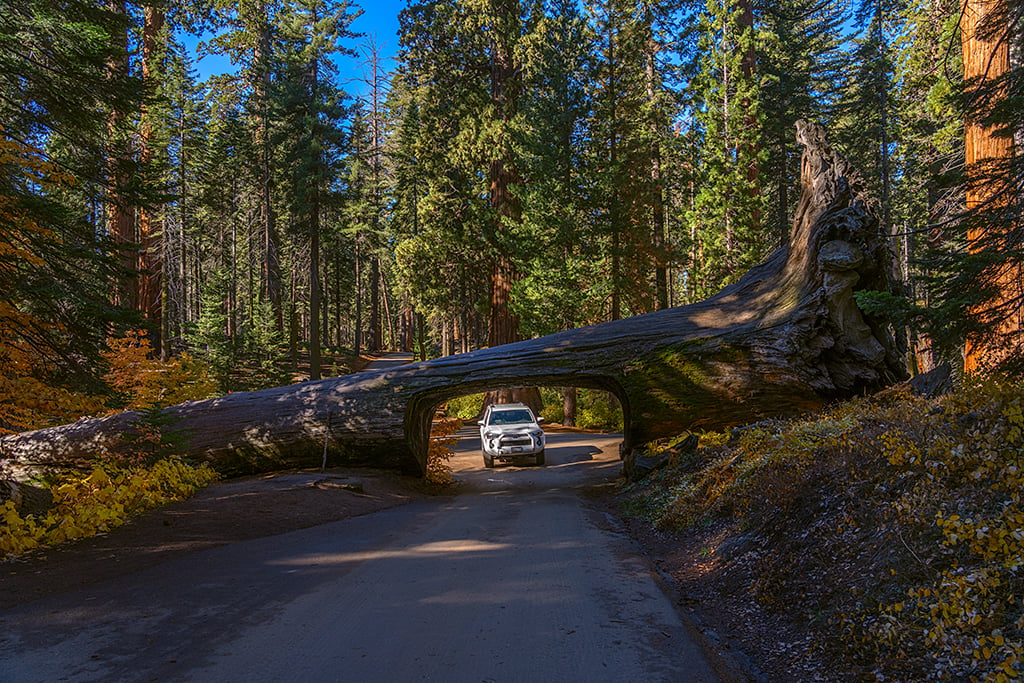
Prior to arriving at the parking area for Crescent Meadow Trail and picnic area, your vehicle will pass through the famous Tunnel Log, carved by the young men of the Civilian Conservation Corps (CCC) from a fallen sequoia tree. Just make sure your vehicle is not taller than eight feet (2.4 meters), otherwise, you’ll need to use a bypass near the log tunnel.
The trailhead for both Crescent Meadows and the much longer High Sierra Trail is next to the Crescent Meadow picnic parking area. The restrooms and some parking spaces are accessible. The trail is partially accessible and perhaps completely accessible, depending upon abilities, as there may be fallen trees and logs to step over to continue along the trail, which is only partially paved.


Because this is a loop trail, you can start at either direction. Hike this trail in the summer and the grassy meadow will be lush and green. During the fall, the grass will turned a straw-yellow color and the foliage will have morphed from green to bright yellow and gold.

While it looks like a path leads into the meadow itself, that course is prohibited to prevent further damage to the grassland.

I took the counterclockwise route around the meadow and walked along a paved trail for 0.3 miles (0.5 kilometers) before stepping onto packed dirt for the remainder of the hike. At that changeover, you also have the option of hiking an extra 0.5 miles (0.8 kilometers) to Tharp’s Log, an 1861 cabin built in a downed sequoia tree by Hale Tharp, the first non-Native American to live in the Giant Forest.
Bypassing the Tharp’s Log turnoff, I continued my hike around Crescent Meadow. The trail narrows here and I passed charred sequoias, downed sequoias, and thriving sequoias all along the way.


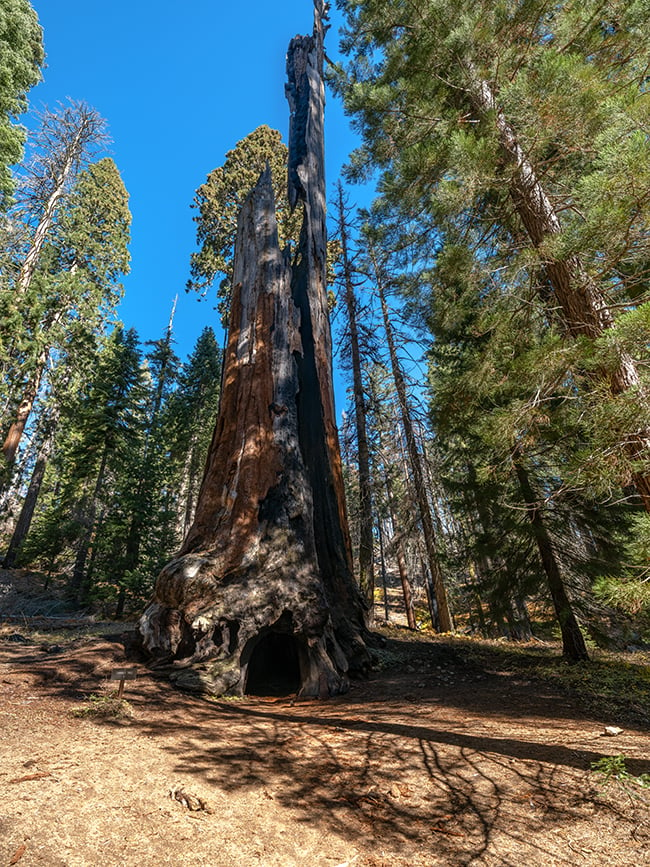
I did take the very short fork from the main path to view the Chimney Tree, a hollowed-out, blackened trunk of a giant sequoia destroyed by fire in 1914.
From there, I headed back to my starting point, surrounded by numerous giant sequoias, skirting past Huckleberry Meadow before returning to Crescent Meadow and the picnic area.

Be observant along your hike. You might spot (or hear) a woodpecker, notice all sorts of fungi growing on the sides of trees both standing and downed, and spy tiny chipmunks scampering around.


In summer, free shuttles run from Giant Forest Museum to the Crescent Meadow parking area. On weekdays, the road remains open, but the small parking area may be full. On weekends, the road closes to private vehicles and shuttles are the only way to reach Moro Rock and Crescent Meadow.
Note: Pets are not allowed on any trails in Sequoia and Kings Canyon National Parks. In developed areas, pets must be kept on a leash at all times.
Stories about:
Story Categories:
A copy of National Parks Traveler's financial statements may be obtained by sending a stamped, self-addressed envelope to: National Parks Traveler, P.O. Box 980452, Park City, Utah 84098. National Parks Traveler was formed in the state of Utah for the purpose of informing and educating about national parks and protected areas.
Residents of the following states may obtain a copy of our financial and additional information as stated below:
- Florida: A COPY OF THE OFFICIAL REGISTRATION AND FINANCIAL INFORMATION FOR NATIONAL PARKS TRAVELER, (REGISTRATION NO. CH 51659), MAY BE OBTAINED FROM THE DIVISION OF CONSUMER SERVICES BY CALLING 800-435-7352 OR VISITING THEIR WEBSITE. REGISTRATION DOES NOT IMPLY ENDORSEMENT, APPROVAL, OR RECOMMENDATION BY THE STATE.
- Georgia: A full and fair description of the programs and financial statement summary of National Parks Traveler is available upon request at the office and phone number indicated above.
- Maryland: Documents and information submitted under the Maryland Solicitations Act are also available, for the cost of postage and copies, from the Secretary of State, State House, Annapolis, MD 21401 (410-974-5534).
- North Carolina: Financial information about this organization and a copy of its license are available from the State Solicitation Licensing Branch at 888-830-4989 or 919-807-2214. The license is not an endorsement by the State.
- Pennsylvania: The official registration and financial information of National Parks Traveler may be obtained from the Pennsylvania Department of State by calling 800-732-0999. Registration does not imply endorsement.
- Virginia: Financial statements are available from the Virginia Department of Agriculture and Consumer Services, 102 Governor Street, Richmond, Virginia 23219.
- Washington: National Parks Traveler is registered with Washington State’s Charities Program as required by law and additional information is available by calling 800-332-4483 or visiting www.sos.wa.gov/charities, or on file at Charities Division, Office of the Secretary of State, State of Washington, Olympia, WA 98504.
INN Member

The easiest way to explore RV-friendly National Park campgrounds.

Here’s the definitive guide to National Park System campgrounds where RVers can park their rigs.
Our app is packed with RVing- specific details on more than 250 campgrounds in more than 70 national parks.
You’ll also find stories about RVing in the parks, tips helpful if you’ve just recently become an RVer, and useful planning suggestions.

