
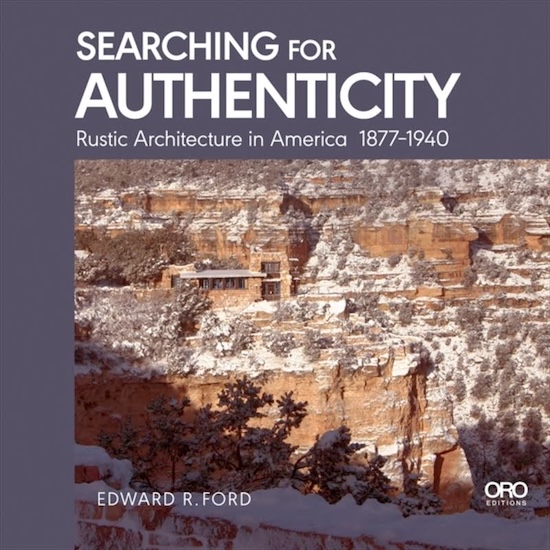
 In publishing, no less than investing, timing can be everything. Consider how this book, intended as an architectural history, has since morphed into an inspiration. But two months before its release, Grand Canyon Lodge burned at the North Rim of Grand Canyon National Park.
In keeping with Edward Ford’s subject, authenticity, no doubt it should be restored. Yes, the lodge was built on the edge of wilderness, but what a grand introduction to the park it made.
Emeritus Professor of Architecture at the University of Virginia, Ford claims to have put ten years into this book. I would venture it was far more. Books this definitive are extremely rare, appearing but once or twice in a generation and leaving their mark on the literature for years to come.
Certainly, there is nothing else like it for the national parks—some wonderful coffee table books and guides, perhaps, but not a volume this painstakingly detailed. Some 40 buildings in all are represented, literally recreated from their foundations up. Scores of full-color drawings, renderings, and paintings illustrate the most famous lodges and cabins from the inside out.
Ford details another important idea: he traces their design origins to the Adirondack Mountains of New York State, where the wealthy discovered the romance of rusticity, surrounded by an abundance of wood and stone. Switzerland was important, but not the only inspiration for grand lodges made of logs and finished wood.
Not that Professor Ford isn’t critical of some of those buildings, and at times all of them, considering the history of the national parks. He obviously has read widely in the so-called New Western History, anchored by Stanford University’s Richard White and Wisconsin’s William Cronon. Oh, those rapacious capitalists, they write! Nor can Professor Ford resist their drumbeat. “The unneeded railroads needed markets,” he agrees. “Tourism beckoned, and the desire for an escape from civilization, however short, provided a much-needed market. Those suffering from the malaise of over-civilization had to be seduced by mass marketing, and rustic architecture was the tool. The architecture was as much the product of capitalist greed as of existential angst.”
Of course, that is what Ford is supposed to say if he wants to sell his book to academics. Fortunately, they are not his audience. His research stands far above that litany of copycats who find nothing to like in the historical record but guilt. Even when he succumbs, his subject steers him back to honesty. What if the American people wanted to be “seduced?” What if the mass marketing, so-called, inspired Easterners to take action for the protection of the American West? Certainly, the railroads were instrumental in establishing the parks. Read the congressional debates. Congress wasn’t funding parks, let alone contributing to their infrastructure. The bulk of that job fell to the railroads.
Did they make money? Not much, at least, not on the parks. Nor did they make much carrying passengers period, still Amtrak’s lament today. The Big Money was in mail, express, and freight, and yes, for that the railroads were needed precisely when they were built. As of 1850 and 1859 respectively, California and Oregon were states. No way was Abraham Lincoln going to leave them isolated just because the Confederacy thought transcontinental railroads were “early.”
The point remains. Before the automobile, it was virtually impossible to make a profit from a season 90 days long. The rest of the year the lodges and cabins stood empty, and, should the season be cut short by snow or forest fires (generally both), its end came far sooner than that.
And what is wrong with making money? Adjusted for inflation, the railroads spent hundreds of millions of dollars on the national parks. Just imagine what it would cost to build Old Faithful Inn today: $100 million? $200 million? True, the railroads could have lodged visitors in tents. The National Park Service, too, could have put up shelters. The railroads instead set the example for both visitors and managers, fashioning buildings that still take our breath away with their elegance and design.
Pride explains that level of commitment, not greed. This book in fact drips with pride. To be sure, what have the airlines left us? Or the trucking industry? These days, corporations will name a stadium—after themselves, that is—and turn everything public into a giant billboard. But build a national park from scratch? Only the railroads have ever done that.
Consequently, whenever Ford strays from pride, the truth gets him back on track (no pun intended). He’s right; our forebears could have done better, but so can that be said of us. Meanwhile, “the architectural results,” Ford concludes, “remain significant. It is an architecture that, then and now, evokes a variety of reactions—nostalgia, awe, romantic allusion, and empathy with nature itself. Like any architectural style it contains some kitsch, some masterpieces, and a great deal that falls between. There is just below the surface the troubling consequences of the processes that produced it, that the architecture was achieved at a cultural, economic, and ecological price. But at its best it produced something truly original, something true to the best impulses of those who wished to experience it, if not necessarily always to those who built it.”

Professor Ford is to be congratulated for making a complex subject sing. The national parks may not be the perfect venue for assessing what the country needs, but they sure beat harping on failure, now to forget what these buildings did—and do—for the American spirit. I will take all of it, including the kitsch. And I do hope that Grand Canyon Lodge is the last building we lose—and that we live to see it rise again.
Alfred Runte is at home writing about railroads and the national parks, having researched the topic for 50 years. His books include Trains of Discovery: Railroads and the Legacy of Our National Parks, and National Parks: The American Experience, each in a fifth edition.
Story Categories:
A copy of National Parks Traveler's financial statements may be obtained by sending a stamped, self-addressed envelope to: National Parks Traveler, P.O. Box 980452, Park City, Utah 84098. National Parks Traveler was formed in the state of Utah for the purpose of informing and educating about national parks and protected areas.
Residents of the following states may obtain a copy of our financial and additional information as stated below:
- Florida: A COPY OF THE OFFICIAL REGISTRATION AND FINANCIAL INFORMATION FOR NATIONAL PARKS TRAVELER, (REGISTRATION NO. CH 51659), MAY BE OBTAINED FROM THE DIVISION OF CONSUMER SERVICES BY CALLING 800-435-7352 OR VISITING THEIR WEBSITE. REGISTRATION DOES NOT IMPLY ENDORSEMENT, APPROVAL, OR RECOMMENDATION BY THE STATE.
- Georgia: A full and fair description of the programs and financial statement summary of National Parks Traveler is available upon request at the office and phone number indicated above.
- Maryland: Documents and information submitted under the Maryland Solicitations Act are also available, for the cost of postage and copies, from the Secretary of State, State House, Annapolis, MD 21401 (410-974-5534).
- North Carolina: Financial information about this organization and a copy of its license are available from the State Solicitation Licensing Branch at 888-830-4989 or 919-807-2214. The license is not an endorsement by the State.
- Pennsylvania: The official registration and financial information of National Parks Traveler may be obtained from the Pennsylvania Department of State by calling 800-732-0999. Registration does not imply endorsement.
- Virginia: Financial statements are available from the Virginia Department of Agriculture and Consumer Services, 102 Governor Street, Richmond, Virginia 23219.
- Washington: National Parks Traveler is registered with Washington State’s Charities Program as required by law and additional information is available by calling 800-332-4483 or visiting www.sos.wa.gov/charities, or on file at Charities Division, Office of the Secretary of State, State of Washington, Olympia, WA 98504.
INN Member

The easiest way to explore RV-friendly National Park campgrounds.

Here’s the definitive guide to National Park System campgrounds where RVers can park their rigs.
Our app is packed with RVing- specific details on more than 250 campgrounds in more than 70 national parks.
You’ll also find stories about RVing in the parks, tips helpful if you’ve just recently become an RVer, and useful planning suggestions.

