
For more than a half-century the Endangered Species Act (ESA) has worked to protect species from teetering towards extinction. Here's a brief overview of how it works.
The act was overwhelmingly passed by Congress in 1973 and signed into law by President Richard Nixon. Bison and bald eagles, California condors, the black-footed ferret, and numerous other species all are alive today thanks to the protection and ministrations of the ESA. The law has kept them in the world, and helped them rebound in number and genetic diversity.
ESA measures over the past half century have ranged from the mundane — think fences to keep out invasive predators — to sophisticated tech, such as infecting mosquitoes with a bacteria to disrupt their reproduction.
This groundbreaking piece of legislation prevents the killing, harm, and destruction of listed animals and habitat, promotes survival and recovery operations, and has been credited with preventing the extinction of more than 99 percent of species listed over the last half-century.
Significantly, the act holds the federal government to account, ensuring that its actions do not jeopardize listed species or damage critical habitat. In a landmark 1978 case, the U.S. Supreme Court affirmed the mission of the ESA, stating that the “plain intent” of the statute was “to halt and reverse the trend toward species extinction, whatever the cost." And it has certainly done that and then some.
The U.S. Fish and Wildlife Service (USFWS) oversees land-based plant and animal species as well as freshwater species, while the National Marine Fisheries Service (NMFS) oversees marine species. Each of those agencies internally can nominate species to be considered for listing under the ESA, and outside groups also can petition those agencies to list species.
A species is listed under one of two categories, endangered species or threatened species, depending on its status and the degree of threat it faces. An “endangered species” is one that is in danger of extinction throughout all or a significant portion of its range. A “threatened species” is one that is likely to become endangered in the foreseeable future throughout all or a significant portion of its range
The law provides for adding species to and removing them from the list of threatened and endangered species, and for having those two agencies preparing and implementing plans for their recovery. It also calls for interagency cooperation to avoid "take" [e.g., killing] of listed species and for issuing permits for otherwise prohibited activities; provides for cooperation with States, including authorization of financial assistance.
A species is added to the list when it is determined to be an endangered or threatened species because of any of the following factors:
- the present or threatened destruction, modification, or curtailment of its habitat or range;
- overutilization for commercial, recreational, scientific, or educational purposes;
- disease or predation;
- the inadequacy of existing regulatory mechanisms;
- other natural or manmade factors affecting its survival.
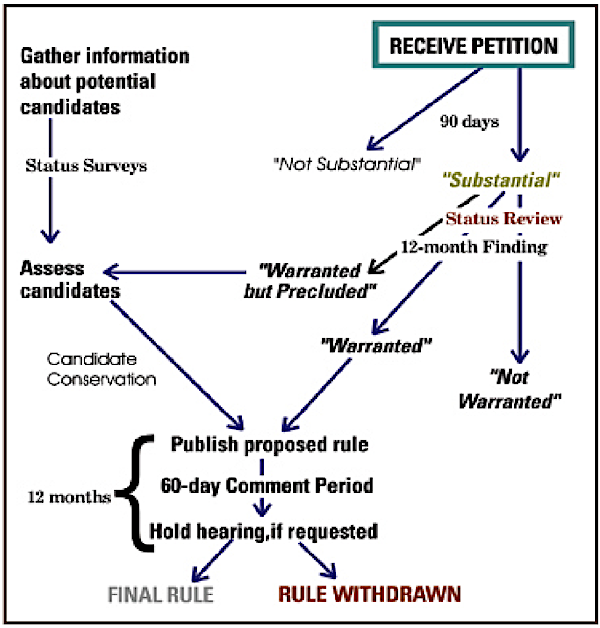
In theory, the process for evaluating whether a species should be listed as "endangered" or "threatened" should move relatively swiftly, but it seldom does. When petitioned to list a species, the USFWS or NMFS are required to make a finding within 90 days of receiving a petition (to the extent practicable) as to whether there is “substantial information” indicating that the petitioned action may be warranted. If this preliminary finding is positive, the agencies conduct a status review. Within one year of receipt of the petition, they must make a finding whether listing is warranted.
Story Categories:
A copy of National Parks Traveler's financial statements may be obtained by sending a stamped, self-addressed envelope to: National Parks Traveler, P.O. Box 980452, Park City, Utah 84098. National Parks Traveler was formed in the state of Utah for the purpose of informing and educating about national parks and protected areas.
Residents of the following states may obtain a copy of our financial and additional information as stated below:
- Florida: A COPY OF THE OFFICIAL REGISTRATION AND FINANCIAL INFORMATION FOR NATIONAL PARKS TRAVELER, (REGISTRATION NO. CH 51659), MAY BE OBTAINED FROM THE DIVISION OF CONSUMER SERVICES BY CALLING 800-435-7352 OR VISITING THEIR WEBSITE. REGISTRATION DOES NOT IMPLY ENDORSEMENT, APPROVAL, OR RECOMMENDATION BY THE STATE.
- Georgia: A full and fair description of the programs and financial statement summary of National Parks Traveler is available upon request at the office and phone number indicated above.
- Maryland: Documents and information submitted under the Maryland Solicitations Act are also available, for the cost of postage and copies, from the Secretary of State, State House, Annapolis, MD 21401 (410-974-5534).
- North Carolina: Financial information about this organization and a copy of its license are available from the State Solicitation Licensing Branch at 888-830-4989 or 919-807-2214. The license is not an endorsement by the State.
- Pennsylvania: The official registration and financial information of National Parks Traveler may be obtained from the Pennsylvania Department of State by calling 800-732-0999. Registration does not imply endorsement.
- Virginia: Financial statements are available from the Virginia Department of Agriculture and Consumer Services, 102 Governor Street, Richmond, Virginia 23219.
- Washington: National Parks Traveler is registered with Washington State’s Charities Program as required by law and additional information is available by calling 800-332-4483 or visiting www.sos.wa.gov/charities, or on file at Charities Division, Office of the Secretary of State, State of Washington, Olympia, WA 98504.
INN Member

The easiest way to explore RV-friendly National Park campgrounds.

Here’s the definitive guide to National Park System campgrounds where RVers can park their rigs.
Our app is packed with RVing- specific details on more than 250 campgrounds in more than 70 national parks.
You’ll also find stories about RVing in the parks, tips helpful if you’ve just recently become an RVer, and useful planning suggestions.

