
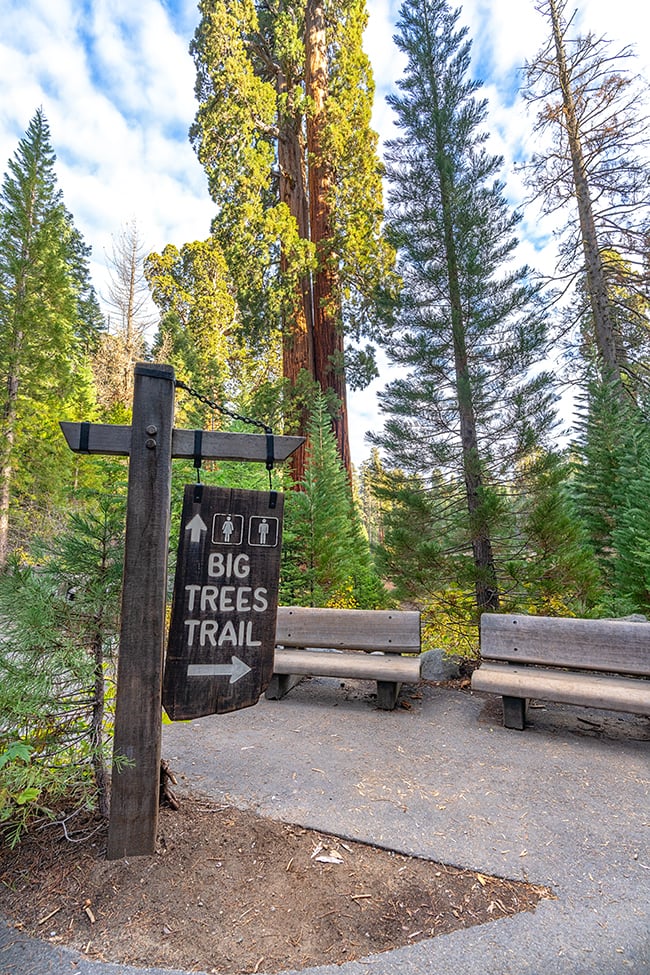
If you read last week’s Trails I’ve Hiked article about hiking up Moro Rock, you’ll know that was one of the more popular trails visitors hike when traveling to Sequoia National Park in California. Add to that another popular hike: the Big Trees Trail. This easy 0.7-mile (1.12-kilometer) loop trail is an accessible trail - a mostly-flat mix of pavement and boardwalk encircling Round Meadow with an accessible parking lot right next to the trail. There are also trailside panels stationed all around the meadow which are must-read features describing various details about the lives and traits of giant sequoias as well as their environment.
For those not parking in the accessible lot, you can park in the lot across the road from the Giant Forest Museum and take either the trail from the parking area, or the trail next to the museum to walk 0.3 miles (0.5 kilometers) to the main trail encircling the meadow.

Depending upon when you walk Big Trees Trail, Round Meadow will look different. During the summer, the grass will be lush, green, and perhaps dotted with wildflowers. You might even see ponded water. You’ll probably also see crowds.

During the fall, the flowers are gone and the green lushness is replaced by flattened straw-gold grass in addition to colorful fall foliage mixed in among the sequoias. Fall also brings fewer crowds.

As mentioned previously, informational signs populate the trail at particular points of interest. You’ll learn why some giant sequoias have flared bases while others have straight bases. You’ll also learn why the sequoias are growing around the meadow and not within it.

Benches dot the trail, providing a quiet respite for listening to birdsong, drinking a little water, and maybe enjoying a snack before continuing your walk. Just don’t give any of your food to the opportunistic chipmunks flitting around your feet.


During early morning and later in the evening, you might spot marmots and black bears. You’ll definitely hear birds, including woodpeckers and jays. You might also hear the high-pitched scolding of a nearby chipmunk hiding in the branches (probably annoyed you refused to feed it some of your snack).
At trail’s end is an area of bricked ground representing the “footprint” of “Ed by Ned,” the nickname given in 1906 to two trees who grew so close together that their bases joined. The combined bases measure 34 feet long by 25 feet wide (10.3 meters by 7.6 meters).


Big Trees Trail is a great introduction to giant sequoias and their ecology. You’ll enjoy a nice stretch of the legs with the opportunity for plenty of photo ops, and learn a little bit about these big trees, impressing family, friends, and coworkers with your knowledge.
To park in the accessible lot during spring, summer, and fall, you will need an accessible parking placard. In winter, this small parking area is open to all vehicles. The vault toilets, however, are closed in winter.
Note: Pets are not allowed on any trails in Sequoia and Kings Canyon National Parks. In developed areas, pets must be kept on a leash at all times.
Stories about:
Story Categories:
A copy of National Parks Traveler's financial statements may be obtained by sending a stamped, self-addressed envelope to: National Parks Traveler, P.O. Box 980452, Park City, Utah 84098. National Parks Traveler was formed in the state of Utah for the purpose of informing and educating about national parks and protected areas.
Residents of the following states may obtain a copy of our financial and additional information as stated below:
- Florida: A COPY OF THE OFFICIAL REGISTRATION AND FINANCIAL INFORMATION FOR NATIONAL PARKS TRAVELER, (REGISTRATION NO. CH 51659), MAY BE OBTAINED FROM THE DIVISION OF CONSUMER SERVICES BY CALLING 800-435-7352 OR VISITING THEIR WEBSITE. REGISTRATION DOES NOT IMPLY ENDORSEMENT, APPROVAL, OR RECOMMENDATION BY THE STATE.
- Georgia: A full and fair description of the programs and financial statement summary of National Parks Traveler is available upon request at the office and phone number indicated above.
- Maryland: Documents and information submitted under the Maryland Solicitations Act are also available, for the cost of postage and copies, from the Secretary of State, State House, Annapolis, MD 21401 (410-974-5534).
- North Carolina: Financial information about this organization and a copy of its license are available from the State Solicitation Licensing Branch at 888-830-4989 or 919-807-2214. The license is not an endorsement by the State.
- Pennsylvania: The official registration and financial information of National Parks Traveler may be obtained from the Pennsylvania Department of State by calling 800-732-0999. Registration does not imply endorsement.
- Virginia: Financial statements are available from the Virginia Department of Agriculture and Consumer Services, 102 Governor Street, Richmond, Virginia 23219.
- Washington: National Parks Traveler is registered with Washington State’s Charities Program as required by law and additional information is available by calling 800-332-4483 or visiting www.sos.wa.gov/charities, or on file at Charities Division, Office of the Secretary of State, State of Washington, Olympia, WA 98504.
INN Member

The easiest way to explore RV-friendly National Park campgrounds.

Here’s the definitive guide to National Park System campgrounds where RVers can park their rigs.
Our app is packed with RVing- specific details on more than 250 campgrounds in more than 70 national parks.
You’ll also find stories about RVing in the parks, tips helpful if you’ve just recently become an RVer, and useful planning suggestions.

