

When you think of a national seashore, the east and southern coasts probably come to mind, with Cape Hatteras, Cape Cod, Gulf Islands, and Padre Island national seashores, to name a few. But the West Coast is home to a national seashore, too. Point Reyes National Seashore in California combines sandy beaches, rugged headlands, grasslands, and forests into a little over 71,000 acres (28,733 hectares) of landscape.
It’s not the largest national seashore, nor is it the oldest. But Point Reyes is a special place, protecting over 50 species of animals listed by the state or federal government as threatened, rare, or endangered. It’s also the windiest place on the Pacific Coast and the second foggiest place on the North American continent. There's some unique geology involved too, as the San Andreas Fault separates the Point Reyes peninsula from the California mainland.
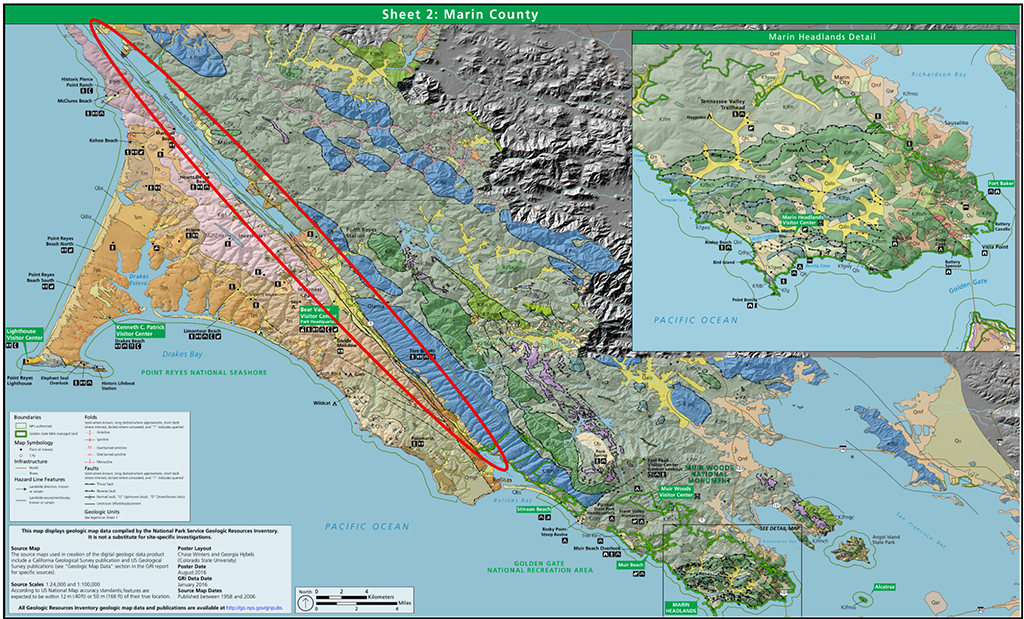
According to Park Staff:
The narrow Tomales Bay and the narrow Olema Valley, along which Shoreline Highway (Highway 1) travels, overlie the San Andreas Fault and were formed as a result of tectonic forces.
While swimming is not the most popular activity at this national seashore (the Pacific is plenty cold, with strong rip currents), there are many other activities to keep you busy while learning about Point Reyes and its ecosystems (forest, ocean, intertidal and subtidal zones, grasslands and prairies, lakes, rivers, marshes and wetlands, and sand dunes).
Feel like stretching your legs? You can hike over 150 miles (240 kilometers) of trails along the coastline and forested ridges of this park. Ranging in difficulty levels from easy to strenuous, with distances between a half mile (0.8 kilometers) to over 10 miles (16 kilometers) roundtrip, you can spend an hour to all day exploring one or more of these trails.

The out-and-back Tomales Point Trail is very popular, with distances ranging from two miles (3.2 kilometers) roundtrip to Windy Gap, to 9.5 miles (15.3 kilometers) roundtrip all the way out to Tomales Point. This trail is a prime wildlife viewing spot where you’re likely to see tule elk, while offering stunning views of Tomales Bay and the Pacific Ocean.
Skylight Cave is another popular destination.
According to Park Staff:
Even though Skylight Cave is only 2.5 miles (3.8 km) from the closest parking lot at Limantour Beach, it is usually only safe to visit at tides that measure -1 (negative one) foot or lower. There is also one section of the route that will require descending and later climbing back up a nearly vertical eight-foot-tall wall of rock.
Enjoy horseback riding? Even if you don’t own a horse or didn’t bring your horse with you, you can take a guided trail ride with the park’s concessioner Five Brooks Ranch.
If you’d rather explore the park’s coastline and wildlife from a watery perspective, you can bring your own kayak or rent one at a nearby outfitter. Tomales Bay is the largest unspoiled coastal embayment on the coast of California and is a very popular location for paddling.
Speaking of water, if you feel like practicing your rod and reel skills, you can fish the lakes, ponds, and lagoons as well as from a sandy beach or a boat on the ocean. Salmon, steelhead, surfperch, striped bass, sole, halibut, and flounder are a few of the species you might reel in for your dinner. Note: You need a valid California fishing license for this outdoor activity if you are 16 years or older.
If casting a line is not your thing and you’d rather explore the outcrops while beachcombing, then tidepooling is a great way to view some of the Pacific Ocean marine life. You might spy one or more colorful ochre sea stars, giant green anemones, California mussels, gooseneck barnacles, periwinkles, mossy chitons, sea lettuce, or purple sea urchins.
Looking to spot larger wildlife at Point Reyes? There are 40 species of land mammals and a dozen species of marine mammals living within or migrating through the waters of this national seashore. Here, you might see tule elk grazing in the grasslands, gray whales out on the ocean, harbor seals on the rocks or in the water, and northern elephant seals basking or birthing on the protected beaches.

If you enjoy birding, bird photography, or simply watching the birds around you, remember to pack your binoculars or telephoto lens, because almost 490 avian species have been observed in the park and on adjacent waters, ranging from ducks, to raptors, to woodpeckers, to warblers.
Point Reyes National Seashore offers historic places and landscapes to visit. For instance, you can drive, then hike to the Point Reyes Lighthouse, which served as a bright beacon of safety guiding mariners away and around the dangerous Point Reyes Headlands for 105 years prior to being retired from service and later transferred by the Coast Guard to the National Park Service.
If you are on your way to the lighthouse, you can stop first at the KPH Maritime Radio Receiving Station and the Cypress Tree Tunnel. Guglielmo Marconi sited and commissioned the building of a wireless telegraphy transmitting station west of Bolinas and a receiving station in Marshall on Tomales Bay in 1913–14. Today, the radio equipment, ship-to-shore Morse communications, and teletype—some of it dating to the World War II-era—remains intact, has been restored and made functional, and is used to broadcast on numerous frequencies, including KPH.
On you way to the receiving station, you’ll drive the road through the Monterey cypress “tree tunnel,” the trees of which were planted around 1930.
If you love horses, there’s the historic Morgan Horse Ranch located within the national seashore’s boundaries. This place served as breeding and training facility for National Park Service patrol horses. Today, there are five year-round resident Morgan horses at the ranch—Honcho, Mira, Knight Hawk, Gentry, and Moon – which are used as the Mounted Enforcement Team within the park and at special events.
Can’t decide what to do first? Join a ranger-guided tour or enroll in one of the Field Institute classes offered by the Point Reyes National Seashore Association. Among the Institute’s courses, you can take a guided hike, identify mushrooms, and capture creative compositions of the national seashore with your smartphone.
Looking for a place to lay your head at night while visiting Point Reyes? The Limantour Lodge within the park offers dorm-style accommodations in addition to four private rooms. If the lodge is full, you can find a variety of overnight options offered by the Marin Convention & Visitors Bureau, the Point Reyes Lodging Association, and the West Marin Chamber of Commerce.
If pitching a tent or parking your RV directly beneath the stars is more to your liking, then the park offers five backcountry hike-in and boat-in campgrounds, and there are off-site nearby campgrounds in Marin County and along the Sonoma County coastline where you can camp near your vehicle or in an RV.

Traveler’s Choice For: Tidepooling, wildlife, birding, history, photography
Stories about:
Story Categories:
A copy of National Parks Traveler's financial statements may be obtained by sending a stamped, self-addressed envelope to: National Parks Traveler, P.O. Box 980452, Park City, Utah 84098. National Parks Traveler was formed in the state of Utah for the purpose of informing and educating about national parks and protected areas.
Residents of the following states may obtain a copy of our financial and additional information as stated below:
- Florida: A COPY OF THE OFFICIAL REGISTRATION AND FINANCIAL INFORMATION FOR NATIONAL PARKS TRAVELER, (REGISTRATION NO. CH 51659), MAY BE OBTAINED FROM THE DIVISION OF CONSUMER SERVICES BY CALLING 800-435-7352 OR VISITING THEIR WEBSITE. REGISTRATION DOES NOT IMPLY ENDORSEMENT, APPROVAL, OR RECOMMENDATION BY THE STATE.
- Georgia: A full and fair description of the programs and financial statement summary of National Parks Traveler is available upon request at the office and phone number indicated above.
- Maryland: Documents and information submitted under the Maryland Solicitations Act are also available, for the cost of postage and copies, from the Secretary of State, State House, Annapolis, MD 21401 (410-974-5534).
- North Carolina: Financial information about this organization and a copy of its license are available from the State Solicitation Licensing Branch at 888-830-4989 or 919-807-2214. The license is not an endorsement by the State.
- Pennsylvania: The official registration and financial information of National Parks Traveler may be obtained from the Pennsylvania Department of State by calling 800-732-0999. Registration does not imply endorsement.
- Virginia: Financial statements are available from the Virginia Department of Agriculture and Consumer Services, 102 Governor Street, Richmond, Virginia 23219.
- Washington: National Parks Traveler is registered with Washington State’s Charities Program as required by law and additional information is available by calling 800-332-4483 or visiting www.sos.wa.gov/charities, or on file at Charities Division, Office of the Secretary of State, State of Washington, Olympia, WA 98504.
INN Member

The easiest way to explore RV-friendly National Park campgrounds.

Here’s the definitive guide to National Park System campgrounds where RVers can park their rigs.
Our app is packed with RVing- specific details on more than 250 campgrounds in more than 70 national parks.
You’ll also find stories about RVing in the parks, tips helpful if you’ve just recently become an RVer, and useful planning suggestions.

