

Editor's note: Some facilities might not be accessible if the government is still shut down.
During 55 years of residing in the Southeast we have visited most of the National Park Service’s numerous Civil War sites. Each proved enjoyable and educational, with the added bonus that few were crowded.
Of the Civil War sites we visited, our favorite is Appomattox Court House National Historical Park, which we found particularly impressive. Our initial visit was so enjoyable we decided to return and spend most of a day re-exploring the park.
Appomattox annually welcomes a little more than 90,000 visitors, compared to three-quarters of a million that visit Gettysburg National Military Park each year.
The village of Appomattox Court House (during that period “court house” often referred to a village that served as a county seat as well as to a building) is where, on April 9, 1865, Union General Ulysses S. Grant accepted the surrender of Confederate General Robert E. Lee and the Army of Northern Virginia. While skirmishes between Union and Confederate soldiers would continue, the surrender at Appomattox signaled the end of the Civil War was near as Rebel forces had become worn down by the Union’s superior manpower and resources.
The surrender followed a week of heavy fighting as Lee’s troops retreated west from Petersburg. The withdrawal included a major battle at Sayler’s Creek, during which nearly a quarter of Lee’s troops were taken prisoner. Lee continued toward Lynchburg for needed supplies with the intention of joining up with Confederate forces in North Carolina.
Union officers learned of Lee’s plan and were waiting at Appomattox Station (a railroad depot 3 miles west of Appomattox Court House) upon the arrival of Confederate troops. An April 8 battle, combined with the addition of Union reinforcements, blocked Lee’s troops from escape and caused the Confederate general to surrender the following day.
Today’s national historical park offers visitors a chance to explore a portion of the village that once had a population of about 140. Many structures existing at the time of the surrender are no longer standing, but several have been reconstructed and upward of a dozen have been restored.
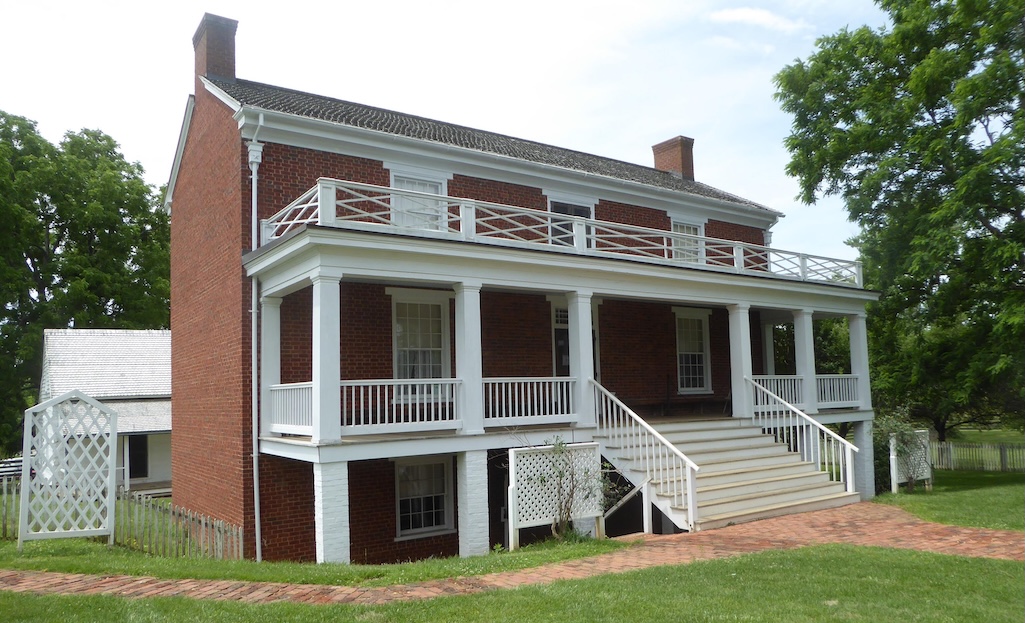
Two of the village’s most important buildings, the McLean House where the formal surrender took place, and Appomattox Courthouse that was closed for Palm Sunday the day of the surrender, are reconstructed. The former, originally constructed in 1848, was dismantled in 1893 and reconstructed on the original site and dedicated in 1950. The home’s outside kitchen and slave quarters have also been reconstructed. Appomattox Courthouse was originally constructed in 1848 and burned in 1892. The building was reconstructed in 1963-64 and now serves as the National Park Service visitor center.
Restored buildings include Clover Hill Tavern, which was built in 1819 for travelers on the Lynchburg-Richmond Stage Road that served as a major trade route. The tavern now serves as home for an exhibit of reproduction presses used to print parole passes for thousands of Confederate soldiers who were able to return home after surrendering their weapons with a promise not to take up arms again.

The tavern’s outside kitchen has also been restored and now serves as the park bookstore. Other restored buildings include a small law office (1851), general store (1852), county jail (1870), and several private homes from the 1800s. A short distance west of Appomattox Court House, a small Confederate cemetery established in 1866 holds the remains of 1 Federal and 18 Confederate soldiers. The former’s body was discovered after all Federal casualties were thought to have been removed. A vehicle parking area is beside the cemetery.
The visitor center in the Appomattox Courthouse offers exhibits, a video program, and an excellent park brochure that includes a map of the grounds plus snippets of relevant history. Each site within the park is a relatively short walk from the courthouse. The availability of ranger talks depends on the season and day of the week. Inquire at the visitor center. A bookstore is in the restored Clover Hill Tavern kitchen with public restrooms next door in the restored former slave quarters. A picnic area with tables is near the parking lot. Planning to stay most of the day, we took a picnic lunch.
The historical park is in south-central Virginia, 92 miles west of Richmond and 18 miles east of Lynchburg. Restaurants, lodging, groceries, and stores are three miles southwest of the park in the town Appomattox.
David and Kay Scott live in Valdosta, GA, and are authors of “Exploring the Oregon Trail: America’s Historic Road Trip” (Globe Pequot). Visit them at blog.valdosta.edu/dlscott.
Stories about:
Story Categories:
A copy of National Parks Traveler's financial statements may be obtained by sending a stamped, self-addressed envelope to: National Parks Traveler, P.O. Box 980452, Park City, Utah 84098. National Parks Traveler was formed in the state of Utah for the purpose of informing and educating about national parks and protected areas.
Residents of the following states may obtain a copy of our financial and additional information as stated below:
- Florida: A COPY OF THE OFFICIAL REGISTRATION AND FINANCIAL INFORMATION FOR NATIONAL PARKS TRAVELER, (REGISTRATION NO. CH 51659), MAY BE OBTAINED FROM THE DIVISION OF CONSUMER SERVICES BY CALLING 800-435-7352 OR VISITING THEIR WEBSITE. REGISTRATION DOES NOT IMPLY ENDORSEMENT, APPROVAL, OR RECOMMENDATION BY THE STATE.
- Georgia: A full and fair description of the programs and financial statement summary of National Parks Traveler is available upon request at the office and phone number indicated above.
- Maryland: Documents and information submitted under the Maryland Solicitations Act are also available, for the cost of postage and copies, from the Secretary of State, State House, Annapolis, MD 21401 (410-974-5534).
- North Carolina: Financial information about this organization and a copy of its license are available from the State Solicitation Licensing Branch at 888-830-4989 or 919-807-2214. The license is not an endorsement by the State.
- Pennsylvania: The official registration and financial information of National Parks Traveler may be obtained from the Pennsylvania Department of State by calling 800-732-0999. Registration does not imply endorsement.
- Virginia: Financial statements are available from the Virginia Department of Agriculture and Consumer Services, 102 Governor Street, Richmond, Virginia 23219.
- Washington: National Parks Traveler is registered with Washington State’s Charities Program as required by law and additional information is available by calling 800-332-4483 or visiting www.sos.wa.gov/charities, or on file at Charities Division, Office of the Secretary of State, State of Washington, Olympia, WA 98504.


National parks and their natural resources belong to you. The National Parks Traveler works to ensure you know how these essential places are being cared for.
Sign Up For Our Weekly Newsletter
Unsubscribe at any time.
INN Member

The easiest way to explore RV-friendly National Park campgrounds.

Here’s the definitive guide to National Park System campgrounds where RVers can park their rigs.
Our app is packed with RVing- specific details on more than 250 campgrounds in more than 70 national parks.
You’ll also find stories about RVing in the parks, tips helpful if you’ve just recently become an RVer, and useful planning suggestions.

