
Editor's note: This updates with testimony from the hearing.
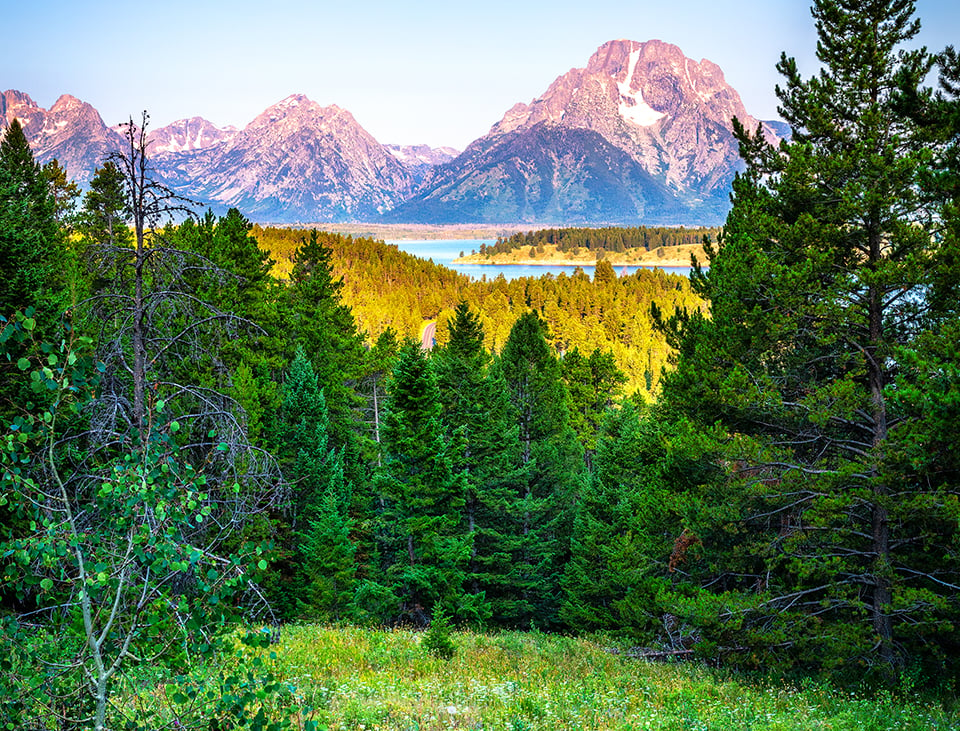
Convening under sunny skies with Grand Teton National Park's iconic mountain range as a backdrop, members of the House Natural Resources Committee on Friday began discussions into how deferred maintenance across the National Park System and other federal lands could best be tackled and what improvements could be made to "modernize" those lands.
The 90-minute hearing on the plaza in front of the Jenny Lake Visitor Center gathered testimony ranging from charging international visitors more to visit America's national parks and crafting a measure that would also cover annual cyclical maintenance in the park system to how the Trump administration's personnel cuts to the National Park Service have adversely impacted park operations and whether the National Environmental Policy Act and Endangered Species Act need to be streamlined to allow for more efficient projects on public lands.
The Great American Outdoors Act (GAOA) that has been funneling billions of dollars to the National Park Service and other federal lands management agencies for five years expires at the end of the month. While that funding — $5.32 billion to the Park Service alone — has paid for numerous projects to tackle backlogged maintenance across the park system, the agency still faces some $23 billion in deferred projects, according to committee documents.
"While all five agencies that receive GAOA funding have seen increases in deferred maintenance, no agency’s backlog has reached the scale of NPS’s," a staff factsheet (attached below) noted. "After receiving four full years of GAOA funding totaling $5.32 billion, NPS’s backlog rose from $12.7 billion at the end of FY 2019 to $22.98 billion at the end of FY 2024. This raises serious concerns about the reliability of NPS’s data and the agency’s transparency in calculating its deferred maintenance numbers."
Against that statement, testimony provided both by members of the committee as well as the witnesses attested to the value of the GAOA and the impact it's had in just five years.
"As we traveled into the park this morning, we saw some of the benefits of (the GAOA) with the entries, the roadway. We did a quick walk down by Jenny Lake and saw some of the beautiful landscape architecture that's been done," said committee Chairman Bruce Westerman, R-Arkansas. "I commented to the Park Service (personnel) that if you look back in the history of our country, if you look at the buildings in Washington, D.C., our the people who came before us didn't halfway do things. They did it right, and what was done here was done right. And the American public expects that, and they deserve that.
"And if we're going to interface with these beautiful federal lands, I don't think we have any option but to do it the best that it can be done," he added.
Grand Teton Superintendent Chip Jenkins, one of five witnesses called to testify on GAOA, told the committee that the park's infrastructure owes much to the funds provided through the act.
"The reason Grand Teton National Park is a national park is literally looming over us right now, the iconic landscape combined with unparalleled wildlife," said Jenkins. "The park welcomes close to 4 million visitors annually and this year, we're on track to have our second busiest year on record. GAOA has been critical in helping us to support these visitors by enabling us to address maintenance repairs long overdue."
As much as the progress made through GAOA funding was applauded by committee members and the witnesses — which also included Leslie Mattson, president of the Grand Teton National Park Foundation; Julie Calder, chair of the Jackson Hole Travel and Tourism Board; Taylor Phillips, founder and owner of Jackson Hole EcoTour Adventures, and; Kristen Brengel, senior vice president of governmental affairs for the National Parks Conservation Association — there were calls for improving on the initial legislation.
"I think that it's time for a new iteration of the GAOA, focusing on things such as visitor experience and making sure that we have the access that we need, so that we could improve the access and the experience for all people who visit these absolutely beautiful places," said Rep. Harriet Hageman, R-Wyoming.
While others agreed on the need for investments in the "guest experience" for park visitors, overshadowing that were the needs of more funding and Park Service personnel.
"Despite these successes at Grand Teton, our deferred maintenance backlog (~$343 million) and infrastructure needs remain significant across the entire NPS," said Jenkins. "Our infrastructure is not always adequate for current visitation, let alone for increasing visitation."
One area of the park greatly in need of an overhaul to improve the visitor experience, said the superintendent, is the Colter Bay area. When it was built in the 1950s and early '60s it was viewed as a masterpiece for park visitors. But since then increasing visitation has created traffic issues and lodging and other visitor facilities are weary and lacking in places.
While the Park Service in 2012 took initial steps to envision how the area might be transformed to meet 21st century visitation, that process was aborted, only to be resumed in 2023 and then put on the back burner yet again due to other park needs.
"The infrastructure is suffering from over 75 years of wear and tear, and it's not meeting our visitor needs, nor matching the beauty that is Colter Bay," said Jenkins.
But dollars alone can't help the Park Service maintain its more than 5,500 miles of paved roads, 17,000 miles of trails, and thousands of buildings, campgrounds, bridges, and utility systems.
Brengel told the committee that "we won't be able to continue this success without the planners, engineers, compliance officers, budget experts, landscape architects, maintenance staff, carpenters and so many more Park Service staff who make it possible for the Great American Outdoors Act to fund the work on the ground."
"The Park Service has lost 24 percent of its permanent workforce since January. We are losing experts and people who know our parks inside and out," she continued. "The (Park Service's) Denver Service Center is the centralized planning, design and construction management office for the Park Service. They are critical to executing GAOA projects. They are they are down more than 20 percent of their staff right now since last October. This tremendous loss of staff does not bode well for the next construction season or for the new list of projects under this law. The current hiring freeze gives us no hope these positions could be filled anytime soon."
Rep. Doug LaMalfa, R-California, reminded those in attendance that the federal budget deficit is counted in trillions of dollars and that costs need to be controlled across the board. Stating that 35 percent of GAOA funds in fiscal 2023 went to planning and compliance work, LaMalfa said there need to be "reforms to NEPA and the Endangered Species Act" because of the costly impediments they erect when projects are proposed on federal lands.
"There's less money going towards the projects" because of regulatory compliance requirements, the Republican said.
Jenkins said the Park Service was interested in "exploring options in order to be able to improve our efficiency and effectiveness for doing the planning and compliance functions. Having said that, it's also, I think, important to understand, as we've heard from testimony here, is that we're in the forever business.
"We are here to be able to care for the natural and historic resources, and we want to make sure that we have highly efficient processes that allow us to make decisions quickly, and to ensure that we both spend our funding wisely and also are making decisions that are protecting the resources that we are in charge," he said.
What didn't draw much attention during the hearing but which was highlighted in the factsheet committee staff provided was the need to enact oversight reforms to "ensure transparency, increase accountability, and wisely steward taxpayer dollars."
That last point was driven by reports from both the Government Accountability Office and the Interior Department's Office of Inspector General that found troubling issues with how the Park Service both reported deferred maintenance and tracking work to address it.
The OIG report issued in 2023 said the Park Service can't successfully manage its multi-billion-dollar maintenance backlog "due to inaccurate and unreliable data" that has made it impossible to accurately state the cost of the backlog.
"Even though its identified number of assets remained relatively constant, the NPS’ deferred maintenance cost estimate has continuously increased from $11.3 billion in FY 2016 to $20 billion in FY 2021. The NPS has cited multiple factors that contributed to this increase, including application of a blanket 35 percent markup to its FY 2021 deferred maintenance estimate, which increased its estimate by an additional $3.7 billion that year for a total of $23.7 billion," the report said.
In response, then-Park Service Director Chuck Sams told OIG that the report "fails to acknowledge improvements NPS has made to obtain more complete, timely, and consistent estimates of facility condition that can be used in identifying needs and targeting investments. Though the NPS had identified and acknowledged many of the issues and data management challenges discussed in the OIG's draft report, and appreciates the OIG team's efforts and professionalism, the lack of consideration for the implementation of planned improvements during the engagement period has largely resulted in a set of conclusions and recommendations that are no longer valid nor relevant in the context described within the report."
Renewing the GAOA would be a boon for the parks and local economies. According to the Interior Department, the GAOA has funded projects that "have repaired or replaced more than 3,800 assets, including recreation facilities, water and utility systems, Bureau of Indian Education-funded schools, hunting and fishing infrastructure, historic structures and other critical infrastructure. Each year, Interior’s GAOA-funded projects support an average of 17,000 jobs and contribute about $1.9 billion to the national economy, benefiting gateway and local communities by supporting outdoor recreation and tourism."
Legislation to replace the GAOA was introduced into the U.S. Senate earlier this year. Sponsored by Angus King, an independent from Maine, and Steve Daines, a Montana Republican, the America the Beautiful Act would reauthorize the National Parks and Public Land Legacy Restoration Fund (LRF) for eight years and increase its funding to $2 billion a year.
Maintenance Millstone
The ever-growing maintenance backlog across the National Park System has been an albatross around the agency's neck. The Park Service in years past has pointed out that the park system "has extensive preventive and recurring maintenance needs resulting from aging infrastructure and heavy use which often exceeds the capacity for which it was designed. Funding related to maintenance is insufficient to keep pace with needs, which means maintenance is delayed adding to the backlog and resulting in compounding costs."
Back in 2018 writers and editors for the National Parks Traveler produced a long-running series of stories chronicling problems created by the backlog, which at the time was estimated to amount to nearly $12 million in needed repairs. That series found trails long closed to hikers, leak-prone water pipelines critical to human safety, bridges in dire need of repairs if not replacement, weary sewer systems that can't handle demands, historic structures at risk of serious deterioration, and lodges that unfit for habitation.
In 2020, Congress passed and President Donald Trump signed into law the Great American Outdoors Act, which queued up $6.5 billion to be doled out in $1.3 billion annual payments for five years for the Park Service to use in tackling backlogged maintenance work. That annual GAOA funding has been spread across the park system to address needed projects.
But two years later, in May 2022, the Park Service said the cost of deferred maintenance across the National Park System had reached $21.8 billion. That figure was contained in a press release about efforts to reduce the backlog. To do so, the agency said, it has "implemented a new and improved assessment process that provides a more complete and timely understanding of facility conditions and the cost to repair them."
The agency claimed that the new system "is more consistent with modern-day industry standards, and it streamlines how the NPS evaluates and collects information providing a more complete understanding of deficiencies and repair needs nationwide."
The Inspector General does not agree with that statement. In its 66-page report the IG said the Park Service's accounting problems did not just arise, but have been ongoing "for at least two decades," or back to the Clinton administration. In some cases maintenance costs were underestimated, in others they were over-estimated, according to the IG's findings.

Story Categories:
A copy of National Parks Traveler's financial statements may be obtained by sending a stamped, self-addressed envelope to: National Parks Traveler, P.O. Box 980452, Park City, Utah 84098. National Parks Traveler was formed in the state of Utah for the purpose of informing and educating about national parks and protected areas.
Residents of the following states may obtain a copy of our financial and additional information as stated below:
- Florida: A COPY OF THE OFFICIAL REGISTRATION AND FINANCIAL INFORMATION FOR NATIONAL PARKS TRAVELER, (REGISTRATION NO. CH 51659), MAY BE OBTAINED FROM THE DIVISION OF CONSUMER SERVICES BY CALLING 800-435-7352 OR VISITING THEIR WEBSITE. REGISTRATION DOES NOT IMPLY ENDORSEMENT, APPROVAL, OR RECOMMENDATION BY THE STATE.
- Georgia: A full and fair description of the programs and financial statement summary of National Parks Traveler is available upon request at the office and phone number indicated above.
- Maryland: Documents and information submitted under the Maryland Solicitations Act are also available, for the cost of postage and copies, from the Secretary of State, State House, Annapolis, MD 21401 (410-974-5534).
- North Carolina: Financial information about this organization and a copy of its license are available from the State Solicitation Licensing Branch at 888-830-4989 or 919-807-2214. The license is not an endorsement by the State.
- Pennsylvania: The official registration and financial information of National Parks Traveler may be obtained from the Pennsylvania Department of State by calling 800-732-0999. Registration does not imply endorsement.
- Virginia: Financial statements are available from the Virginia Department of Agriculture and Consumer Services, 102 Governor Street, Richmond, Virginia 23219.
- Washington: National Parks Traveler is registered with Washington State’s Charities Program as required by law and additional information is available by calling 800-332-4483 or visiting www.sos.wa.gov/charities, or on file at Charities Division, Office of the Secretary of State, State of Washington, Olympia, WA 98504.


National parks and their natural resources belong to you. The National Parks Traveler works to ensure you know how these essential places are being cared for.
Sign Up For Our Weekly Newsletter
Unsubscribe at any time.
INN Member

The easiest way to explore RV-friendly National Park campgrounds.

Here’s the definitive guide to National Park System campgrounds where RVers can park their rigs.
Our app is packed with RVing- specific details on more than 250 campgrounds in more than 70 national parks.
You’ll also find stories about RVing in the parks, tips helpful if you’ve just recently become an RVer, and useful planning suggestions.

