
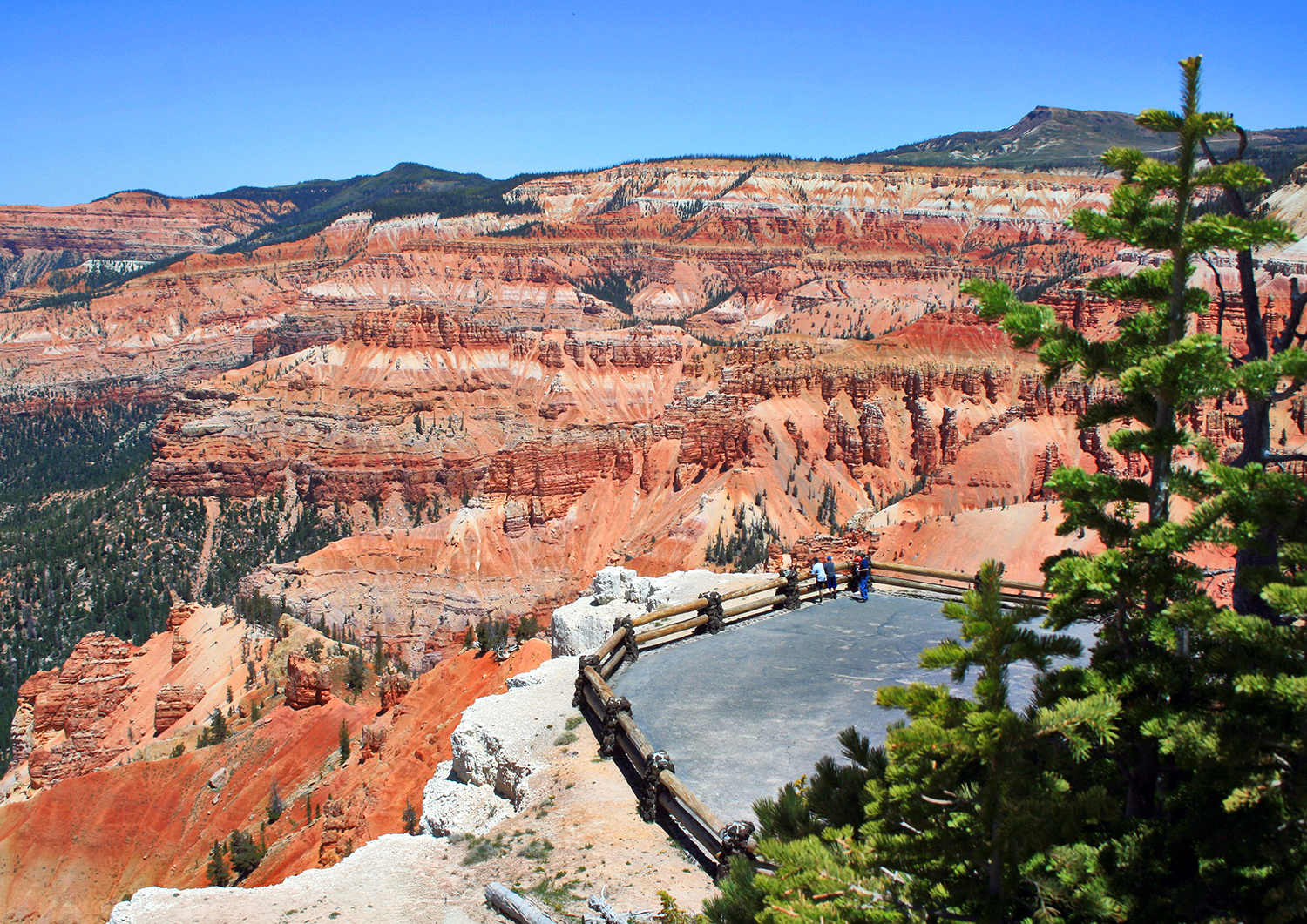
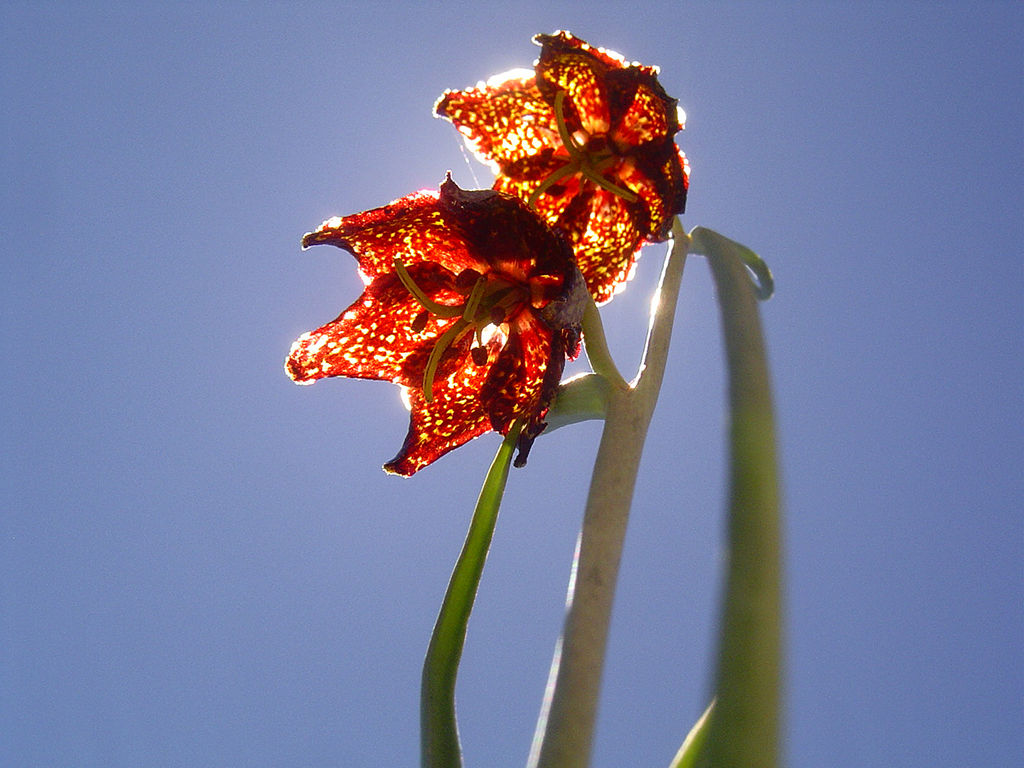
While visiting Bryce Canyon National Park in Utah, it’s worth spending a day traveling to the smaller Cedar Breaks National Monument an hour’s drive southwest of the larger national park. You may wonder why bother, since it probably looks like a miniature version of Bryce Canyon. True, the colorful geology is similar, since both are at the top (Cedar Breaks is higher at 10,000 feet/3,048 meters) of the Grand Staircase - an immense sequence of sedimentary rock layers stretching south for 100 miles (161 kilometers) from Bryce Canyon National Park through Zion National Park and down into the Grand Canyon. However, Cedar Breaks offers a smaller, more intimate view of these colorful rock formations with steeper, deeper cliffs than Bryce Canyon. The trails here are easy-to-moderate, all affording great views and the opportunity to spot any of over 100 species of birds and almost 400 species of plants, including a plethora of wildflowers.
And, Cedar Breaks National Monument is less crowded – a bonus during a time when national parks continue to grow in popularity. It’s truly a gem of a park at which to spend a day or two, since you can pitch your tent or park your RV directly beneath the starry sky at this park’s Point Supreme Campground.

Speaking of starry skies, you can enjoy the wide-open night sky to gaze at sparkling stars and the Milky Way from any of the park’s view areas year-round. The little to no light pollution makes this national monument prime night sky-viewing territory. The park offers ranger-led night sky tours every Friday and Saturday through mid-October for 2025. If you want to practice your night sky photography, Cedar Breaks National Monument is the perfect venue.
There’s history here, too. The Southern Paiute called this land home long before the first settlers arrived. They called Cedar Breaks umapwich, or “the place where the rocks are sliding down all the time.”
According to Park Staff:
Settlers later called it “Cedar Breaks,” by misidentifying the area’s juniper trees as cedars. “Breaks,” is a geographic term to describe a sharp/abrupt change or “break” in topography. As western tourism began to explode in the early 1900s, the lands which today comprise national park were included within the boundaries of Sevier National Forest in 1909, and subsequently incorporated into the Dixie National Forest. Management responsibility transferred from the Department of Agriculture to the Department of Interior and the National Park Service on August 22, 1933, when President Franklin D. Roosevelt proclaimed Cedar Breaks a national monument.
The Civilian Conservation Corps (CCC or Cs) even made an appearance at Cedar Breaks in 1934, “acting as traffic directors, assisting in getting many of the stalled cars up to the Breaks and serving a barbecue to some 3,000 people” at the official dedication ceremony and celebration for the new national monument.
According to Park Staff:
From 1934 to 1938, the Cs completed a wide range of projects in the monument. They created roads, trails, rail guards, and parking, established a campground for visitors, complete with picnic tables, fireplaces, restrooms, sewer line, and a disposal system.
One of their proudest accomplishments at Cedar Breaks was in 1935, when “[w]ith a force of 50 enrollees and 2 foremen” they built a boundary fence around the monument, consisting of 4,932 posts that were “cut and hauled [from] Zion National Park” in just under two months. These fences eventually helped to keep livestock out of certain areas of the monument and may attribute to today’s remarkably lush wildflowers within Cedar Breaks’ boundary.
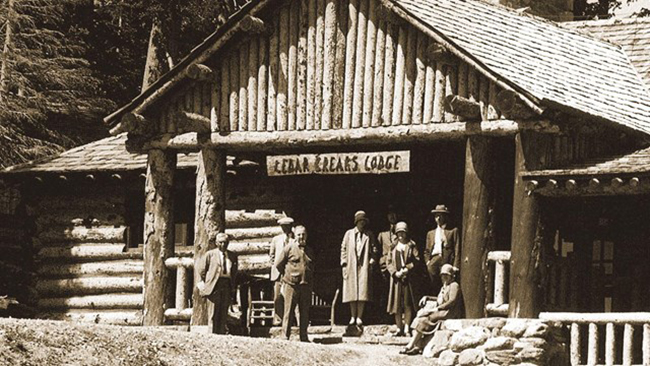
While there may not be any in-park lodging now, park history tells us there once was. Back in 1924, the Cedar Breaks Lodge - built by the Utah Parks Company - served as a stop on the Grand Circle Tour, along with Zion, Bryce Canyon, and the North Rim of the Grand Canyon. The lodge, designed by architect Gilbert Stanley Underwood (known for the Ahwahnee Hotel at Yosemite and the Grand Canyon Lodge on the canyon’s North Rim) offered amenities like seating for 120 people in the dining room and a large stone fireplace around which to sit and relax. Donated to the National Park Service, the lodge was later demolished due to high maintenance costs. Now, the nearest brick-and-mortar lodging to Cedar Breaks is in Cedar City, approximately 21 miles (34 kilometers) northwest of the park.
Whether you are on your way to, or heading from, Bryce Canyon National Park, or you simply want to check out landscapes in nearby areas, spending all or part of a day at Cedar Breaks National Monument is worth the drive there.
Traveler’s Choice For: Geology, less crowds, easy hikes, photography, night skies
Stories about:
Story Categories:
A copy of National Parks Traveler's financial statements may be obtained by sending a stamped, self-addressed envelope to: National Parks Traveler, P.O. Box 980452, Park City, Utah 84098. National Parks Traveler was formed in the state of Utah for the purpose of informing and educating about national parks and protected areas.
Residents of the following states may obtain a copy of our financial and additional information as stated below:
- Florida: A COPY OF THE OFFICIAL REGISTRATION AND FINANCIAL INFORMATION FOR NATIONAL PARKS TRAVELER, (REGISTRATION NO. CH 51659), MAY BE OBTAINED FROM THE DIVISION OF CONSUMER SERVICES BY CALLING 800-435-7352 OR VISITING THEIR WEBSITE. REGISTRATION DOES NOT IMPLY ENDORSEMENT, APPROVAL, OR RECOMMENDATION BY THE STATE.
- Georgia: A full and fair description of the programs and financial statement summary of National Parks Traveler is available upon request at the office and phone number indicated above.
- Maryland: Documents and information submitted under the Maryland Solicitations Act are also available, for the cost of postage and copies, from the Secretary of State, State House, Annapolis, MD 21401 (410-974-5534).
- North Carolina: Financial information about this organization and a copy of its license are available from the State Solicitation Licensing Branch at 888-830-4989 or 919-807-2214. The license is not an endorsement by the State.
- Pennsylvania: The official registration and financial information of National Parks Traveler may be obtained from the Pennsylvania Department of State by calling 800-732-0999. Registration does not imply endorsement.
- Virginia: Financial statements are available from the Virginia Department of Agriculture and Consumer Services, 102 Governor Street, Richmond, Virginia 23219.
- Washington: National Parks Traveler is registered with Washington State’s Charities Program as required by law and additional information is available by calling 800-332-4483 or visiting www.sos.wa.gov/charities, or on file at Charities Division, Office of the Secretary of State, State of Washington, Olympia, WA 98504.
INN Member

The easiest way to explore RV-friendly National Park campgrounds.

Here’s the definitive guide to National Park System campgrounds where RVers can park their rigs.
Our app is packed with RVing- specific details on more than 250 campgrounds in more than 70 national parks.
You’ll also find stories about RVing in the parks, tips helpful if you’ve just recently become an RVer, and useful planning suggestions.

