
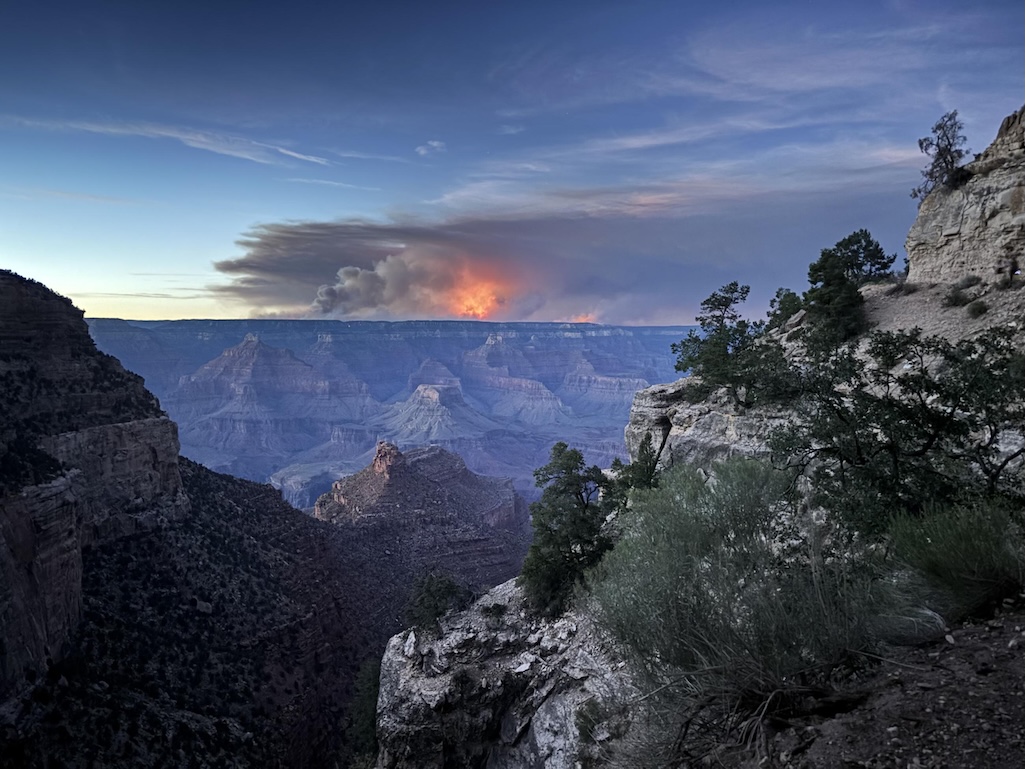
The Dragon Bravo fire and other blazes burning across the West recently prompted concerns over air quality at some national parks, and experts say it's a problem that's likely to keep getting worse.
“We’ve been seeing a lot of large increases in many different metrics related to wildfires," Gaige Kerr, a senior research scientist and professor in the department of environmental and occupational health at George Washington University, said in a recent phone call.
That includes more "smoke days," more land burned and more health risks for humans.
Why Wildfire Smoke Is So Dangerous
Smoke from wildfires can carry tiny particulate pollution known as PM 2.5. These particles are packed with toxic substances from burning materials and can penetrate all the way into human lungs and bloodstream.
They can also be moved hundreds of miles by winds. In recent days, for example, smoke from wildfires including the Dragon Bravo fire on the Grand Canyon's North Rim in Arizona prompted warnings over poor air quality at Utah's Canyonlands National Park, Capitol Reef National Park, and Glen Canyon National Recreation Area.
The Dragon Bravo fire is one of at least six large wildfires burning across Arizona, according to the National Interagency Fire Center. Four large blazes are burning in Colorado and two in Utah.
People with certain pre-existing conditions such as asthma, chronic obstructive pulmonary disease, or chronic bronchitis are especially at risk of health complications from air pollution. The things that draw people to parks can also increase exposure.
“When we’re in national parks we’re often moving around, we’re active, and when we’re active we’re breathing more," Kerr said.
How National Parks Monitor Air Quality
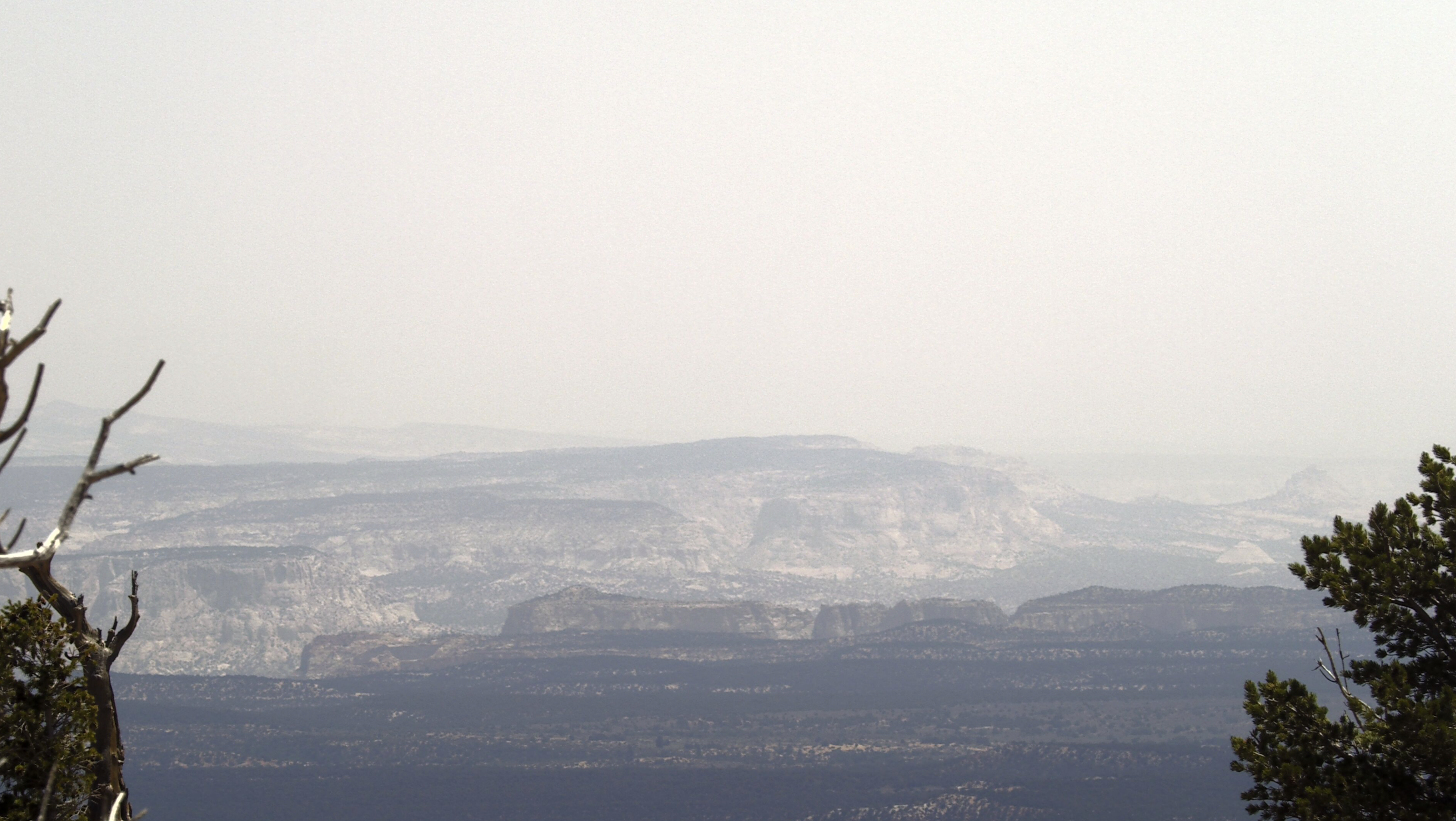
The National Park Service has an Air Resources Division that participates in several national, multiagency air monitoring networks, according to a group of staff members who answered questions via email Friday. Seventy sites have in-park monitors that feed data to one or more of these networks. In addition, more than 230 parks have nearby or regional monitoring equipment and 22 have live webcams that measure air quality. The photo above is a screenshot from one of those webcams Friday in Utah's Bryce Canyon National Park.
"Some pollutants like ozone and particulate matter (PM2.5) are measured continuously and provide live data on air quality in parks," the email said. "Other pollutants are monitored with filters and water samples that go through lab analysis."
The data is used for a number of things including understanding air quality across the country, informing research and park management decisions, and helping park management respond to real-time air quality threats like wildfire smoke.
"The NPS operates the most complete, most respected rural air quality monitoring network in the world," Bob Krumenaker, who was chief of natural resources for two different Park Service regions during his four-decade career with the agency, told the Traveler in May.
Air quality monitoring on federal lands, including national parks, is required under the Clean Air Act. The Environmental Protection Agency under President Donald Trump has made moves to roll back many of the Clean Air Act's provisions. It's not yet clear how that might affect the Park Service.
The email from staff Friday indicated that some employees in the office chose to take the deferred resignation or early retirement options that aimed to cut staff after Trump took office earlier this year.
"The Air Resources Division continues to manage its programs and operate within its budget," the email noted.
Why Wildfire Smoke Is Getting Worse
Scientists say warmer temperatures and climate change are fueling more frequent and more intense wildfires.
Between 1895 and 2020, temperatures in areas under National Park Service control rose at more than twice the rate of the rest of the U.S., according to an analysis by Patrick Gonzalez, a climate change scientist at the University of California, Berkeley. Gonzalez, who also previously served as the Park Service's principal climate change scientist, said one reason for that is that many parks are located in environments that are already extreme, like the arid West.
His analysis noted a doubling of the area burned by wildfires across the western U.S., where NASA says "human-caused climate change has been found to be the main cause for increasing fire weather." As Earth's atmosphere warms, the region is seeing earlier snowmelt, warmer nighttime temperatures and less summertime rainfall. This combination of hot and dry conditions creates conditions ripe for large, unpredictable fires.
The situation is made worse in areas more prone to "hydroclimate whiplash," which happens in repeated cycles of prolonged drought followed by periods of wetness. The drought years sap the landscape of moisture while the wet years spur renewed vegetation that becomes prime fire fuel in the next extreme dry period.
Not Just A Health Issue
Different kinds of air pollution can impact parks in different ways. For example, increased ozone levels can lead to hazy skies, inhibiting the main draw for many hikers and campers.
“When air pollution's bad it’s not just hurting our lungs, but hurting these views as well," Kerr said.
Ground-level ozone is the main ingredient in smog and is created when sunlight reacts with pollutants from fossil fuels, according to the EPA. That includes emissions from cars, power plants and refineries.
Ozone also damages also damages plants and vegetation and causes different health issues in humans.
Both PM 2.5 and ozone are long lasting and can travel long distances in the atmosphere, Kerr said. That's why they can be present even in natural parks far from major cities.
What Park Visitors Can Do
Many of the things that cause pollution in national parks, like wildfires and prescribed burns, happen more often in summer. That's also when park visitation peaks.
“Unlike urban areas which have persistent higher pollution levels, pollution in national parks is going to vary day to day," Kerr said, adding people should check online forecasting tools before their visit.
One of the best sources is the AirNow website, which is a partnership between the EPA, NOAA, Park Service and other federal and local agencies. Individual park websites and National Weather Service forecasts are also good resources.
Kerr notes that people should look at air quality the same way they do weather.
“Lightning can kill people, it can come out of nowhere," he said. "Pollution is kind of the same thing.”
Story Categories:
A copy of National Parks Traveler's financial statements may be obtained by sending a stamped, self-addressed envelope to: National Parks Traveler, P.O. Box 980452, Park City, Utah 84098. National Parks Traveler was formed in the state of Utah for the purpose of informing and educating about national parks and protected areas.
Residents of the following states may obtain a copy of our financial and additional information as stated below:
- Florida: A COPY OF THE OFFICIAL REGISTRATION AND FINANCIAL INFORMATION FOR NATIONAL PARKS TRAVELER, (REGISTRATION NO. CH 51659), MAY BE OBTAINED FROM THE DIVISION OF CONSUMER SERVICES BY CALLING 800-435-7352 OR VISITING THEIR WEBSITE. REGISTRATION DOES NOT IMPLY ENDORSEMENT, APPROVAL, OR RECOMMENDATION BY THE STATE.
- Georgia: A full and fair description of the programs and financial statement summary of National Parks Traveler is available upon request at the office and phone number indicated above.
- Maryland: Documents and information submitted under the Maryland Solicitations Act are also available, for the cost of postage and copies, from the Secretary of State, State House, Annapolis, MD 21401 (410-974-5534).
- North Carolina: Financial information about this organization and a copy of its license are available from the State Solicitation Licensing Branch at 888-830-4989 or 919-807-2214. The license is not an endorsement by the State.
- Pennsylvania: The official registration and financial information of National Parks Traveler may be obtained from the Pennsylvania Department of State by calling 800-732-0999. Registration does not imply endorsement.
- Virginia: Financial statements are available from the Virginia Department of Agriculture and Consumer Services, 102 Governor Street, Richmond, Virginia 23219.
- Washington: National Parks Traveler is registered with Washington State’s Charities Program as required by law and additional information is available by calling 800-332-4483 or visiting www.sos.wa.gov/charities, or on file at Charities Division, Office of the Secretary of State, State of Washington, Olympia, WA 98504.


National parks and their natural resources belong to you. The National Parks Traveler works to ensure you know how these essential places are being cared for.
Sign Up For Our Weekly Newsletter
Unsubscribe at any time.
INN Member

The easiest way to explore RV-friendly National Park campgrounds.

Here’s the definitive guide to National Park System campgrounds where RVers can park their rigs.
Our app is packed with RVing- specific details on more than 250 campgrounds in more than 70 national parks.
You’ll also find stories about RVing in the parks, tips helpful if you’ve just recently become an RVer, and useful planning suggestions.

