
Editor's note: Yellowstone Caldera Chronicles is a weekly column written by scientists and collaborators of the Yellowstone Volcano Observatory. This week's contribution is from Blaine McCleskey, research chemist with the U.S. Geological Survey.
Yellowstone National Park has more than 1,000 miles of trails and nearly 300 designated backcountry campsites, allowing people to venture beyond the main roads and boardwalks. The Yellowstone backcountry includes amazing forests, grasslands, mountains, rivers, waterfalls, thermal areas, and good opportunities to view wildlife!
For those venturing into the backcountry for more than a day, a clean and safe water supply is an important consideration. Water chemists who work in Yellowstone are often asked if the water in the backcountry is safe to drink. Let’s break down three broad water types in Yellowstone so that backcountry hikers and campers can make the best decision when choosing a water source.

Thermal Water
Thermal water should not be used as drinking water. First, off-trail travel in thermal areas is prohibited, and the ground in thermal areas is often dangerous to traverse. In addition, thermal waters can have microorganisms that are known to be harmful, such as Naegleria (a brain-eating amoeba), and can contain elevated concentrations of arsenic and fluoride.
The U.S. Environmental Protection Agency’s (EPA) Maximum Contaminant Level (MCL) for arsenic is 0.010 mg/L, and for fluoride is 4.0 mg/L. The arsenic concentration in Yellowstone thermal waters is often 1 mg/L, but concentrations as high as 17 mg/L have measured—that’s about 2,000 times higher than the MCL! In addition, fluoride as high as 57 mg/L has been measured in Yellowstone thermal waters.
Other nasty chemical constituents that are known to be elevated and may cause adverse health effects include antimony and mercury. So, for a lot of reasons, stay away from thermal water. It is not good for your health!nal Park? Well, that depends on whether there are any nearby thermal features.
Non-Thermal Water
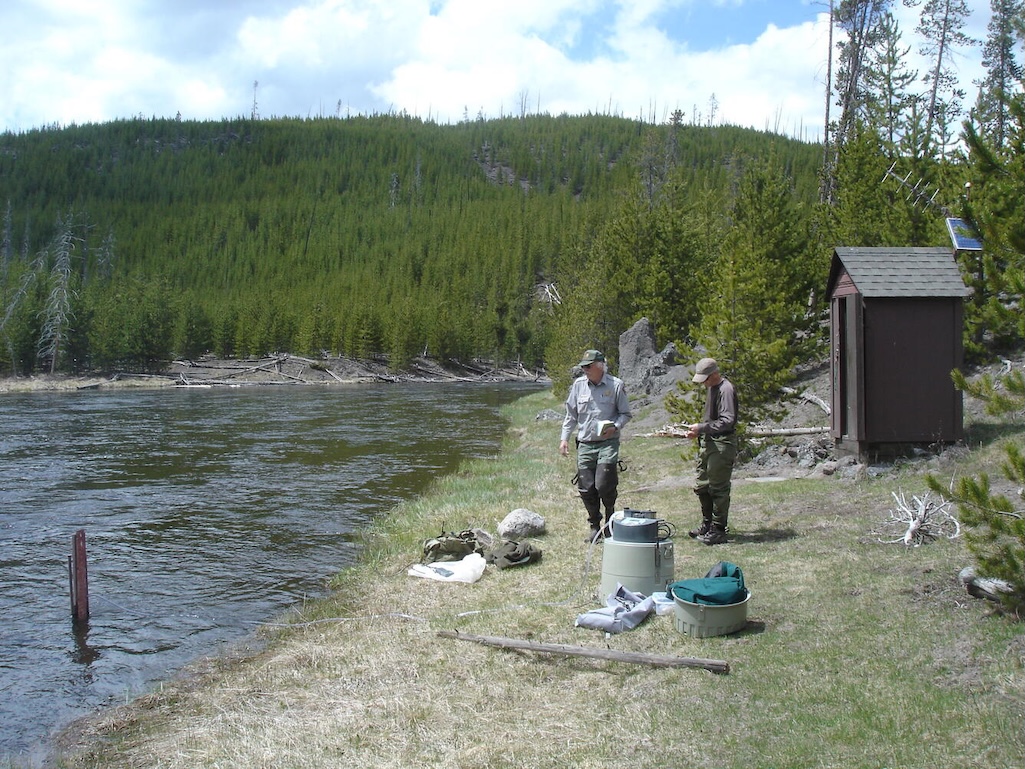
Non-thermal waters from rivers and creeks in Yellowstone are typically derived from snow and rain and are well suited for drinking after onsite treatment. Cool non-thermal waters may contain microorganisms such as E. Coli or parasites such as giardia that should be removed by filtration or sterilized by chlorination, iodination, or boiling before drinking. There are many miles of non-thermal rivers and creeks in Yellowstone.
But what about discharge from thermal features that flows into pristine rivers and creeks, creating mixed waters? Chemical investigations indicate that most material contributed by thermal runoff tends to remain dissolved in solution when mixed with river water and is readily transported downstream. Because of dilution, the concentrations of the nasty chemical components, including arsenic and fluoride, are often substantially less than the thermal waters.
But in some cases the concentration of arsenic and fluoride in mixed waters, especially just downstream from thermal areas, can still exceed the MCL set by the EPA. Most backpacking filtration systems will readily remove particulates, including microorganisms, but they may not remove chemical components like arsenic and fluoride. Boiling kills microorganisms but would not lower arsenic and fluoride concentrations.
Fortunately, over 140 years of study of water in Yellowstone provide an indication of where mixed waters may be hazardous. As you might expect, it’s mostly in the vicinity of the park’s major geyser basins—especially those along the Firehole and Gibbon rivers.
In most Yellowstone backcountry areas, there several options for obtaining safe drinking water. When looking to top off your supply, ask yourself "where does the water come from and is there is a thermal area upstream?" Whenever possible, choose a river or stream without thermal waters draining into it. Enjoy the Yellowstone backcountry, and stay safe!
Stories about:
Story Categories:
A copy of National Parks Traveler's financial statements may be obtained by sending a stamped, self-addressed envelope to: National Parks Traveler, P.O. Box 980452, Park City, Utah 84098. National Parks Traveler was formed in the state of Utah for the purpose of informing and educating about national parks and protected areas.
Residents of the following states may obtain a copy of our financial and additional information as stated below:
- Florida: A COPY OF THE OFFICIAL REGISTRATION AND FINANCIAL INFORMATION FOR NATIONAL PARKS TRAVELER, (REGISTRATION NO. CH 51659), MAY BE OBTAINED FROM THE DIVISION OF CONSUMER SERVICES BY CALLING 800-435-7352 OR VISITING THEIR WEBSITE. REGISTRATION DOES NOT IMPLY ENDORSEMENT, APPROVAL, OR RECOMMENDATION BY THE STATE.
- Georgia: A full and fair description of the programs and financial statement summary of National Parks Traveler is available upon request at the office and phone number indicated above.
- Maryland: Documents and information submitted under the Maryland Solicitations Act are also available, for the cost of postage and copies, from the Secretary of State, State House, Annapolis, MD 21401 (410-974-5534).
- North Carolina: Financial information about this organization and a copy of its license are available from the State Solicitation Licensing Branch at 888-830-4989 or 919-807-2214. The license is not an endorsement by the State.
- Pennsylvania: The official registration and financial information of National Parks Traveler may be obtained from the Pennsylvania Department of State by calling 800-732-0999. Registration does not imply endorsement.
- Virginia: Financial statements are available from the Virginia Department of Agriculture and Consumer Services, 102 Governor Street, Richmond, Virginia 23219.
- Washington: National Parks Traveler is registered with Washington State’s Charities Program as required by law and additional information is available by calling 800-332-4483 or visiting www.sos.wa.gov/charities, or on file at Charities Division, Office of the Secretary of State, State of Washington, Olympia, WA 98504.


National parks and their natural resources belong to you. The National Parks Traveler works to ensure you know how these essential places are being cared for.
Sign Up For Our Weekly Newsletter
Unsubscribe at any time.
INN Member

The easiest way to explore RV-friendly National Park campgrounds.

Here’s the definitive guide to National Park System campgrounds where RVers can park their rigs.
Our app is packed with RVing- specific details on more than 250 campgrounds in more than 70 national parks.
You’ll also find stories about RVing in the parks, tips helpful if you’ve just recently become an RVer, and useful planning suggestions.

