
Editor's note: Yellowstone Caldera Chronicles is a weekly column written by scientists and collaborators of the Yellowstone Volcano Observatory. This week's contribution is from Behnaz Hosseini, National Science Foundation Postdoctoral Research Fellow, and Madison Myers, Associate Professor of Volcanology and Geochemistry, both in the Department of Earth Sciences at Montana State University.
To time how fast a sprinter runs, you just need a stopwatch. To time how fast magma moves, you need to know a little bit about chemistry.
Picture a bizarre race: a sloth inching forward, a jogger picking up pace, an Olympic sprinter at full tilt…and deep underground, magma surging upwards. Who wins? Well, it depends. In some volcanic eruptions, magma creeps toward the surface so slowly that it would lose to the sloth, while in others, it would leave even Usain Bolt in the dust. But how do scientists measure a process that happens miles underground, hidden from view? The answer lies in tiny chemical changes preserved within erupted materials—microscopic clues that reveal the speeds at which magma rises toward the surface during explosive eruptions.
As magma cools, crystals begin to form—crystals that record changes in temperature, pressure, and chemistry within magma chambers. But crystals aren’t the only magma residents logging physical and chemical changes in their surrounding environment. Melt, the liquid portion of magma, also captures these changes! Enter embayments (also called reentrants), which are tubular melt-filled pockets burrowed into the side of volcanic crystals. Unlike melt inclusions, which are fully trapped inside crystals, embayments remain connected to the surrounding magma as the crystal forms, and so the embayments can record chemical shifts in the magmatic system up until the point of eruption. With the right tools, scientists can turn these tiny melt pockets into speedometers, clocking magma’s crawl (or sprint) to the surface.
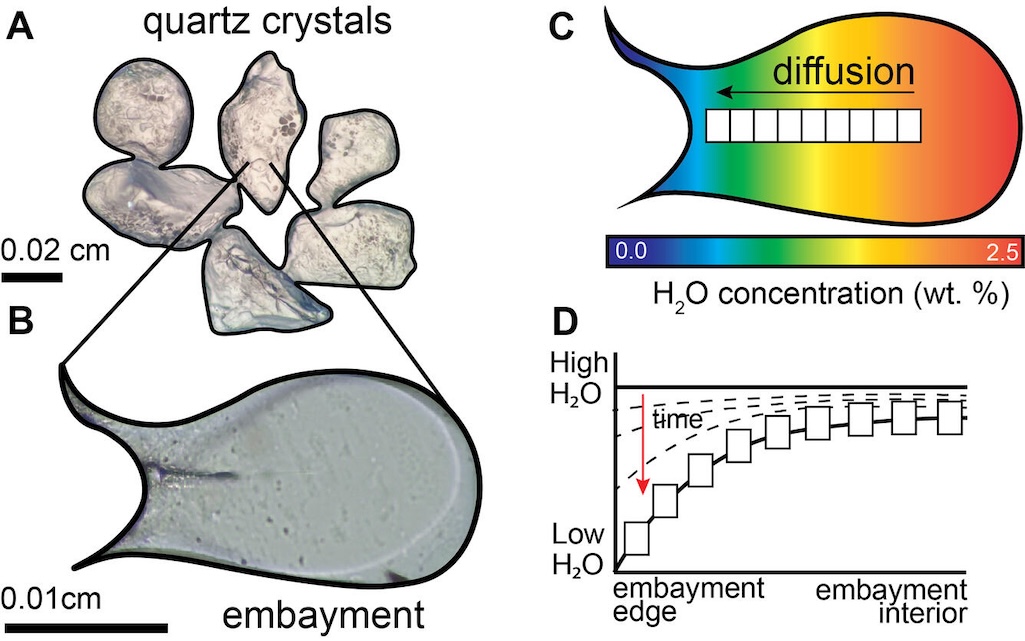
So, how does it work? It all comes down to the physical process of diffusion, which causes particles to spread from areas of high concentration to areas of low concentration—like a drop of food coloring dispersing through a glass of water over time. The same principle applies to chemical elements in melt. Volatile elements like water (H2O), carbon dioxide (CO2), and sulfur (S) are dissolved in melt under the high pressures within magma chambers. But as magma rises and pressure decreases, the concentration of these volatile elements also decreases as bubbles form. At high temperatures, this process drives diffusion of volatiles from the inner part of the embayment (where volatile concentrations are high) to the outer edge (where they are actively decreasing). The moment the magma erupts and completely solidifies, diffusion stops, locking a chemical “speed record” within the embayment. By measuring and modeling concentrations of volatile elements within embayments, scientists can determine how fast the magma was moving prior to eruption.
But how do scientists actually read these chemical “speed records”? That’s where specialized instruments and computer modeling come in! Using analytical techniques like Fourier Transform Infrared (FTIR) spectroscopy, scientists can precisely measure the concentrations of water and carbon dioxide trapped inside an embayment, creating a map of the chemistry from the outer edge to the interior. These profiles reveal how volatile elements degassed as pressure decreased during magma ascent, allowing scientists to work backward to calculate how quickly the magma traveled before it erupted.
Applying this technique to embayments in quartz crystals from Yellowstone’s massive Huckleberry Ridge Tuff eruption, which occurred 2.08 million years ago, scientists estimate that, upon the onset of eruption, magma ascended at rates ranging from 0.3 to 4 meters per second. This means it took anywhere from 10 minutes to 2 hours to travel from depths less than 10 miles to the surface—times that reflect a fully developed pathway for magma to rise once the eruption was well underway (the initial phases of pre-eruption magma rise would have been much slower). That’s astonishingly fast—faster than the average human’s long-distance running speed!
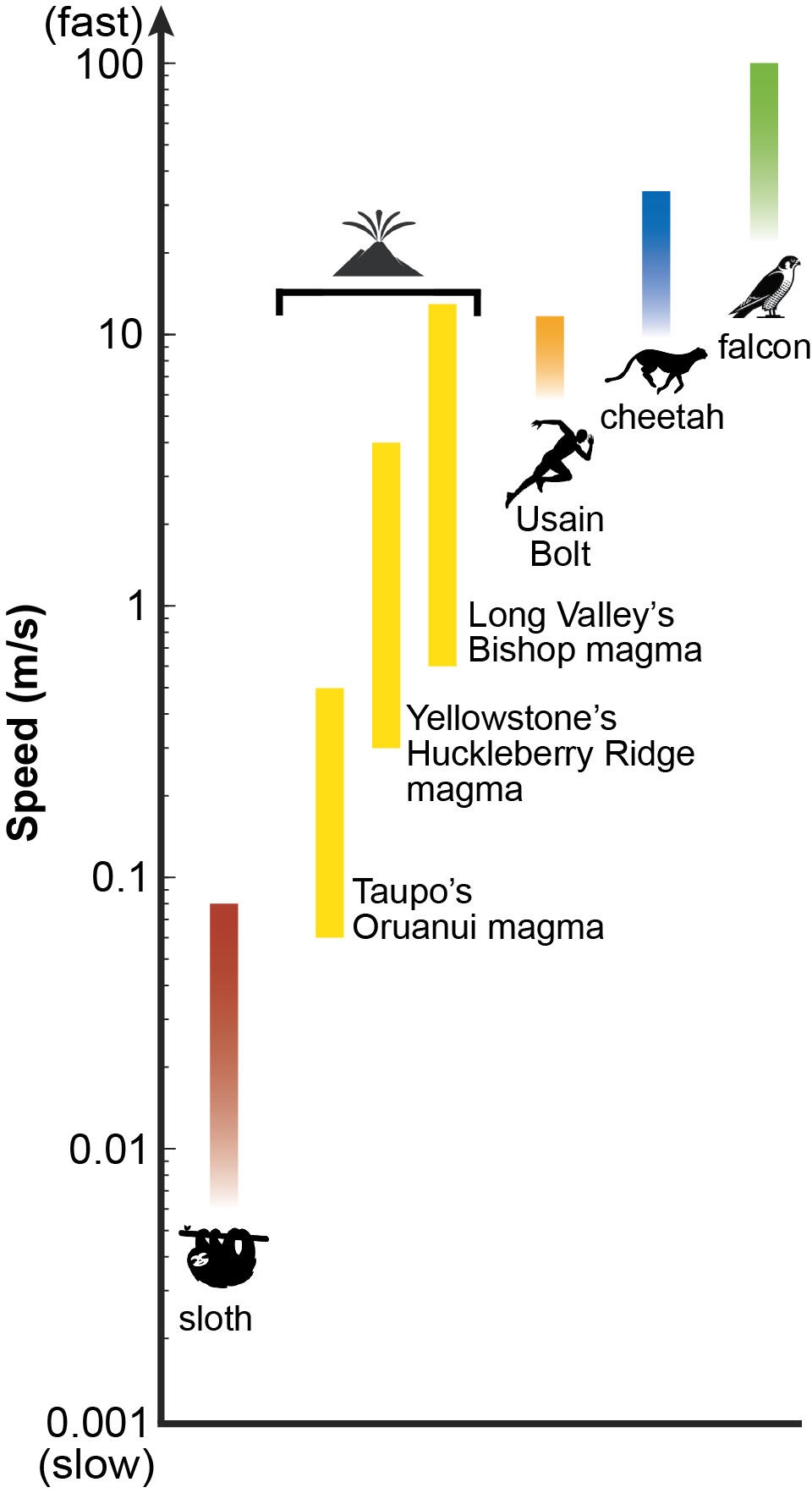
Measuring the ascent speed of magma isn’t simply an academic exercise—it has major implications for understanding how volcanoes like Yellowstone have behaved in the past. Whether magma rises at a sloth’s pace or races to the surface like a sprinter, the speed influences everything from the signals that monitoring systems like seismometers detect before an eruption to the style of eruption (for instance, explosive versus gentle). By unlocking the chemical records preserved in embayments, scientists can piece together the timing of past eruptions and, ultimately, improve how we monitor active volcanoes like Yellowstone. While we can’t witness magma’s race to the surface in real time, its chemical fingerprint preserved in embayments allows us to reconstruct its journey, one diffusion profile at a time.
Stories about:
Story Categories:
A copy of National Parks Traveler's financial statements may be obtained by sending a stamped, self-addressed envelope to: National Parks Traveler, P.O. Box 980452, Park City, Utah 84098. National Parks Traveler was formed in the state of Utah for the purpose of informing and educating about national parks and protected areas.
Residents of the following states may obtain a copy of our financial and additional information as stated below:
- Florida: A COPY OF THE OFFICIAL REGISTRATION AND FINANCIAL INFORMATION FOR NATIONAL PARKS TRAVELER, (REGISTRATION NO. CH 51659), MAY BE OBTAINED FROM THE DIVISION OF CONSUMER SERVICES BY CALLING 800-435-7352 OR VISITING THEIR WEBSITE. REGISTRATION DOES NOT IMPLY ENDORSEMENT, APPROVAL, OR RECOMMENDATION BY THE STATE.
- Georgia: A full and fair description of the programs and financial statement summary of National Parks Traveler is available upon request at the office and phone number indicated above.
- Maryland: Documents and information submitted under the Maryland Solicitations Act are also available, for the cost of postage and copies, from the Secretary of State, State House, Annapolis, MD 21401 (410-974-5534).
- North Carolina: Financial information about this organization and a copy of its license are available from the State Solicitation Licensing Branch at 888-830-4989 or 919-807-2214. The license is not an endorsement by the State.
- Pennsylvania: The official registration and financial information of National Parks Traveler may be obtained from the Pennsylvania Department of State by calling 800-732-0999. Registration does not imply endorsement.
- Virginia: Financial statements are available from the Virginia Department of Agriculture and Consumer Services, 102 Governor Street, Richmond, Virginia 23219.
- Washington: National Parks Traveler is registered with Washington State’s Charities Program as required by law and additional information is available by calling 800-332-4483 or visiting www.sos.wa.gov/charities, or on file at Charities Division, Office of the Secretary of State, State of Washington, Olympia, WA 98504.


National parks and their natural resources belong to you. The National Parks Traveler works to ensure you know how these essential places are being cared for.
Sign Up For Our Weekly Newsletter
Unsubscribe at any time.
INN Member

The easiest way to explore RV-friendly National Park campgrounds.

Here’s the definitive guide to National Park System campgrounds where RVers can park their rigs.
Our app is packed with RVing- specific details on more than 250 campgrounds in more than 70 national parks.
You’ll also find stories about RVing in the parks, tips helpful if you’ve just recently become an RVer, and useful planning suggestions.

