
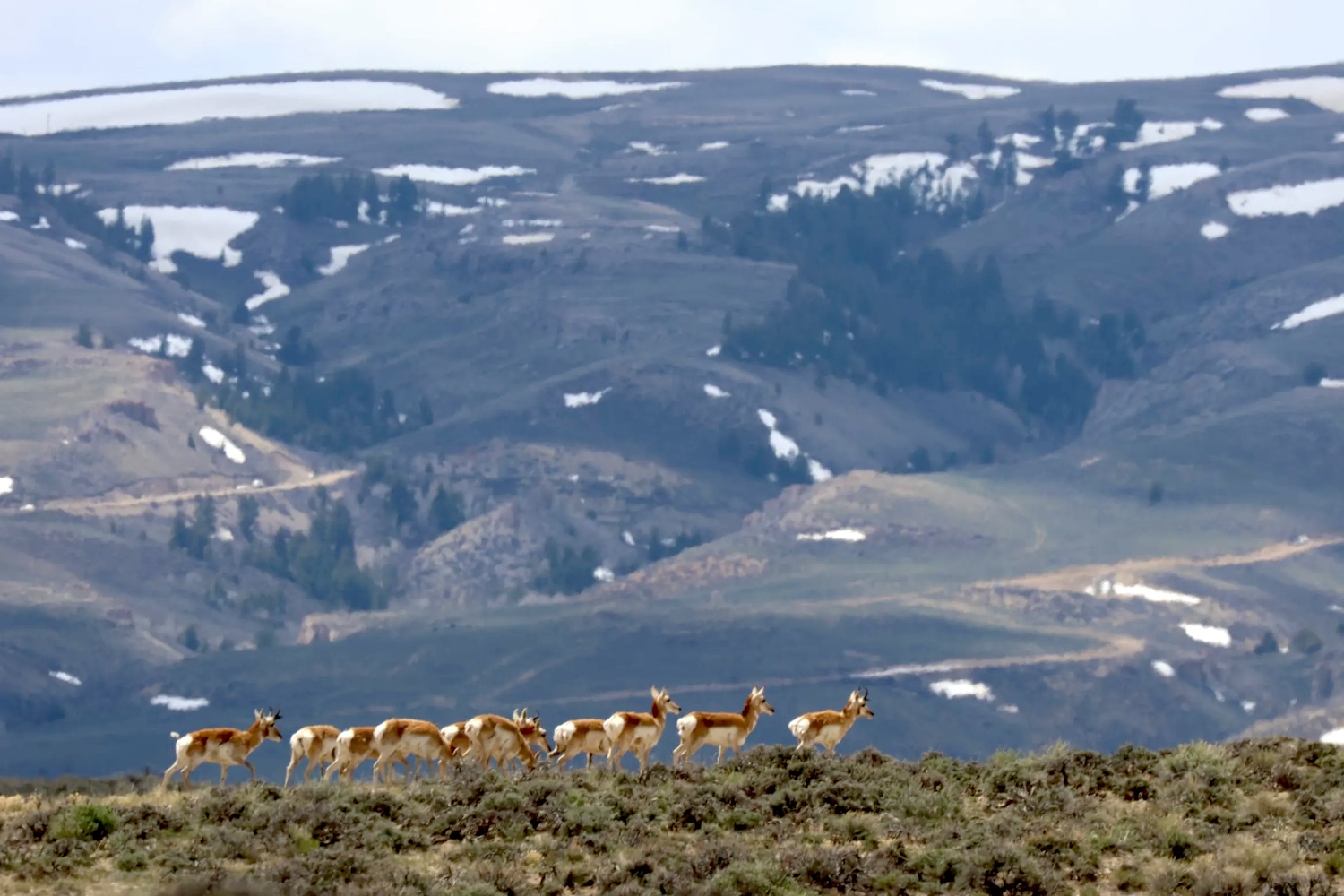
Analysis Says "Path Of the Pronghorn" In Wyoming At ‘High Risk’ Of Being Lost
By Mike Koshmrl, WyoFile.com
The pathway of a highly migratory western Wyoming pronghorn herd that’s been known by researchers for a quarter-century is at “high risk” of being lost.
That’s according to a draft “threat evaluation” released Thursday by the Wyoming Game and Fish Department in conjunction with an announcement that the state agency will consider identifying or designating migration corridors used by the Sublette Pronghorn Herd.
“In summary, the known current and potential threats pose a high risk to the functionality of the Sublette Pronghorn migration corridor,” the state’s evaluation reads. “The existing trend of suburban expansion and demand for renewable energy resources are the most concerning threats to the functionality of the corridor.”
The 13-page report includes a map, which shows three primary migration areas.
The largest, northmost part of the corridor connects Grand Teton National Park to the Green River Basin’s sagebrush sea. The southernmost migration area runs from the east slope of the Wyoming Range to the lowest reaches of the basin and the Interstate 80 corridor, while two other smaller routes branch off the southern Wind River Range and tread through the Red Desert.
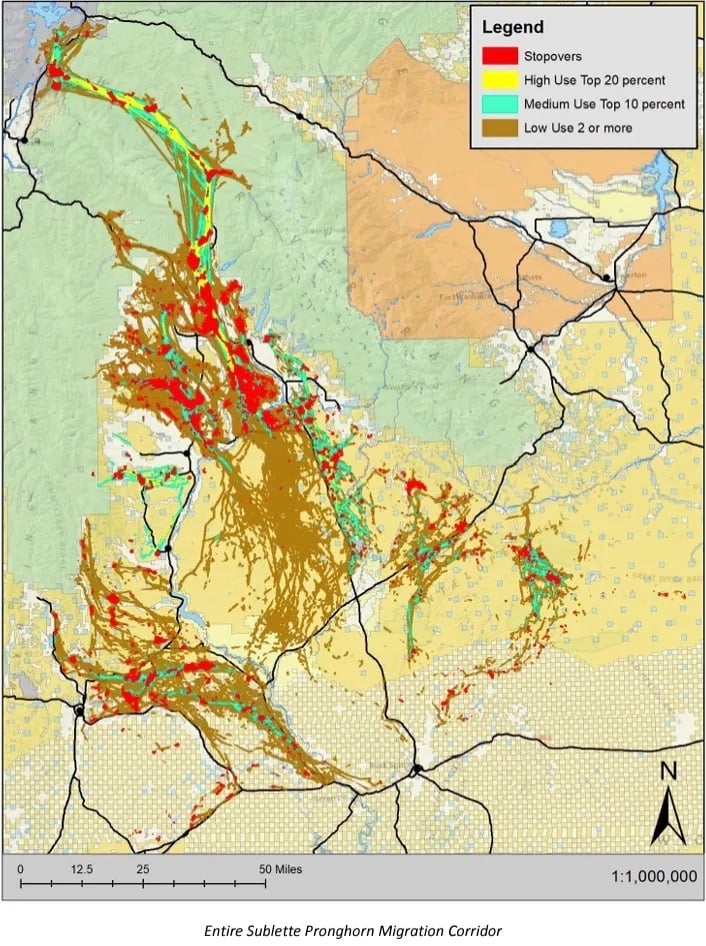
Scientists built the map off of the movements of 415 GPS-collared pronghorn that transmitted location data from 2002 to 2022. Biologists learned that roughly 75 percent of the Sublette Herd was migratory, and they traveled between 6 and 165 miles, according to the threat evaluation.
Also known as the ‘Path of the Pronghorn,’ management of the Sublette Pronghorn Herd’s migration has been scrutinized because of a politically influenced delay in recognizing the corridor. Game and Fish hit pause on classifying the Path of the Pronghorn, and subsequently, Gov. Mark Gordon rolled out an entirely new process for designating migration corridors.
Then the new policy went unused for over three years while a series of developments advanced within the likely corridor, including subdivisions, a 3,500-well gas field and a recent Wyoming gas auction that leased out 640 acres for $19 an acre within a bottleneck section that could soon be classified as “high use.”
Refining the scientific method for translating raw GPS collar data into a mapped corridor was a big reason for the delay, according to Game and Fish Deputy Chief Doug Brimeyer. Specifically, University of Wyoming researchers and others were developing a new “line buffer” method — and the final product was just published in the Journal of Applied Ecology
“We’re glad to see that the science has improved enough that we feel comfortable with what the line-buffer method has outlined as being the corridor,” Brimeyer said. “I think people might be questioning, ‘Well, if you had 20 years of data, why wouldn’t we have done something sooner?’ But I hope they can understand that when we used the [old method] it was a very, very large footprint.”
Professional conservationists who’ve engaged in Wyoming migration politics welcomed the state taking a step toward designating the Path of the Pronghorn.
“I feel really confident that Game and Fish is doing the right thing here,” said Meghan Riley, the public lands and wildlife advocate for the Wyoming Outdoor Council. “We’re really excited to support them and the animals.”
Nick Dobric, The Wilderness Society’s Wyoming conservation manager, pointed out how the state’s potential auction of the tract known as the “Kelly Parcel” is yet another potential incursion into the pronghorn’s migration path.
“Designating the Path of the Pronghorn and managing the state lands it crosses as vital habitats, and in cooperation with federal land management agencies, is exactly the kind of action needed if Wyoming officials want to lead the way in migration corridor conservation and ensure the future of our prized wildlife,” Dobric said in a statement.
Game and Fish’s threat evaluation outlined other trends that don’t bode well for pronghorn. Sublette County’s human population grew 78 percent since 1990, adding barriers and stressors for the herd. Meanwhile, the herd just sustained its worst winter on record, a double whammy of weather and disease that left 75 percent of collared does dead by the spring thaw.

Industrial development from the oil and gas and renewable energy industries was yet another “significant” pressure identified.
“In the Pinedale Anticline Project Area adjacent to the Jonah Field, [Hall Sawyer] demonstrated that pronghorn both avoid energy infrastructure and spend considerably less time in traditional winter ranges once habitat fragmentation occurs due to development,” the document says. “More recently, solar energy developments have been constructed in the southern portion of the proposed corridor near Green River and along the Gateway West Transmission Line.”
Fencing at the solar developments creates a “complete movement barrier to migrating pronghorn,” the evaluation says.
Although it’s officially begun, there’s a protracted process ahead to designate the Path of the Pronghorn. First, the state’s seeking public comment — remarks are due January 5. There are also three upcoming public meetings: at 6 p.m. Nov. 16 in Pinedale, 6 p.m. Nov. 29 in Green River and 6 p.m. Nov. 30 in Jackson.
The plan is for the Wyoming Game and Fish Commission to consider moving forward with a designation at its March meeting, Brimeyer said. If the commission gives the agency the go-ahead, there are many steps after that. A more detailed “risk assessment” must be completed, and a stakeholder group will also be assembled to review the proposal. After that, the designation goes back to the Game and Fish Commission.
And that’s not the end of it. Ultimately, the decision to designate the Path of the Pronghorn will be made by Gordon. Depending on how long it all takes, it could even be his successor making the final call.
WyoFile is an independent nonprofit news organization focused on Wyoming people, places and policy.
Stories about:
Story Categories:
A copy of National Parks Traveler's financial statements may be obtained by sending a stamped, self-addressed envelope to: National Parks Traveler, P.O. Box 980452, Park City, Utah 84098. National Parks Traveler was formed in the state of Utah for the purpose of informing and educating about national parks and protected areas.
Residents of the following states may obtain a copy of our financial and additional information as stated below:
- Florida: A COPY OF THE OFFICIAL REGISTRATION AND FINANCIAL INFORMATION FOR NATIONAL PARKS TRAVELER, (REGISTRATION NO. CH 51659), MAY BE OBTAINED FROM THE DIVISION OF CONSUMER SERVICES BY CALLING 800-435-7352 OR VISITING THEIR WEBSITE. REGISTRATION DOES NOT IMPLY ENDORSEMENT, APPROVAL, OR RECOMMENDATION BY THE STATE.
- Georgia: A full and fair description of the programs and financial statement summary of National Parks Traveler is available upon request at the office and phone number indicated above.
- Maryland: Documents and information submitted under the Maryland Solicitations Act are also available, for the cost of postage and copies, from the Secretary of State, State House, Annapolis, MD 21401 (410-974-5534).
- North Carolina: Financial information about this organization and a copy of its license are available from the State Solicitation Licensing Branch at 888-830-4989 or 919-807-2214. The license is not an endorsement by the State.
- Pennsylvania: The official registration and financial information of National Parks Traveler may be obtained from the Pennsylvania Department of State by calling 800-732-0999. Registration does not imply endorsement.
- Virginia: Financial statements are available from the Virginia Department of Agriculture and Consumer Services, 102 Governor Street, Richmond, Virginia 23219.
- Washington: National Parks Traveler is registered with Washington State’s Charities Program as required by law and additional information is available by calling 800-332-4483 or visiting www.sos.wa.gov/charities, or on file at Charities Division, Office of the Secretary of State, State of Washington, Olympia, WA 98504.


National parks and their natural resources belong to you. The National Parks Traveler works to ensure you know how these essential places are being cared for.
Sign Up For Our Weekly Newsletter
Unsubscribe at any time.
INN Member

The easiest way to explore RV-friendly National Park campgrounds.

Here’s the definitive guide to National Park System campgrounds where RVers can park their rigs.
Our app is packed with RVing- specific details on more than 250 campgrounds in more than 70 national parks.
You’ll also find stories about RVing in the parks, tips helpful if you’ve just recently become an RVer, and useful planning suggestions.

