
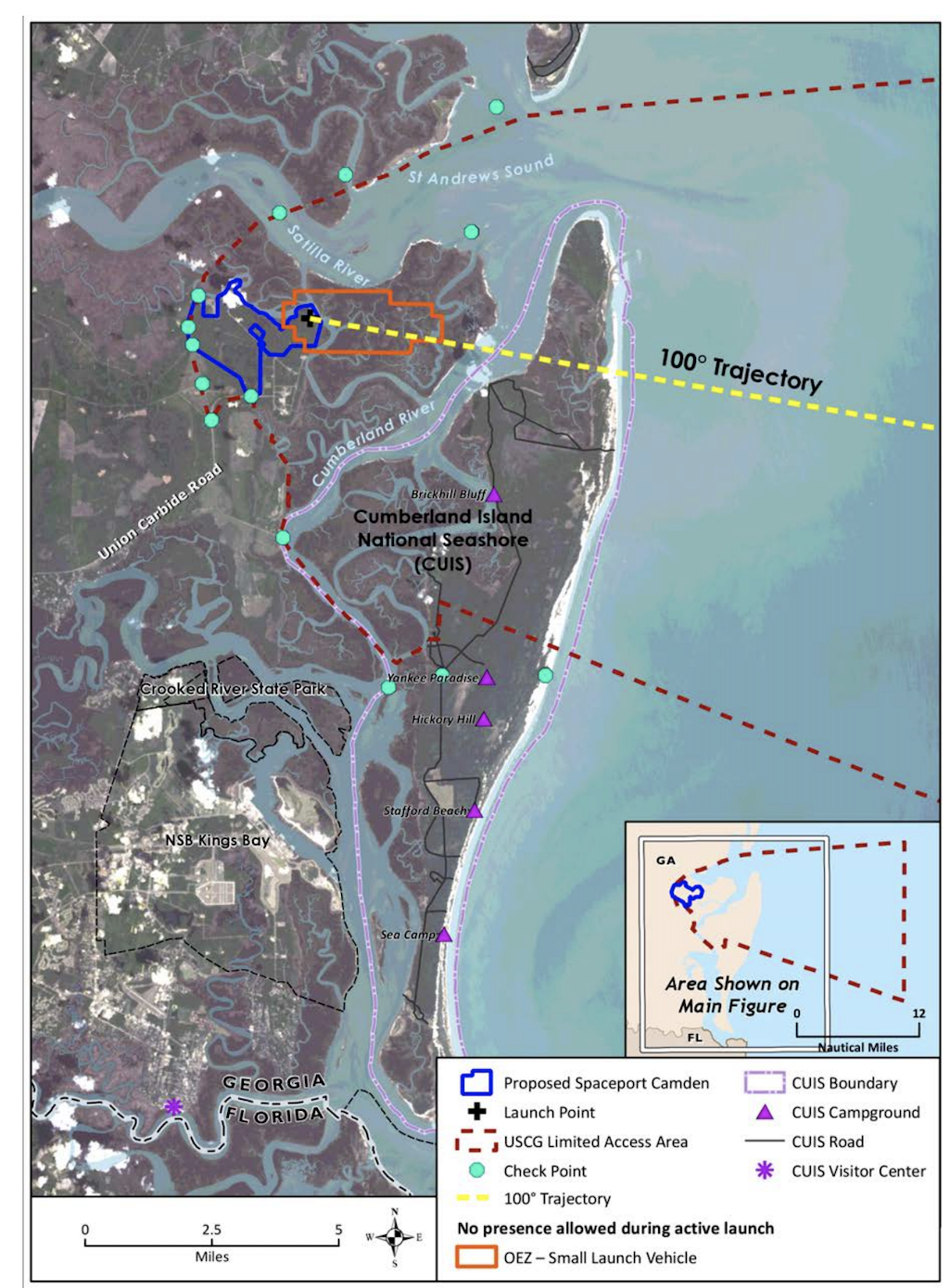
A legal challenge has been mounted in a bid to reverse the Federal Aviation Administration's decision to issue an operating license to a commercial spaceport that would launch rocket ships over Cumberland Island National Seashore off the coast of Georgia.
Though the spaceport is not close to operating, the lawsuit filed by the Southern Environmental Law Center on behalf of the National Parks Conservation Association and One Hundred Miles, a nonprofit conservation organization with a mission of protecting and preserving Georgia’s 100-mile coast through advocacy, education, and public engagement, argues that the FAA lacked key information on the facility’s operations and failed to properly evaluate its impacts on public health, private property, and the environment.
“Cumberland Island National Seashore is the largest maritime wilderness on the U.S. Eastern seaboard. This national park site was designated by an act of Congress to protect sensitive wildlife and priceless history. It was not protected so private companies could fire off rockets next to its shores,” said Emily Jones, NPCA's Southeast regional director. “Rockets launched from the proposed site endanger park staff, visitors, and resources, as well as the lifeblood of a thriving local tourist economy. Science, economics and common sense indicate Camden County’s proposed spaceport lacks merit.”
Under terms of the five-year license granted by FAA, as many as a dozen commercial launches a year could arc across the northern end of Cumberland Island National Seashore, where the seashore's official wilderness area spans more than 9,800 acres, with another adjacent 10,000-acre tract of potential wilderness. The trajectory cone also encompasses much of Little Cumberland Island, which is private property but within the seashore's boundaries.

While NASA long has handled space launches for the United States, recent years have seen the rise of private rocket companies that see a profit to be made in taking on at least some of NASA's workload, and commercial spaceports have surfaced to support those companies. Camden County is just one of the latest communities to explore the possibilities of a spaceport. Other entities in Florida, Texas, New Mexico have looked into spaceports, and Virginia is an official partner with NASA at the Mid-Atlantic Regional Spaceport on Wallops Island.
According to The Pew Charitable Trusts, “the commercial space industry is worth $345 billion globally,” and while there might not currently be a need for commercial spaceports around the country, those behind proposals such as Camden County’s are betting on the future.
The filing made Tuesday in the U.S. District Court for the District of Columbia also claims the FAA ignored requests by local residents, park visitors, and the Interior Department to fully evaluate the effects of failed launches on Cumberland Island National Seashore and its visitors.
Further, the FAA refused to revisit its environmental review of Spaceport Camden after the project was changed to focus on what opponents maintain are "more failure-prone small rockets." In an internal email, the FAA admitted that the law required the agency to “revise the existing Draft [Environmental Impact Statement] to outline the potential environmental impacts from the change in the scope of the proposed project.” But after acknowledging that the law required it, the FAA chose to move forward without this revised environmental review, a SELC release said.
Among other laws, the complaint cites the FAA’s failure to comply with the National Environmental Policy Act, the national seashore’s enabling legislation, and the FAA’s own regulations.
“By not requiring a supplemental EIS, the FAA has caused massive uncertainty for businesses in Glynn and Camden Counties. Charter boat captains, commercial fishermen, and tourists hoping to visit and enjoy our rivers, marshes, and offshore ocean could likely have their plans thwarted because of evacuations for launch events or catastrophes due to launch failures,” said Megan Desrosiers, president and CEO of One Hundred Miles. “Without an accurate analysis of the environmental impacts of Spaceport Camden, no one can be sure what to expect or how their lives or incomes will be affected."
Stories about:
Story Categories:
A copy of National Parks Traveler's financial statements may be obtained by sending a stamped, self-addressed envelope to: National Parks Traveler, P.O. Box 980452, Park City, Utah 84098. National Parks Traveler was formed in the state of Utah for the purpose of informing and educating about national parks and protected areas.
Residents of the following states may obtain a copy of our financial and additional information as stated below:
- Florida: A COPY OF THE OFFICIAL REGISTRATION AND FINANCIAL INFORMATION FOR NATIONAL PARKS TRAVELER, (REGISTRATION NO. CH 51659), MAY BE OBTAINED FROM THE DIVISION OF CONSUMER SERVICES BY CALLING 800-435-7352 OR VISITING THEIR WEBSITE. REGISTRATION DOES NOT IMPLY ENDORSEMENT, APPROVAL, OR RECOMMENDATION BY THE STATE.
- Georgia: A full and fair description of the programs and financial statement summary of National Parks Traveler is available upon request at the office and phone number indicated above.
- Maryland: Documents and information submitted under the Maryland Solicitations Act are also available, for the cost of postage and copies, from the Secretary of State, State House, Annapolis, MD 21401 (410-974-5534).
- North Carolina: Financial information about this organization and a copy of its license are available from the State Solicitation Licensing Branch at 888-830-4989 or 919-807-2214. The license is not an endorsement by the State.
- Pennsylvania: The official registration and financial information of National Parks Traveler may be obtained from the Pennsylvania Department of State by calling 800-732-0999. Registration does not imply endorsement.
- Virginia: Financial statements are available from the Virginia Department of Agriculture and Consumer Services, 102 Governor Street, Richmond, Virginia 23219.
- Washington: National Parks Traveler is registered with Washington State’s Charities Program as required by law and additional information is available by calling 800-332-4483 or visiting www.sos.wa.gov/charities, or on file at Charities Division, Office of the Secretary of State, State of Washington, Olympia, WA 98504.


National parks and their natural resources belong to you. The National Parks Traveler works to ensure you know how these essential places are being cared for.
Sign Up For Our Weekly Newsletter
Unsubscribe at any time.
INN Member

The easiest way to explore RV-friendly National Park campgrounds.

Here’s the definitive guide to National Park System campgrounds where RVers can park their rigs.
Our app is packed with RVing- specific details on more than 250 campgrounds in more than 70 national parks.
You’ll also find stories about RVing in the parks, tips helpful if you’ve just recently become an RVer, and useful planning suggestions.


Comments
Thank you, Kurt, for continuing to cover this important story. Launching rocket ships over this national seashore and these coastal communities is a certain case of poor siting that will create hazard for the environment, the people, the coastal tourism and seafood economies and more.
Spaceport Camden is touted locally as an economic development project. Yet, during the seven years of the project no space industry client has been found that is willing to launch rockets over a NPS unit. Cumberland Island draws 60,000+ visitors to Camden County every year. They come for the uniqueness of Cumberland Island – not to watch a rocket launch. A ferry ride is required for the visit which has helped keep Cumberland Island remote and primitive. The CUIS Wilderness is still wild and beautiful, like it should be. The FAA is vulnerable in this lawsuit because it succumbed to political pressure and lobbying. The FAA made a lot of mistakes because it had a pro-spaceport bias. It took three years before they recognized that spaceport promoters couldn’t evacuate the island to remove residents, NPS employees, or park visitors for a rocket launch. Yet, they licensed a spaceport that would allow rockets for the first time ever over US residents, private homes, and a visitor active NPS unit. They’re counting on the cost of liability insurance to make launches impossible from a spaceport they never should have considered. It’s a typical Federal bureaucratic mess. Millions wasted. Rare public property put at risk. Lawyers and politicians feeding at the trough. It should be easier than this to protect coastal tidewaters and national parks. info: www.spaceportfacts.org
Why is no one mentioning that a a Trident Nuclear Submarine Base is located at Kingsland, Georgia practically adjacent to the Spaceport site. On launch days, the beautiful, almost sanctuary of Cumberland Island would have to be evacuated. Would the same be true of Amelia Island Florida separated by the channel of water used as a waterway by the Trident subs to enter the Atlantic Ocean?????Bobbie Mathews
As a CUIS volunteer, I have raised the American Flag at the Sea Camp ferry dock on Cumberland Island. And a few times I watched one of our boomer submarines pass by CUIS less than a mile offshore. I was proud that Camden County contributes to world peace through Kings Bay Naval Submarine Base and also hosts a historic wild place that I can reach by kayak from my home. CUIS is a challenging property for the NPS. President Reagan acknowledged the difficulties of sustaining such valuable property as a National Park unit when he authorized the CUIS Wilderness. He understood that there would be development pressures and that selfish interests would seek to monetize a truly unique place. But he said"YES" we will protect this place for all Americans for all future generations. We are obligated to overrule economic development that can be accomplished in other ways at other sites. Stopping Spaceport Camden is a MORAL issue based on Americans' long-term commitment to shared American values. I can't wait to take my 3-year-old granddaughter on a CUIS trail to see the wild alligators and gopher tortoises. And soon, the loggerhead hatchlings will start their perilous journey from the safety of their CUIS dune nests. There should be no uncertainty about how we protect such a special place. To be sure, CUIS will not undergo evacuation (That would be a DOT 4(f) violation). The FAA says they'll just launch over "authorized personnel", whatever that means. Maybe the spaceport will provide backpackers with rocket debris-proof tents for nights in the Wilderness? And just who will be paying for the foot patrols covering 10,000-acres to pick up carbon fiber debris from a mid-air rocket explosion? And how long does it take a Maritime forest to recover from a multi-point forest fire caused by a rocket explosion? The FAA failed its duty to America.
It's unfortunate that the starving feral horses go in-noticed with all this concern for the island. This is the only herd of horses on the East Coast that is not managed (no food, fresh water, vet care or population control. It's more important to get money from tourists.