
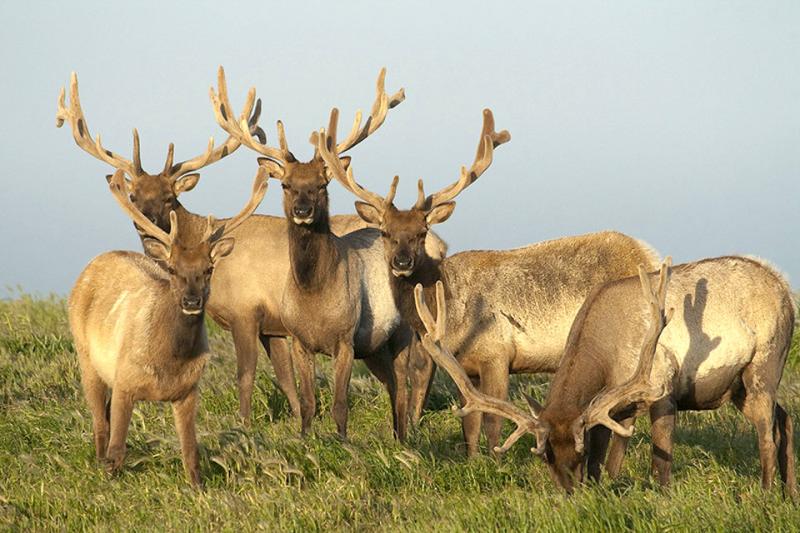
Tule elk at Point Reyes National Seashore in California struggled with poor forage conditions during 2020, with two of the three herds declining in number, the National Park Service announced.
In releasing the year-end population counts on Wednesday, the Park Service stated that "there is no evidence that the population decline is due to dehydration and a lack of water" and that the declines "are within normal and predicted population fluctuations."
The news comes in the wake of the Park Service's adoption last September of an elk management plan that would allow for the killing of elk near livestock operations that operate in the seashore.
In recent years the ranch operations have drawn harsh criticism for impacts to the landscape and to the seashore's Tule elk herds. Tule elk are the smallest elk subspecies in North American and a California native. They had been extirpated from Point Reyes by the 1860s, but in 1978 the Park Service brought some back at the direction of Congress.
There are three herds at the seashore: Drakes Beach, Limantour, and Tomales Point. The Tomales Point herd is managed within a fenced-in area, while the Drakes Beach and Limantour herds are free-ranging.
Through 2020 the herd at Tomales Point declined from 445 to 293 elk, similar to past declines in this area, park staff said. The Limantour herd declined from 164 to 155 individuals, while the Drakes Beach herd went from 138 to 139 individuals.
"Investigations of dead elk, observations of living elk, and range assessments conducted by park staff in coordination and consultation with wildlife managers and veterinarians from the California Department of Fish and Wildlife suggest poor forage quality is the underlying cause of these population changes," the park announced in a release.
The range carrying capacity for tule elk at Tomales Point is estimated at 350 individuals. Over the past 25 years, the Tomales Point elk population has fluctuated between 280 and 550 individuals. The herd’s population tends to increase incrementally during favorable conditions, with the population expanding beyond carrying capacity, followed by less favorable conditions and subsequent population declines, a park release said.
" These census results, along with necropsies, observations of living elk, and assessment of range conditions, suggest poor forage quality caused by drought conditions exist parkwide," it added. "NPS management of elk at Tomales Point is guided by the 1998 Tule Elk Management Plan, which predicts a series of modulated swings of population growth and decline in this herd, a process called natural or self-regulation."
The tule elk at Tomales Point are not being considered as part of the ongoing General Management Plan Amendment, which addresses the active ranching areas in the park and the free-ranging tule elk in those regions, the release said.
Stories about:
Story Categories:
A copy of National Parks Traveler's financial statements may be obtained by sending a stamped, self-addressed envelope to: National Parks Traveler, P.O. Box 980452, Park City, Utah 84098. National Parks Traveler was formed in the state of Utah for the purpose of informing and educating about national parks and protected areas.
Residents of the following states may obtain a copy of our financial and additional information as stated below:
- Florida: A COPY OF THE OFFICIAL REGISTRATION AND FINANCIAL INFORMATION FOR NATIONAL PARKS TRAVELER, (REGISTRATION NO. CH 51659), MAY BE OBTAINED FROM THE DIVISION OF CONSUMER SERVICES BY CALLING 800-435-7352 OR VISITING THEIR WEBSITE. REGISTRATION DOES NOT IMPLY ENDORSEMENT, APPROVAL, OR RECOMMENDATION BY THE STATE.
- Georgia: A full and fair description of the programs and financial statement summary of National Parks Traveler is available upon request at the office and phone number indicated above.
- Maryland: Documents and information submitted under the Maryland Solicitations Act are also available, for the cost of postage and copies, from the Secretary of State, State House, Annapolis, MD 21401 (410-974-5534).
- North Carolina: Financial information about this organization and a copy of its license are available from the State Solicitation Licensing Branch at 888-830-4989 or 919-807-2214. The license is not an endorsement by the State.
- Pennsylvania: The official registration and financial information of National Parks Traveler may be obtained from the Pennsylvania Department of State by calling 800-732-0999. Registration does not imply endorsement.
- Virginia: Financial statements are available from the Virginia Department of Agriculture and Consumer Services, 102 Governor Street, Richmond, Virginia 23219.
- Washington: National Parks Traveler is registered with Washington State’s Charities Program as required by law and additional information is available by calling 800-332-4483 or visiting www.sos.wa.gov/charities, or on file at Charities Division, Office of the Secretary of State, State of Washington, Olympia, WA 98504.


National parks and their natural resources belong to you. The National Parks Traveler works to ensure you know how these essential places are being cared for.
Sign Up For Our Weekly Newsletter
Unsubscribe at any time.
INN Member

The easiest way to explore RV-friendly National Park campgrounds.

Here’s the definitive guide to National Park System campgrounds where RVers can park their rigs.
Our app is packed with RVing- specific details on more than 250 campgrounds in more than 70 national parks.
You’ll also find stories about RVing in the parks, tips helpful if you’ve just recently become an RVer, and useful planning suggestions.


Comments
We’ve been through a lot over the twenty years since that election in Florida in November of 2000 led to the rise of today’s corrupt, rightwing, lunatic fringe version of the republican party. We started the 21st century with James Watt’s protégée Gale Norton as Secretary of the Interior, only to ultimately descend into the depths of Ryan Zinke and then David Bernhardt who, along with the freakish Lauren Boebert, was a gift to the nation from the marginally literate stronghold of Rifle, Colorado. Our national parks, public lands, and wildlife have all suffered as a result.
One of the most morally deplorable aspects of these last twenty years has been the increasingly sophisticated use of conservation poseurs in our social media, often seeming to work in propagandistic lockstep with the political meddling being staged by hostile foreign intelligence operations. These provocateurs posing as conservationists have a wide range of “axes to grind” that motivate them, from personal political agendas like that driving conservation poseur nonpareil Representative Jared Huffman to racial, ethnic, and even religious agendas. And, their specific methods and points of attack can vary as well. From specious arguments being promulgated to perpetuate damaging activities and land uses to a rightwing rats’ nest in Bozeman slithering its way into control over and financially destroying an influential nonprofit supporting an influential national park, we’ve seen it all.
At the same time, the conservation movement has been maturing away from amusement park entertainments and toward the roles of national parks and protected lands as impediments to the next mass extinction. Within the last decade, respected naturalist and professor E. O. Wilson stepped up and advocated maintaining fifty percent of the planet as pristine and undeveloped as possible as a means to provide enough habitat to forestall that next mass extinction. Now, President Biden, working with newly confirmed Secretary of the Interior Deb Haaland, has proposed, in his 30 by 30 Plan, the slightly less ambitious goal of having thirty percent of the nation protected in as undeveloped a condition as possible by the year 2030.
But, even here among the NPT commenters, the conservation poseurs soon jumped in with their misinformation and disinformation campaigns. One such poseur posted about how the 30 by 30 Plan must “bring together politicians, Native Americans, hunters, anglers, loggers, miners, energy industry, outdoor enthusiast, ATV groups, bikers as equals to the table” because “traditional” uses must be part of “continued lands management” ...in his mind. Although he threw in some flowery words about cleaning up old mines, those were just the usual bones tossed into the woods to distract the gullible from what was really just a thinly camouflaged repudiation of the 30 by 30 Plan and he closed by emphasizing “protection of American Farms/Farmland” and how we “need our farmland for continuous food production.” When confonted about his comments, he responded with a prefabricated wail blaming conservation for “why nothing is ever done with lands management” and how we all instead need to “look to better our future with continued multiple land uses.” And, this is pretty much the modus operandi for the conservation poseurs we’re stuck with today; we’re continually challenged to wade past flowery and distracting bones tossed into the woods and focus on what they’re really trying to sell us, which is generally bigger doses what caused the problems in the first place.
I hate to be so hard on Parks Canada; but, the NPT article Hiking Though A Canadian National Park That Protects Farmland (https://www.nationalparkstraveler.org/2021/03/hiking-though-canadian-nat...) is another example of this kind of thinking …and pretending. We’re already well into the first stages of that next mass extinction and true conservationists are intently focused on protecting enough habitat to limit anthropogenic impacts and let as much nature survive as possible. Yet, the author of this article waxed eloquent about “glorious old barns” and about how this park “protects agricultural heritage” and “is still home to working farms.” The author described how, as a park devoted to protecting commercial agriculture, this park really didn’t “fit into the Canada National Parks Act” and special legislation for it was needed. I can imagine. The author asserted that this park’s “top priority is maintaining or restoring ecological integrity.” But, it seems like an example of serving two masters and honoring neither.
The author proclaimed this park to be “a ‘learn-to’ park” aimed at new Canadians and young people; but, I wonder about the welcoming content of the lessons. There are the author’s all-too-candid descriptions of the “yellow warning signs ordering motorists to share the road with tractors,” the problem with “illegal dumping of household waste and construction materials,” and the signs warning “Stay on marked trails” and “Access to agricultural lands is not permitted.” There is also the description of how a “peaceful hike” ends at a wire fence and a sign warning of a “Farm Crossing” and need to “Yield to Farm Equipment.” Then, there’s the author’s account of “an abandoned vintage car, its windows long gone, its roof covered in dried grass, the remnant of a past farmer” and her admonition that she didn’t “dare step off the trail for a closer look” and how she knew that in a few short weeks the spring foliage will once again hide this relic.” I was left wondering where the firing line for the shooting range might be.
My concerns are, of course, 1) that, at a time when it’s urgent to preserve as much of the most undisturbed habitat possible, Canada chose to devote their time and money to subsidize and protect commercial agriculture and dumping grounds that are actually somewhat unsafe for both human and wildlife visitors and 2) that the time and money Canada spent doing this could have done so much more good being applied to the protection of other habitat that could have hosted more and a greater diversity of wildlife. Yet, the conservation poseurs were undeterred in their supportive comments. One emphatically asserted that he’d “rather see farms than houses everywhere” and another posted that there “are working farms on NPS land” and that “Point Reyes National Seashore obviously is the most prominent because of the working dairy and beef cattle ranches.”
Let’s look at that “rather see farms than houses everywhere” comment for a moment before moving on to the specific Point Reyes issues. It has been common for rightwing conservation poseurs to confront genuine conservation and preservation advocates with the threat that they must either accept farming, ranching, or some other commercial exploitation scheme or they’ll lose their chance to conserve or protect anything at all. This was Gifford Pinchot’s politically self-serving approach and the reason our national forests are under the USDA instead of where they belong. And, it’s the approach game and fish departments use today. If you want a species protected, it better have a hook and bullet constituency behind it and you better buy a license to kill it because generally the only money going toward the protection of most wildlife species, especially in the west, comes through the game and fish department license fees. As I commented previously, it's a variation of a “stop struggling; it will only make it worse" threat; it’s old; it's offensive; and it's immoral.
So, let’s look at the specific Point Reyes issues. Again as I commented previously, the plight of Tule Elk has already been extensively discussed on NPT before, with little or nothing changing for the better; it just gets worse. There were originally at least six, probably eight or more, elk species or subspecies in North America. All but four are now extinct; the other species or subspecies have been lost forever. Of the remaining elk, Tule Elk are generally considered the most unique, and the rarest. Out of a population estimated from between half and three quarters of a million prior to European colonization, only a few dozen survived by the end of the nineteenth century. In notional terms, that represents an evolutionarily recent reduction in their gene pool of up to twenty thousand to one. Current estimates are that as many as five thousand Tule Elk exist today; however, today's five thousand elk are the recent descendants of that remnant gene pool of no more than a few dozen. That's an inbreeding catastrophe waiting to be recognized.
The Tule Elk at Point Reyes are tightly trapped in fenced areas so they can't eat grass "leased" at outrageously subsidized rates to a few ranchers. Hundreds of these rare elk have died in previous droughts because they were trapped without water or forage. And, the response of the National Park Service (NPS) to those previous droughts was to actually consider killing even more of these rare elk, all because a few degenerate ranchers were complaining that the remnant Tule Elk were eating grass, grass within a NPS unit, that these degenerate ranchers wanted reserved for their cattle. At that time cattle were already outnumbering Tule Elk by "nearly 10 to 1" in this shamefully mismanaged NPS unit.
How did this situation arise? In its enabling legislation, ranching was not intended at Point Reyes National Seashore. As indicated in other articles and comments, the federal government payed ranch owners tens of millions of dollars in American taxpayers' money to purchase these ranches in the 1960s and 1970s, with ranch owners only retaining the right to stay for not more than 25 years or for a term ending at the death of the owner or the death of his or her spouse, whichever came later, shades of Caneel Bay. The purchase of the ranches clearly indicates that the intent was to remove the ranching operations from the park unit lands. However, after fifty years, long after ranchers used up the time limits that they agreed to when they accepted those millions of dollars in purchase money, after all of those original ranchers have long been gone, hirelings are still being used to try to squat on the park's valuable lands until corrupt political dodges and manipulations can be used to connive the lands away from the public and eventually into private development schemes. After all those years, the hired squatters, their phony ranch and dairy operations, and thousands of cattle remain in this park unit.
The NPS's own NEPA analyses and documentation attest that the ranches and their operations pose significant threats, causing damage to park air and water quality, native vegetation, and wildlife; adversely affecting the experience of park visitors; and preventing visitors from accessing their own public land at Point Reyes. Even worse, the cavalier and derelict dairy operations at Point Reyes have introduced often fatal Johne's disease and spread the infection into the Tule Elk. Johne's disease is a "contagious, chronic, and usually fatal infection" spread by exposure to the colostrum, milk, or manure of an infected animal. Roughly half of the dairy herds at Point Reyes have tested positive. Studies have also shown abnormally high levels of the same bacterium in humans suffering from Crohn's disease. The high rate of infection in the dairy herds at Point Reyes, coupled with the ease of contagion through exposure to the dried and windblown manure of poorly contained and managed dairy cattle, raises the risk of infection for both the Tule Elk and human hikers and other visitors.
As if all of this is not bad enough, the ranchers and dairy operators squatting on Point Reyes continue to complain about "their" grass being consumed by Tule Elk and continue to call for, indeed insist on, the continuous killing of Tule Elk in the park, despite the fact that the killing of rare, native, Tule Elk for the benefit of commercial agriculture runs contrary to both NPS and conservation biology principles. Only public outrage and outcry have limited the killing; but, if the NPS and these ranchers just stall and dither a while, leave the Tule Elk tightly trapped without water and forage; then nature can and will do their dirty work for them. And, a malicious little politically connected clique of derelict ranchers and dairies that were paid to leave and legally required to leave this NPS unit fifty years ago will have been supported in their schemes to stay in the park and keep their sleazy disease-ridden operations going.
So, why haven't these conniving ranchers at Point Reyes, who have already been paid for their holdings and were supposed to have left long ago, been shown the door? They're now threatening the American taxpayers that "turning away" from this toxic relationship with this little clique of corrupt ranch trash at Point Reyes "would threaten the creation of public land elsewhere." They’re essentially telling us to “stop struggling; it will only make it worse.”