
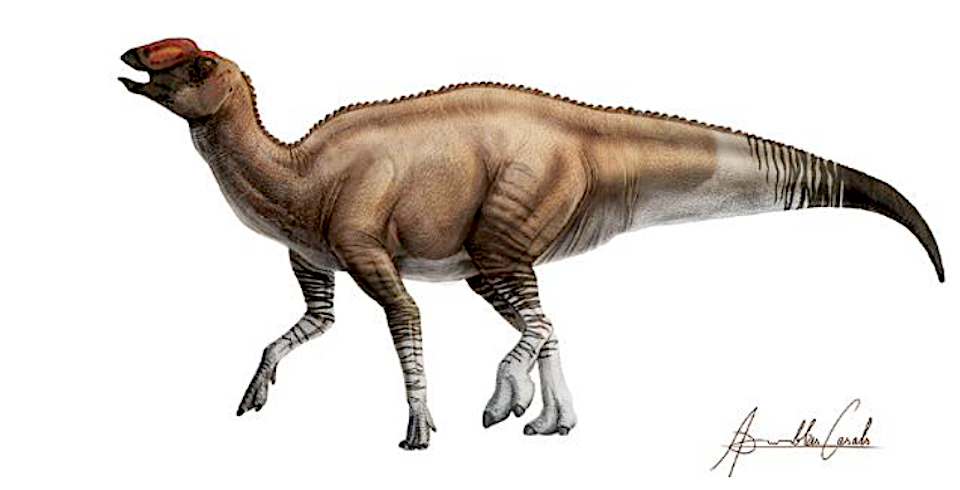
A new dinosaur species has been identified from fossilized remains found at Big Bend National Park 35 years ago/Illustration by ICRA Art
More than three decades ago, fossilized remains were pulled from the earth at Big Bend National Park. It wasn't until just recently, though, that the fossils were determined to be from a previously unknown species of duck-billed dinosaur.
The species, Aquilarhinus palimentus, is known for its aquiline nose and wide lower jaw, "shaped like two trowels laid side by side," a park release said.
The fossil was originally discovered in the 1980s by Texas Tech University Professor Tom Lehman. The bones were badly weathered and stuck together, making them impossible to study, the park said. Research in the 1990s revealed two arched nasal crests thought to be distinctive of the Gryposaurus genus. At that time the peculiar lower jaw was recognized, but it wasn’t until recent analysis that researchers came to realize that the specimen was more primitive than Gryposaurus and all other saurolophid duck-billed dinosaurs.
“This new animal is one of the more primitive hadrosaurids known and can therefore help us to understand how and why the ornamentation on their heads evolved, as well as where the group initially evolved and migrated from,” said lead author Dr. Albert Prieto-Márquez of the Institut Català de Paleontologia Miquel Crusafont, near Barcelona. “Its existence adds another piece of evidence to the growing hypothesis, still up in the air, that the group began in the Southwestern area of the U.S.”
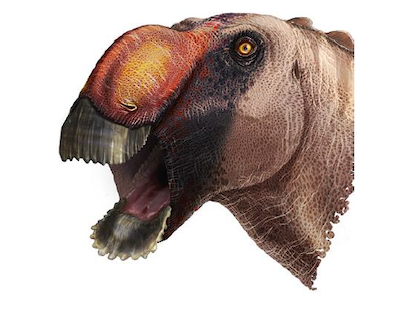
An artist's interpretation of what this new dinosaur species might have looked like/Illustration by ICRA Art
Duck-billed dinosaurs, also known as hadrosaurids, were the most common herbivorous dinosaur at the end of the Mesozoic Era, and all had a similar looking snout. The front of the jaws meet in a U-shape to support a cupped beak used for cropping plants, park staff said. The beak of some species is broader than others, but there was no evidence of a significantly different shape (and therefore likely a different feeding style) until Aquilarhinus was discovered. The lower jaws of Aquilarinus meet in a peculiar W-shape, creating a wide, flattened scoop. Around 80 million years ago, this particular dinosaur would have been shoveling through loose, wet sediment to scoop loosely-rooted aquatic plants from the tidal marshes of an ancient delta, where today lies the Chihuahuan desert.
The significance of this discovery includes that the jaw and other characteristics of the specimen show that it doesn’t fit with the group of duck-billed dinosaurs known as Saurolophidae. It’s more primitive than this group, suggesting there might have been a greater number of primitive species than previously recognized. Saurophids had a cranial crest and the current specimen also had a bony crest, shaped like a humped nose. The discovery of a solid crest outside the group supports the hypothesis that both types of crest evolved from a common ancestor.
The work was conducted under permit from Big Bend National Park, as well as the Texas Vertebrate Paleontology Collections at The University of Texas at Austin, where the specimen is housed.
Stories about:
Story Categories:
A copy of National Parks Traveler's financial statements may be obtained by sending a stamped, self-addressed envelope to: National Parks Traveler, P.O. Box 980452, Park City, Utah 84098. National Parks Traveler was formed in the state of Utah for the purpose of informing and educating about national parks and protected areas.
Residents of the following states may obtain a copy of our financial and additional information as stated below:
- Florida: A COPY OF THE OFFICIAL REGISTRATION AND FINANCIAL INFORMATION FOR NATIONAL PARKS TRAVELER, (REGISTRATION NO. CH 51659), MAY BE OBTAINED FROM THE DIVISION OF CONSUMER SERVICES BY CALLING 800-435-7352 OR VISITING THEIR WEBSITE. REGISTRATION DOES NOT IMPLY ENDORSEMENT, APPROVAL, OR RECOMMENDATION BY THE STATE.
- Georgia: A full and fair description of the programs and financial statement summary of National Parks Traveler is available upon request at the office and phone number indicated above.
- Maryland: Documents and information submitted under the Maryland Solicitations Act are also available, for the cost of postage and copies, from the Secretary of State, State House, Annapolis, MD 21401 (410-974-5534).
- North Carolina: Financial information about this organization and a copy of its license are available from the State Solicitation Licensing Branch at 888-830-4989 or 919-807-2214. The license is not an endorsement by the State.
- Pennsylvania: The official registration and financial information of National Parks Traveler may be obtained from the Pennsylvania Department of State by calling 800-732-0999. Registration does not imply endorsement.
- Virginia: Financial statements are available from the Virginia Department of Agriculture and Consumer Services, 102 Governor Street, Richmond, Virginia 23219.
- Washington: National Parks Traveler is registered with Washington State’s Charities Program as required by law and additional information is available by calling 800-332-4483 or visiting www.sos.wa.gov/charities, or on file at Charities Division, Office of the Secretary of State, State of Washington, Olympia, WA 98504.


National parks and their natural resources belong to you. The National Parks Traveler works to ensure you know how these essential places are being cared for.
Sign Up For Our Weekly Newsletter
Unsubscribe at any time.
INN Member

The easiest way to explore RV-friendly National Park campgrounds.

Here’s the definitive guide to National Park System campgrounds where RVers can park their rigs.
Our app is packed with RVing- specific details on more than 250 campgrounds in more than 70 national parks.
You’ll also find stories about RVing in the parks, tips helpful if you’ve just recently become an RVer, and useful planning suggestions.

