
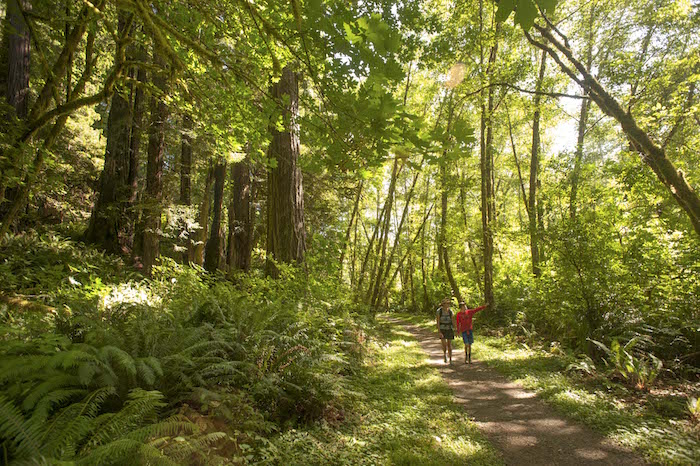
A walk along the Redwood Creek Trail at Redwood National and State Parks can take you into the big trees and deep into nature/Patrick Cone
Last summer, my wife, son, and I headed inland after traveling down the Oregon Coast, opting to spend a day hiking the beach in Redwood National Park before heading up the Bald Hills Road to the east of the town of Orick. The road climbed along a ridge, until a pullout afforded us a view down into a verdant valley: Redwood Creek. It stretched to the southern horizon, and looked big, wild and cool, with ferns, flowers and tall trees. We were intrigued, and vowed to come back.
Redwood Creek is a vast watershed, extending 61 miles to the south of its estuary on the Pacific. In 1978 this lower third of the creek was included in the expansion of Redwood National Park, but not without controversy and pushback from the locals. Upstream of the park, the private land is still being commercially logged for redwoods and other species. Within the park, old logging roads are being rehabilitated, but massive redwood stumps speak to the logging days that once filled this lower part of the valley.
So back in the park this past July, we took a day to walk up the lower part of Redwood Creek. While there are three other access points, the Redwood Creek Trail is certainly the most popular, and accessible, just half a mile east of Highway 101. The parking lot was once the home of the Orick Lumber Company back in the 1940s and 1950s, when these giant trees fell to the saw and ax. But, surprisingly, just to the southeast, an 8,000-acre grove of redwoods was left untouched, one of the largest remaining stands of big trees.
As we made our lunch at the trailhead, we watched a number of backpacking groups collect their gear, since dispersed camping is permitted on the gravel bars above MacArther Creek, with a permit, of course. Heeding warning signs about vehicle break-ins, we took our cameras and valuables with us, and walked up this easy and beautiful trail. It was a good thing we brought our camera gear, as the forest here is dark and primeval and speaks to a land of long ago.
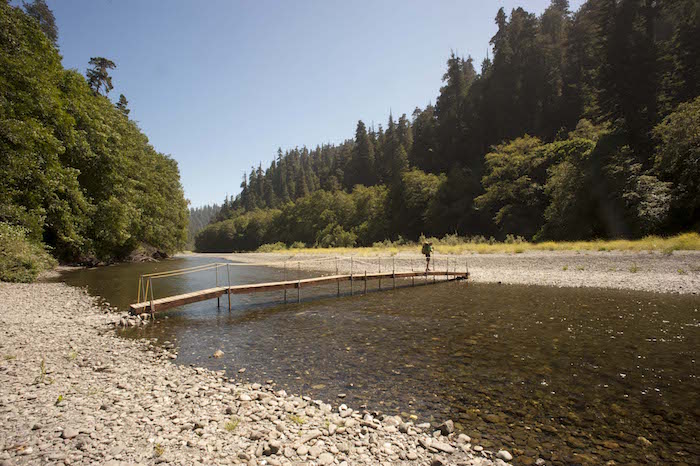
Seasonal bridges make it easy to cross Redwood Creek/Patrick Cone
Along the way were big leaf maples, red alder, giant redwoods, azaleas, blackberries and ferns, which filled every square inch of ground above the stream banks. Three hundred-foot redwoods line the trail, and where fallen giants had been cut to make way for the trail, hundreds of years of climate history were revealed. Banana slugs seemed especially interested in these slabs, as they clung to the wet wood. An osprey nest was visible in a dead snag to the west as we crossed the first of two bridges on the creek. A prairie a few miles up is home to a herd of Roosevelt Elk, but we didn’t see these elusive beasts.
The Tall Trees Grove was 8 miles up the creek, too far for an out-and-back day hike with an earlier start, but would be a perfectly lovely and isolated place to camp. But, we enjoyed the forest and crystal waters of the first few miles of the stream, a welcome respite from an unseasonable heat wave. Since it was mid-summer, the water was clear and cool, but it’s not always so placid. These two bridges are removed every year, to make way for the high waters during the rainy season, and there have been large floods that roared down the valley in the mid-1900s. We ate lunch along the stream, where the rock cobbles made great skipping stones, and a deep pool made for a refreshing dip, too.
We headed back along the trail holding hands, refreshed by the quiet solitude of the forest.
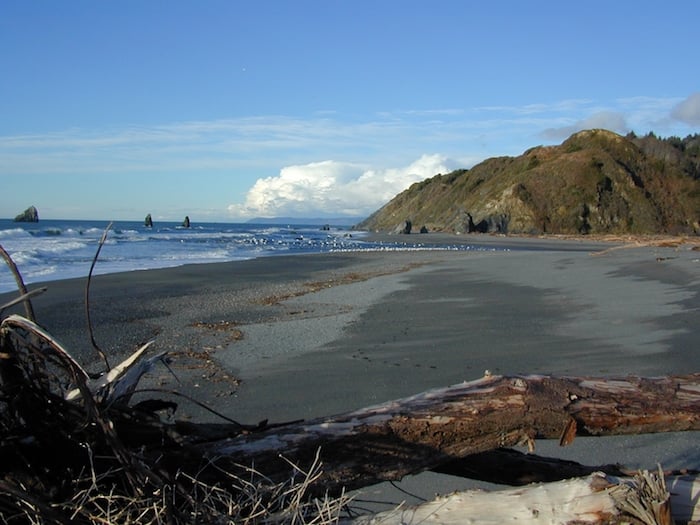
Redwood Creek empties into the Pacific Ocean/NPS
Stories about:
Story Categories:
A copy of National Parks Traveler's financial statements may be obtained by sending a stamped, self-addressed envelope to: National Parks Traveler, P.O. Box 980452, Park City, Utah 84098. National Parks Traveler was formed in the state of Utah for the purpose of informing and educating about national parks and protected areas.
Residents of the following states may obtain a copy of our financial and additional information as stated below:
- Florida: A COPY OF THE OFFICIAL REGISTRATION AND FINANCIAL INFORMATION FOR NATIONAL PARKS TRAVELER, (REGISTRATION NO. CH 51659), MAY BE OBTAINED FROM THE DIVISION OF CONSUMER SERVICES BY CALLING 800-435-7352 OR VISITING THEIR WEBSITE. REGISTRATION DOES NOT IMPLY ENDORSEMENT, APPROVAL, OR RECOMMENDATION BY THE STATE.
- Georgia: A full and fair description of the programs and financial statement summary of National Parks Traveler is available upon request at the office and phone number indicated above.
- Maryland: Documents and information submitted under the Maryland Solicitations Act are also available, for the cost of postage and copies, from the Secretary of State, State House, Annapolis, MD 21401 (410-974-5534).
- North Carolina: Financial information about this organization and a copy of its license are available from the State Solicitation Licensing Branch at 888-830-4989 or 919-807-2214. The license is not an endorsement by the State.
- Pennsylvania: The official registration and financial information of National Parks Traveler may be obtained from the Pennsylvania Department of State by calling 800-732-0999. Registration does not imply endorsement.
- Virginia: Financial statements are available from the Virginia Department of Agriculture and Consumer Services, 102 Governor Street, Richmond, Virginia 23219.
- Washington: National Parks Traveler is registered with Washington State’s Charities Program as required by law and additional information is available by calling 800-332-4483 or visiting www.sos.wa.gov/charities, or on file at Charities Division, Office of the Secretary of State, State of Washington, Olympia, WA 98504.


National parks and their natural resources belong to you. The National Parks Traveler works to ensure you know how these essential places are being cared for.
Sign Up For Our Weekly Newsletter
Unsubscribe at any time.
INN Member

The easiest way to explore RV-friendly National Park campgrounds.

Here’s the definitive guide to National Park System campgrounds where RVers can park their rigs.
Our app is packed with RVing- specific details on more than 250 campgrounds in more than 70 national parks.
You’ll also find stories about RVing in the parks, tips helpful if you’ve just recently become an RVer, and useful planning suggestions.

