
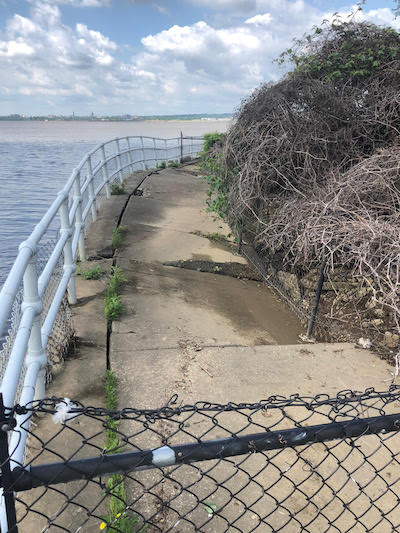
A chain link fence blocks access to a 60-foot section of East Potomac Park, part of the National Mall where deteriorating sidewalk and seawall have made it unsafe. Can Congress agree on a measure to address the park system's maintenance backlog?/NPS
Not quite a month after an effort was mounted in the U.S. Senate to provide up to $1.3 billion a year to address the National Park System's maintenance backlog, a similar piece of legislation is being raised in the U.S. House of Representatives, though with a little less money to address the backlog.
It was roughly 19 months ago, in late December 2016, that U.S. Rep. Rob Bishop, R-Utah, as chairman of the House Natural Resources Committee, refused to consider a proposal from Rep. Raúl Grijalva's, D-Arizona, to provide $300 million a year for the National Park Service to work on reducing the backlog, now nearly $12 billion. Now the two have come together to sponsor legislation that would also provide $1.3 billion a year for five years in revenues from on- and off-shore energy development to address maintenance needs. However, unlike the Senate bill, the money would be split between the Park Service, the U.S. Fish and Wildlife Service, and the U.S. Bureau of Land Management.
According to Marcia Argust, who directs The Pew Charitable Trusts’ Restore America’s Parks campaign, the Park Service would receive 80 percent of the revenue, with 65 percent dedicated to non-transportation projects. Thirty-five percent could be applied to transportation-related backlog issues, she said.
“The effort to find a compromise to fix our parks is not only bipartisan; now it is also bicameral,” said Ms. Argust. “Pew applauds Reps. Rob Bishop, Raúl Grijalva, and their colleagues for collaborating on this proposal, which combines the best of the parks deferred-maintenance bills and provides significant and consistent funding to address the backlog.”
The maintenance backlog has been akin to an albatross around the Park Service's neck. It touches almost all 417 units of the National Park System, and affects everything from working restrooms to backcountry trails. It has created safety issues for both park visitors and employees, and impacts historic structures the Park Service is tasked with preserving.
The backlog didn't arise overnight, but has grown steadily through the years, under both Republican and Democratic administrations. When he was running for president in 2001, George W. Bush said he would eliminate the backlog, which then stood at $4.9 billion, in five years. That, of course, didn't happen, and it has grown year by year, fed both by insufficient annual appropriations for the National Park Service, new problems that crop up, and as more than a few capital projects funded new construction rather than addressing maintenance needs, many tied to aging infrastructure.
The legislation Reps. Bishop and Grijalva announced Wednesday drew praise from conservation groups and others
“Our country’s national parks hold some of America’s most precious natural and cultural resources from the rocky coastlines of Acadia to the Navajo sandstone cliffs of Zion. Unfortunately, due to years of funding shortfalls, our most treasured places are plagued by outdated water infrastructure, crumbling trails and decaying park facilities across the National Park System – nearly $12 billion in needed repairs," said Theresa Pierno, president and CEO of the National Parks Conservation Association. "Millions of Americans visit our parks annually and expect great experiences when there. Today, with the introduction of the Restore our Parks and Public Lands Act, Congress is one step closer to ensuring that our parks can continue to provide safe conditions for visitors, while also protecting the resources that help tell our shared American story.
“This bipartisan compromise bill is a major step towards addressing our parks’ maintenance needs, ensuring our most historically, culturally and naturally significant places are preserved for years to come. By restoring park roads, buildings and trails at national parks, we also enhance visitor access and experiences, and provide tremendous economic benefits for gateway communities nationwide," she added.
At the U.S. Travel Association, Tori Barnes, senior vice president for government relations, said it's vital for Congress to address the backlog.
“America’s national parks are major attractions for visitors from far and near. In 2017 alone, visitors to national parks spent $18 billion in gateway communities, which supported thousands of local jobs and fueled nearby businesses, like restaurants, hotels and retail shops," she said. "It is critical to preserve and protect our national parks to benefit generations to come, and the Restore Our Parks and Public Lands Act will help to do just that by providing a dedicated and reliable source of funding to maintain and repair our nation’s parks."
That sentiment was echoed by the Public Lands Alliance, which represents nonprofit organizations that work in the national parks and other public landscapes.
"The Public Lands Alliance believes that America's parks, wildlife refuges, conservation areas, and public lands require a dedicated, reliable, and sizeable funding source to substantially address their existing maintenance backlog," said Dan Puskar, the group's executive director. "PLA applauds the bipartisan Restore Our Parks and Public Lands Act for doing just that, while emphasizing critical improvements to public lands access, safety, recreation, and enjoyment. Investments created through the Restore Our Parks and Public Lands Act can help inspire continued private support for historic preservation, trail restoration, and other infrastructure needs that enhance the visitor experience."
What remains to be seen is whether Congress, facing mid-term elections in November, will find the time and energy to come up with a compromise on the House and Senate measures and send it to President Trump for his signature.
Story Categories:
A copy of National Parks Traveler's financial statements may be obtained by sending a stamped, self-addressed envelope to: National Parks Traveler, P.O. Box 980452, Park City, Utah 84098. National Parks Traveler was formed in the state of Utah for the purpose of informing and educating about national parks and protected areas.
Residents of the following states may obtain a copy of our financial and additional information as stated below:
- Florida: A COPY OF THE OFFICIAL REGISTRATION AND FINANCIAL INFORMATION FOR NATIONAL PARKS TRAVELER, (REGISTRATION NO. CH 51659), MAY BE OBTAINED FROM THE DIVISION OF CONSUMER SERVICES BY CALLING 800-435-7352 OR VISITING THEIR WEBSITE. REGISTRATION DOES NOT IMPLY ENDORSEMENT, APPROVAL, OR RECOMMENDATION BY THE STATE.
- Georgia: A full and fair description of the programs and financial statement summary of National Parks Traveler is available upon request at the office and phone number indicated above.
- Maryland: Documents and information submitted under the Maryland Solicitations Act are also available, for the cost of postage and copies, from the Secretary of State, State House, Annapolis, MD 21401 (410-974-5534).
- North Carolina: Financial information about this organization and a copy of its license are available from the State Solicitation Licensing Branch at 888-830-4989 or 919-807-2214. The license is not an endorsement by the State.
- Pennsylvania: The official registration and financial information of National Parks Traveler may be obtained from the Pennsylvania Department of State by calling 800-732-0999. Registration does not imply endorsement.
- Virginia: Financial statements are available from the Virginia Department of Agriculture and Consumer Services, 102 Governor Street, Richmond, Virginia 23219.
- Washington: National Parks Traveler is registered with Washington State’s Charities Program as required by law and additional information is available by calling 800-332-4483 or visiting www.sos.wa.gov/charities, or on file at Charities Division, Office of the Secretary of State, State of Washington, Olympia, WA 98504.


National parks and their natural resources belong to you. The National Parks Traveler works to ensure you know how these essential places are being cared for.
Sign Up For Our Weekly Newsletter
Unsubscribe at any time.
INN Member

The easiest way to explore RV-friendly National Park campgrounds.

Here’s the definitive guide to National Park System campgrounds where RVers can park their rigs.
Our app is packed with RVing- specific details on more than 250 campgrounds in more than 70 national parks.
You’ll also find stories about RVing in the parks, tips helpful if you’ve just recently become an RVer, and useful planning suggestions.

