
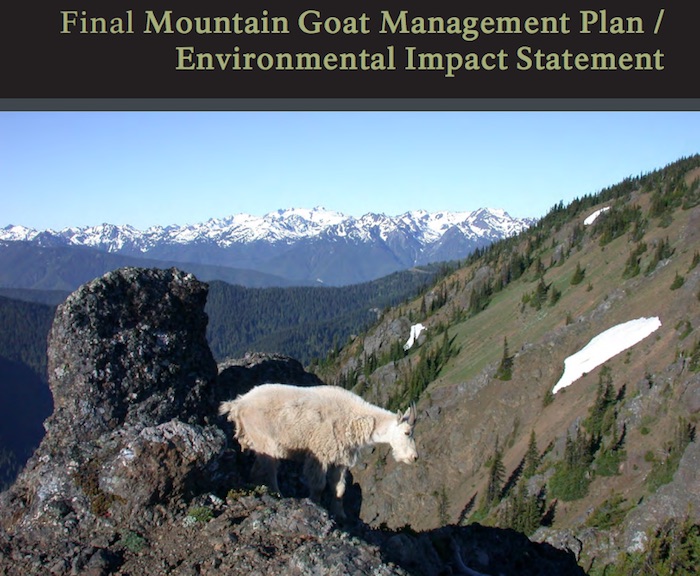
Mountain goats, introduced between 1925 and 1929 to the landscape now covered by Olympic National Park, would be removed from the park through both trapping and lethal means under an alternative the National Park Service has settled on.
The plan, open for public review through June 4, calls for trapping and relocating as many of the park's estimated 625-675 mountain goats. However, culling of the animals would be used to rid the park of mountain goats "determined to be uncatchable."
Park officials have been working in cooperation with the U.S. Forest Service and Washington Department of Fish and Wildlife to develop a management plan for the goats. While the animals are considered picturesque to photographers and a symbol of wildness to others, they can be deadly. The family of 63-year-old Robert Boardman, of Port Angeles, Washington, filed a multimillion-dollar lawsuit against the Park Service over his death in Olympic in October 2010. He was protecting other hikers from a goat, estimated at 370 pounds, when it gored him in the thigh and then reportedly stood over him as he bled to death.
In deciding to remove the goats, park staff say the animals can be a threat to visitors, adversely impact soils by wallowing and trails, could be impacting habitat used by threatened and or endangered species, and damage vegetation. Trapping could involve the use in some areas of salt blocks to congregate goats.
According to the Final Environmental Impact Statement prepared for managing the non-native species, removal of the goats would "result in long-term, beneficial impacts on most resources, including substantial beneficial impacts on the natural quality of wilderness, wildlife and wildlife habitat, including special-status species; vegetation, including special-status plant species; archeological resources; and soils, as a result of the removal of the majority of adverse impacts on these resources by mountain goats."
"Approximately 50 percent of the mountain goats would be captured and relocated and the remaining mountain goats would be lethally removed," the document said.
You can read the entire document at this site.
Stories about:
Story Categories:
A copy of National Parks Traveler's financial statements may be obtained by sending a stamped, self-addressed envelope to: National Parks Traveler, P.O. Box 980452, Park City, Utah 84098. National Parks Traveler was formed in the state of Utah for the purpose of informing and educating about national parks and protected areas.
Residents of the following states may obtain a copy of our financial and additional information as stated below:
- Florida: A COPY OF THE OFFICIAL REGISTRATION AND FINANCIAL INFORMATION FOR NATIONAL PARKS TRAVELER, (REGISTRATION NO. CH 51659), MAY BE OBTAINED FROM THE DIVISION OF CONSUMER SERVICES BY CALLING 800-435-7352 OR VISITING THEIR WEBSITE. REGISTRATION DOES NOT IMPLY ENDORSEMENT, APPROVAL, OR RECOMMENDATION BY THE STATE.
- Georgia: A full and fair description of the programs and financial statement summary of National Parks Traveler is available upon request at the office and phone number indicated above.
- Maryland: Documents and information submitted under the Maryland Solicitations Act are also available, for the cost of postage and copies, from the Secretary of State, State House, Annapolis, MD 21401 (410-974-5534).
- North Carolina: Financial information about this organization and a copy of its license are available from the State Solicitation Licensing Branch at 888-830-4989 or 919-807-2214. The license is not an endorsement by the State.
- Pennsylvania: The official registration and financial information of National Parks Traveler may be obtained from the Pennsylvania Department of State by calling 800-732-0999. Registration does not imply endorsement.
- Virginia: Financial statements are available from the Virginia Department of Agriculture and Consumer Services, 102 Governor Street, Richmond, Virginia 23219.
- Washington: National Parks Traveler is registered with Washington State’s Charities Program as required by law and additional information is available by calling 800-332-4483 or visiting www.sos.wa.gov/charities, or on file at Charities Division, Office of the Secretary of State, State of Washington, Olympia, WA 98504.


National parks and their natural resources belong to you. The National Parks Traveler works to ensure you know how these essential places are being cared for.
Sign Up For Our Weekly Newsletter
Unsubscribe at any time.
INN Member

The easiest way to explore RV-friendly National Park campgrounds.

Here’s the definitive guide to National Park System campgrounds where RVers can park their rigs.
Our app is packed with RVing- specific details on more than 250 campgrounds in more than 70 national parks.
You’ll also find stories about RVing in the parks, tips helpful if you’ve just recently become an RVer, and useful planning suggestions.


Comments
On what grounds is Mr, Boardman’s family suing how can the NPS be held responsible for a wild animal attack?
Jay- I believe the lawsuit is over, but NPT had a good summary of the issues a while back:
https://www.nationalparkstraveler.org/2015/07/appellate-court-affirms-na...
im sorry for the family’s loss, but you’re in the animals home, don’t expect them to act like a tame animal.
i understand removing some of the goats, but not killing them. There must be other locations they can be transferred to.
I am sorry for the family ‘s loss but often animals are just defending their families. The hikers were lucky that Mr. Boardman stepped in to rescue them, but why did they need rescued. I have seen people do really dangerous things to get close to a wild animal for a photo.
Are goats the only lethal animals in the park? Elk Moose Bears and even coyotes are dangerous, do they get moved also? Where do these non native mountain goats belong?
The goats are wild animals just like bears, moose, wolves, etc and should be allowed to live in their environment even if they are technically non-native to that park. I too am sorry that a man lost his life and did so while protecting other people, but lethally removing these animals is not the solution.
The goats are an invasive species in the park and need to be removed to protect the park's ecosystems. As for the goat attack that occurred, none of the humans involved approached or antagonized the goat in question. The goat was known by park rangers to be aggressive and that was the grounds of the lawsuit. While I'm glad the NPS won the lawsuit, the hikers involved in the attack were not to blame.
I cannot believe they are going to KILL 50% of these goats, that's over 300 of them. That is unconsionable! Remove them if you must to other places where they are native but DO NOT KILL THEM!