
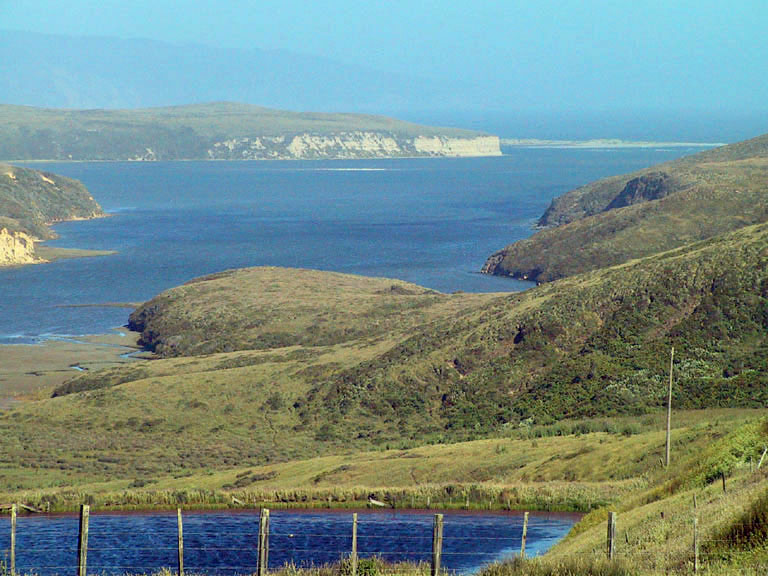
A 30-day comment period has opened to provide the National Park Service with thoughts, ideas, and opinions on the question of dairy and beef ranching on Point Reyes National Seashore and a portion of Golden Gate National Recreation Area, as well as the future of Tule elk on the seashore.
Both issues carry a measure of controversy, as some think cattle don't belong on the national seashore and bring adverse impacts, while others maintain that the Park Service doesn't properly manage the Tule elk herd.
The issue of cattle ranching led this past summer to a settlement in federal court by which the Park Service agreed to consider an amendment to its 37-year-old General Management Plan at Point Reyes to guide the future of cattle on the seashore. Three alternatives the Park Service agreed to consider are: no ranching, no dairy ranching, and reduced ranching.
Last February, three environmental groups – Resource Renewal Institute, the Center for Biological Diversity, and the Western Watersheds Project – filed a lawsuit claiming the Park Service violated laws, including the National Environmental Policy Act, by authorizing year-round livestock ranching without without preparing an environmental analysis of its impact on Point Reyes.
Under the settlement, the Park Service agreed to complete an environmental impact statement for approximately 28,000 acres in the national seashore and the north district of Golden Gate National Recreation Area, including all lands currently leased for ranching.
In seeking public input on the matter, the Park Service has offered six "conceptual" alternatives, ranging from the three noted above to one that would provide 20-year agricultural lease/permits with diversification and increased operational flexibility, a proposal to balance Tule elk numbers with livestock numbers, and one to remove the elk from the seashore. Details of the proposal can be found at this site.
Those alternatives could change depending on public input, the Park Service noted.
Two open houses to discuss the matter have been scheduled:
Wednesday, October 25
5 p.m.–7 p.m.
West Marin School Gym
Point Reyes Station, CAThursday, October 26
5 p.m.–7 p.m.
Bay Model Visitor Center
Sausalito, CA
Approximately 15 private ranching enterprises, some passed down within the family for generations, graze beef and dairy cattle on 24 lease units, which make up more than 18,000 of the park’s 71,000 acres. The settlement allows the Park Service to issue leases or permits to commercial ranchers for terms not to exceed five years from the date the agreement is approved. These interim leases provide greater certainty to ranchers than the one-year authorizations the Park Service has been issuing while developing a Ranch Comprehensive Management Plan.
The settlement ceases work on the Ranch Comprehensive Management Plan, which has been in progress since 2014 but did not include an alternative that would completely remove ranching from the park.
The tule elk were thought to be extinct in the 1800s, primarily due to overhunting and displacement by cattle. Around 30 animals were discovered in 1874, and efforts were made to save the species. State and federal legislation led to 10 animals being reintroduced at a 2,600-acre fenced enclosure on Tomales Point in 1978 in an attempt to restore natural systems historically found at Point Reyes. After a period of slow growth, the population exploded to more than 500 in the 1990s, and ranchers pointed to studies that that number far exceeded optimal carrying capacity.
Story Categories:
A copy of National Parks Traveler's financial statements may be obtained by sending a stamped, self-addressed envelope to: National Parks Traveler, P.O. Box 980452, Park City, Utah 84098. National Parks Traveler was formed in the state of Utah for the purpose of informing and educating about national parks and protected areas.
Residents of the following states may obtain a copy of our financial and additional information as stated below:
- Florida: A COPY OF THE OFFICIAL REGISTRATION AND FINANCIAL INFORMATION FOR NATIONAL PARKS TRAVELER, (REGISTRATION NO. CH 51659), MAY BE OBTAINED FROM THE DIVISION OF CONSUMER SERVICES BY CALLING 800-435-7352 OR VISITING THEIR WEBSITE. REGISTRATION DOES NOT IMPLY ENDORSEMENT, APPROVAL, OR RECOMMENDATION BY THE STATE.
- Georgia: A full and fair description of the programs and financial statement summary of National Parks Traveler is available upon request at the office and phone number indicated above.
- Maryland: Documents and information submitted under the Maryland Solicitations Act are also available, for the cost of postage and copies, from the Secretary of State, State House, Annapolis, MD 21401 (410-974-5534).
- North Carolina: Financial information about this organization and a copy of its license are available from the State Solicitation Licensing Branch at 888-830-4989 or 919-807-2214. The license is not an endorsement by the State.
- Pennsylvania: The official registration and financial information of National Parks Traveler may be obtained from the Pennsylvania Department of State by calling 800-732-0999. Registration does not imply endorsement.
- Virginia: Financial statements are available from the Virginia Department of Agriculture and Consumer Services, 102 Governor Street, Richmond, Virginia 23219.
- Washington: National Parks Traveler is registered with Washington State’s Charities Program as required by law and additional information is available by calling 800-332-4483 or visiting www.sos.wa.gov/charities, or on file at Charities Division, Office of the Secretary of State, State of Washington, Olympia, WA 98504.


National parks and their natural resources belong to you. The National Parks Traveler works to ensure you know how these essential places are being cared for.
Sign Up For Our Weekly Newsletter
Unsubscribe at any time.
INN Member

The easiest way to explore RV-friendly National Park campgrounds.

Here’s the definitive guide to National Park System campgrounds where RVers can park their rigs.
Our app is packed with RVing- specific details on more than 250 campgrounds in more than 70 national parks.
You’ll also find stories about RVing in the parks, tips helpful if you’ve just recently become an RVer, and useful planning suggestions.

