
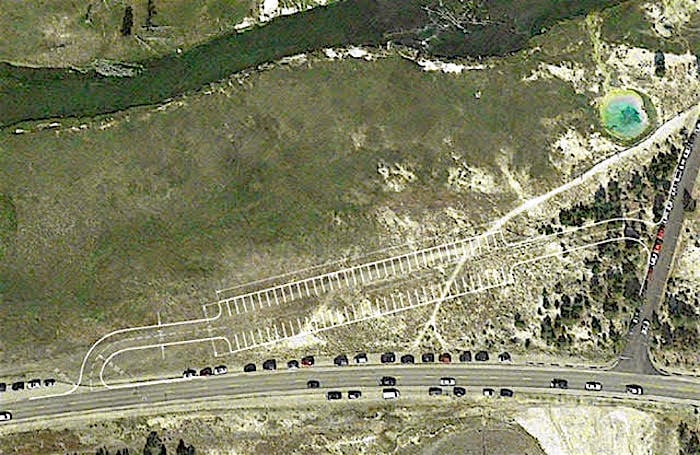
Yosemite Valley is so crowded, why not build a temporary gravel lot in Cook's Meadow that could handle 75 vehicles?
Parking at the Logan Pass Visitor Center in Glacier National Park in August is near-impossible if you don't show up shortly after sunrise, so why not expand the lot with an acre of gravel in the meadow? And, surely, there must be a half-acre of ground near the summit of Cadillac Mountain at Acadia National Park where tour buses could idle while visitors take in the view of Frenchman Bay and sip some lemonade.
And if all those temporary solutions gain headway, why not make them permanent by paving over the gravel?
Of course, all those suggestions are ridiculous and wouldn't gain traction, let alone be vetted before the public. So why are Yellowstone National Park officials thinking of building a three-quarters-of-an-acre gravel lot near the Fairy Falls Trailhead that, while temporary at first bad thought, could turn into a permanent asphalt lot?
Although the trail leads to Fairy Falls and Imperial Geyser, another major draw is a hill along the route that offers a bird’s-eye view of the nearby Grand Prismatic Spring in Midway Geyser Basin. Social media and guidebooks started driving so many people to this location that Yellowstone crews are constructing an official trail and overlook to replace the many existing social trails on the hill. A formal trail to a spectacular view of the largest hot spring in the United States? It doesn’t take much imagination to see how the proposed temporary lot could become so popular that the park would be urged to lay down some asphalt.
Too many cars, trucks, and buses in Yellowstone? Surely there has to be a better solution than stripping two inches of topsoil and cutting down five lodgepole piness from a small slice of Yellowstone to create additional parking in a park that is struggling with record visitation. If this is the response to the nearly 4.3 million visitors who explored Yellowstone in 2016, what will the solution be when that tally bumps up to 4.5 million, or 4.75 million, or 5 million?
Yes, it can be frustrating to find a parking space at the often-busy Midway Geyser Basin. Of course, if drivers get fed up waiting for an opening, they could decide to turn the new temporary lot into a de facto “overflow” lot and walk about a mile back along the Grand Loop Road to the Midway boardwalk, negating any safety gains. And what happens when that parking lot is consistently full? Build another?
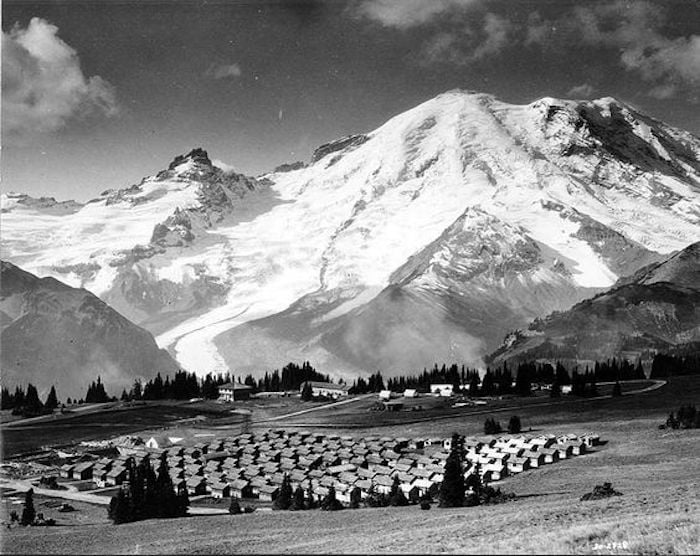
Yellowstone officials, in trying to justify this lot, note that once upon a time the ground had been disturbed by a freight road. Well, once upon a time a sprawling campground along with 215 cabins was located on the flanks of Sunrise in Mount Rainier National Park. Though those cabins were removed in the 1930s and 1940s, should the Park Service justify rebuilding a cabin city there on the grounds that other park campgrounds are insufficient to handle demand and, by the way, this area had previously been disturbed?
"It's critical that we don't get caught in a cycle of simply creating new parking lots or expanding infrastructure in a one-off manner. This approach could negatively impact the very natural resources visitors flock to Yellowstone to view," Stephanie Adams, the Yellowstone Program manager for the National Parks Conservation Association, told the Traveler. "NPCA will be submitting comments on the parking lot project encouraging the Park Service to hit the brakes on the parking lot and complete a long-term infrastructure and visitation plan for Yellowstone over the next year."
We couldn't agree more.
Unfortunately, growing visitation to the National Park System's crown jewels is a given. The Park Service should not bow down to that visitation and see how many more folks its can squeeze into the parks by building more parking lots, more lodges, and more front-country campgrounds. Rather, as unfortunate as it also may be, the agency should move to set carrying capacities for the parks, and enforce existing parking regulations, to ensure these landscapes are not further eroded away by visitors and their rigs.
The comment period on this proposed gravel lot in Yellowstone runs through the end of March. Comment now.
Stories about:
Story Categories:
A copy of National Parks Traveler's financial statements may be obtained by sending a stamped, self-addressed envelope to: National Parks Traveler, P.O. Box 980452, Park City, Utah 84098. National Parks Traveler was formed in the state of Utah for the purpose of informing and educating about national parks and protected areas.
Residents of the following states may obtain a copy of our financial and additional information as stated below:
- Florida: A COPY OF THE OFFICIAL REGISTRATION AND FINANCIAL INFORMATION FOR NATIONAL PARKS TRAVELER, (REGISTRATION NO. CH 51659), MAY BE OBTAINED FROM THE DIVISION OF CONSUMER SERVICES BY CALLING 800-435-7352 OR VISITING THEIR WEBSITE. REGISTRATION DOES NOT IMPLY ENDORSEMENT, APPROVAL, OR RECOMMENDATION BY THE STATE.
- Georgia: A full and fair description of the programs and financial statement summary of National Parks Traveler is available upon request at the office and phone number indicated above.
- Maryland: Documents and information submitted under the Maryland Solicitations Act are also available, for the cost of postage and copies, from the Secretary of State, State House, Annapolis, MD 21401 (410-974-5534).
- North Carolina: Financial information about this organization and a copy of its license are available from the State Solicitation Licensing Branch at 888-830-4989 or 919-807-2214. The license is not an endorsement by the State.
- Pennsylvania: The official registration and financial information of National Parks Traveler may be obtained from the Pennsylvania Department of State by calling 800-732-0999. Registration does not imply endorsement.
- Virginia: Financial statements are available from the Virginia Department of Agriculture and Consumer Services, 102 Governor Street, Richmond, Virginia 23219.
- Washington: National Parks Traveler is registered with Washington State’s Charities Program as required by law and additional information is available by calling 800-332-4483 or visiting www.sos.wa.gov/charities, or on file at Charities Division, Office of the Secretary of State, State of Washington, Olympia, WA 98504.


National parks and their natural resources belong to you. The National Parks Traveler works to ensure you know how these essential places are being cared for.
Sign Up For Our Weekly Newsletter
Unsubscribe at any time.
INN Member

The easiest way to explore RV-friendly National Park campgrounds.

Here’s the definitive guide to National Park System campgrounds where RVers can park their rigs.
Our app is packed with RVing- specific details on more than 250 campgrounds in more than 70 national parks.
You’ll also find stories about RVing in the parks, tips helpful if you’ve just recently become an RVer, and useful planning suggestions.


Comments
Perhaps we can look at out of park structures like Hoover Dam and trolleys to carry people in the parks.
Good luck. The obvious solution (shuttles and other forms of public transit to/from/in the parks) was fought tooth and nail even by more environmentally concerned administrations. People love their cars and the freedom they offer and won't give them up without a fight. Progress might be made by getting people out of their cars and off the very beaten paths to see what can be experienced just a short distance from the asphalt, but that, too, seems to be a pipe dream.
Why not expand public transportation within the parks so people don't have to drive in. Hybrid buses would cause less pollution. I would love it if I didn't have to drive in. Pick up points at the entrances would lessen the traffic, buses taking park goers to all of the attractions would be so much nicer than lines of cars waiting for parking spaces. Would have loved that in Smokey Mts.
These areas have not been set aside to create parking lots. What a waste of beauty and natural resource just to allow more people to pack in. Would rather see permit only, or daily limits out on traffic than see areas wasted in parking lots. It will never be enough, and soon, there will be nothing but parking facilities.
You will never buld enough lots in the right places.....and the cost of decimating our precious park areas is too high of a price! Get out of your cars and hop on a shuttle or walk!
There's a song about this, "Big Yellow Taxi". Some of the verse is; ".. they paved paradise and put up a parking lot...". We don't need more parking lots in paradise.
Exactly my thought, thank you!
I love our National Parks and have visited over half of them with the goal of someday seeing them all. I get one 2 week vacation each summer to travel. While the parking lots are unsightly and adverse to the natural environment, I would be devastated if I arrived at a park on the other side of the continent only to be denied entry because the park is full. It seems like people are upset that so many others also enjoy the parks. I enjoy the solitude of being the only one in a remote area of the parks, but with our population those moments are very rare. We need to find creative solutions so that all Americans (and foreigners) can enjoy our amazing parks. Everyone deserves to see these yet we don't want to destroy them with parking lots. I sure hope top minds can find a way to construct eco friendly underground parking areas or something similar.
Build the parking lots and make them large enough for RVs. Most of the parks are hundreds or thousands of acres and theres no reason I can think of that more and larger parking areas can't be made. It is much safer for pedestrians to walk in parking lots than along the edge of roadways. Especially families with young children. Safety first!
Curious how a shuttle would work at Yellowstone with over 250 miles of road: To and from the Old Faithful Visitor center could take hours, to say nothing of taking it from Gardiner, Jackson, etc. Maybe time restrictions on a certain amount of parking lots (say 1 hr limit in the popular areas) might be workable, encourage the long term usres to park further out. Who knows, but what works in a confined location like Zion or Yosemite would be impractical at a huge spread out park like Yellowstone
For what it's worth, Ricky, one shuttle possibility might be to base shuttles out of lodging areas. For instance, have a shuttle from Old Faithful that runs down to Madison Junction, stopping at the pertinent spots to let people out, collect those going back to Old Faithful.
Another from Canyon could run to Tower Junction, Lake and Madison Junction. From Mammoth you could run a shuttle to Tower Junction and another to Madison Junction. From Grant Village you run to Old Faithful, Lake and the South Entrance.
Just a rough idea, but something to build on, eh? Have enough shuttles, running upwards of 18 hours or so a day, and folks could park their cars for their stay and use shuttles to get around, kinda like hiker shuttles work in some parks.
The NPS should interpret the population trend of Homo sapiens and point out the correlation to extinctions of other species and greenhouse gas measurements. The "loved to death" parks are overrun by Sapiens.
hhaving spent last season in Yellowstone I can tell you that there was way more than 4.3 million visitors. when most people get to the 'must-see' spots like grand prismatic there is no parking so they make their own parking along the roads sometimes a mile long i either direction. this causes an enormous amount of destruction to the lanscape both physically and visually. it also turns the roads into parking lots which creates very hazardous situations for people walking and makes it very difficult for emergency vehicles to get through. im not sure that this is the best solution but something needs to be done
Assuming this situation continues, I think they'll have to have mandatory shuttles and ticketing for the big famous parks. If you want to stay in the park, you'll be reserving lodging two years out.
Let's expand the park system to spread out the impacts - add new parks and monuments, and expand the size of those that we have. Yellowstone needs to be expanded just to support the winter habitat of the wildlife that lives there! If it were larger, people would spread out somewhat into the new area, and put a bit less pressure on the existing sites.
Yes its disppointing to not get to see the things you traveld to a National Park to see, but paving over acres of grass isn't the solution. Who wants to go to a NAtional Park to commune with nature and see amusement park sized parking lots everywhere?
I don't see how a mandatory mass-transit system could work in Yellowstone. Would it include lodging guests, RV & car campers, stock users, backpackers, bicyclists, canoeists, or visitors who had planned to transit the park from one side to another as part of a larger itinerary? If not, then you have a built-in double-standard favoring some visitors over others. If no private vehicles were allowed in the core of the park, then many parking lots far larger than 75 spaces would need to be built somewhere, not to mention bus barns and maintenance shops.
IMO, entry quotas are the only realistic way to limit long-term damage to some parks.
They should TOTALLY build that lot. It hurts conservation efforts to restrict people from enjoying our national parks. Getting people in, many of whom have never encountered this type of wilderness, excites them and creates a populace more inclined to preserve our land. Cutting down a handful of trees to accomodate this is more than fair. Over 80 million trees burned in the Yellowstone fire of 1988, which the National Park Service argues was good for the parks biodiversity.
Expanding people's access to the parks, in a responsible way, is the key to their protection. Restricting access leads to higher fees and fewer visitors. Visiting national parks should not be an elite activity, it should be an American right of passage!