
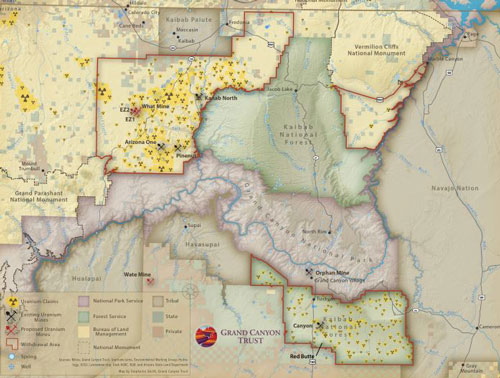
This map shows uranium mines and claims in the vicinity of Grand Canyon National Park. A larger version is available at this link. Map courtesy Grand Canyon Trust.
A federal judge has denied a request by a coalition of conservation groups and the Havasupai Tribe to halt uranium mining at a site near the South Rim of Grand Canyon National Park. The legal action had challenged the U.S. Forest Service’s decision to allow the mine to be reopened without updating a federal environmental review that was originally prepared in 1986.
The uranium mine, known as the Canyon Mine, is located on U. S. Forest Service property, and is being developed by Energy Fuels. According to the company website, the site is located approximately 6 miles southeast of Tusayan, Arizona; that small community is immediately south of the main entrance to the park.
“We are very disappointed with the ruling by Judge Campbell in the Canyon Mine case,” said Havasupai Chairman Rex Tilousi. “We believe that the National Historic Preservation Act requires the Forest Service to consult with us and the other affiliated tribes before they let the mining company damage Red Butte, one of our most sacred traditional cultural properties. The Havasupai Tribal Council will meet this week to talk about appealing this ruling.”
Concerns Raised About Possible Impacts on Groundwater
“This is bad news for protecting Grand Canyon and tribal sacred sites,” said Roger Clark of the Grand Canyon Trust. “Over the last two decades, we’ve learned how uranium mining can pollute aquifers that feed canyon springs and Havasu Falls. But the Forest Service has ignored that information and failed to require Energy Fuels to take reasonable steps to prevent contamination of water, sacred sites and public lands.”
According to the Center for Biological Diversity (CBD), "the Forest Service first approved the Canyon mining plan in 1986, despite a challenge from the Havasupai tribe. Uranium prices plummeted shortly thereafter and the mine closed in 1990 before producing any uranium."
"The Forest Service allowed the Canyon Mine to reopen in 2012 without a plan update or environmental assessment to reflect the extensive changed circumstances since the original review and approval. These changes include the 2010 designation of the Red Butte traditional cultural property, reintroduction of the endangered California condor in the vicinity of the Canyon Mine, and the 2012 decision to ban new uranium mining across 1 million acres near the Grand Canyon."
“This uranium project could haunt the Grand Canyon region for decades to come,” said Katie Davis with the Center for Biological Diversity. “Uranium mining leaves a highly toxic legacy that endangers human health, wildlife and the streams and aquifers that feed the Grand Canyon. It’s disappointing to see the Forest Service prioritizing the extraction industry over the long-term protection of a place as iconic as the Grand Canyon.”
Mine's Original Approval Dates to 1986
The mine’s original approval in 1986 was the subject of protests and lawsuits by the Havasupai Tribe and others objecting to potential uranium mining impacts on regional groundwater, springs, creeks, ecosystems and cultural values associated with Red Butte. Aboveground infrastructure was built in the early 1990s, but a crash in uranium prices caused the mine’s closure before the shaft or ore bodies could be excavated.
According to the CBD, "Pre-mining exploratory drilling drained groundwater beneath the mine site, eliminating an estimated 1.3 million gallons per year from the region’s springs that are fed by groundwater."
"A 2010 U.S. Geological Survey report noted that past samples of groundwater beneath the mine exhibited dissolved uranium concentrations in excess of EPA drinking water standards. Groundwater threatened by the mine feeds municipal wells and seeps and springs in Grand Canyon, including Havasu Springs and Havasu Creek."
Mine opponents express concerns that "Aquifer Protection Permits issued for the mine by Arizona Department of Environmental Quality do not require monitoring of deep aquifers and do not include remediation plans or bonding to correct deep aquifer contamination."
"Geologists have warned that uranium mining could deplete and contaminate aquifers that discharge into Grand Canyon and that cleaning them up would be next to impossible," says the CBD.
"A 2010 U.S. Geological Survey study found elevated uranium levels in soil and water sources associated with past uranium mining," a CBD spokesperson noted. "Groundwater connectivity studies of the Grand Canyon that were published subsequent to the Canyon Mine’s 1986 approval indicate the potential for uranium contamination to infiltrate perched and deep aquifers and regional creeks and springs, including Havasu Falls."
Colorado River at Grand Canyon Recently Named "America's Most Endangered River"
The Colorado River at Grand Canyon National Park was recently named the "Most Endangered River in the Nation" by the conservation group American Rivers. The potential for renewed uranium mining was cited as one of three major issues in that designation.
A press release by Energy Fuels says the company is "currently America’s largest conventional uranium producer," and noted the company "recently announced that it was preparing to resume development at this project. At the current time, surface development at the Canyon mine, including a headframe, evaporation pond, hoist, environmental controls, and an office/maintenance facility, is in place. To complete the mine, the Company expects to sink an additional 1,200 feet of shaft, install a ventilation shaft and complete underground development."
Opponents of the mine are discussing the possibility of an appeal of this week's court order. A copy of the decision by U. S. District Judge David Campbell, which was issued on April 7, 2015, is available at this link.
Stories about:
Story Categories:
A copy of National Parks Traveler's financial statements may be obtained by sending a stamped, self-addressed envelope to: National Parks Traveler, P.O. Box 980452, Park City, Utah 84098. National Parks Traveler was formed in the state of Utah for the purpose of informing and educating about national parks and protected areas.
Residents of the following states may obtain a copy of our financial and additional information as stated below:
- Florida: A COPY OF THE OFFICIAL REGISTRATION AND FINANCIAL INFORMATION FOR NATIONAL PARKS TRAVELER, (REGISTRATION NO. CH 51659), MAY BE OBTAINED FROM THE DIVISION OF CONSUMER SERVICES BY CALLING 800-435-7352 OR VISITING THEIR WEBSITE. REGISTRATION DOES NOT IMPLY ENDORSEMENT, APPROVAL, OR RECOMMENDATION BY THE STATE.
- Georgia: A full and fair description of the programs and financial statement summary of National Parks Traveler is available upon request at the office and phone number indicated above.
- Maryland: Documents and information submitted under the Maryland Solicitations Act are also available, for the cost of postage and copies, from the Secretary of State, State House, Annapolis, MD 21401 (410-974-5534).
- North Carolina: Financial information about this organization and a copy of its license are available from the State Solicitation Licensing Branch at 888-830-4989 or 919-807-2214. The license is not an endorsement by the State.
- Pennsylvania: The official registration and financial information of National Parks Traveler may be obtained from the Pennsylvania Department of State by calling 800-732-0999. Registration does not imply endorsement.
- Virginia: Financial statements are available from the Virginia Department of Agriculture and Consumer Services, 102 Governor Street, Richmond, Virginia 23219.
- Washington: National Parks Traveler is registered with Washington State’s Charities Program as required by law and additional information is available by calling 800-332-4483 or visiting www.sos.wa.gov/charities, or on file at Charities Division, Office of the Secretary of State, State of Washington, Olympia, WA 98504.
INN Member

The easiest way to explore RV-friendly National Park campgrounds.

Here’s the definitive guide to National Park System campgrounds where RVers can park their rigs.
Our app is packed with RVing- specific details on more than 250 campgrounds in more than 70 national parks.
You’ll also find stories about RVing in the parks, tips helpful if you’ve just recently become an RVer, and useful planning suggestions.


Comments
"Nothing dollarable is safe, however guarded."
John Muir, 1910
A conservative LDS appointee of George W. Bush.
Thank you Afred Runte and Rick B, a terrible decision. I hope it is appealed. By the way Alfred Runte, the Sierra Club California/ Nevada Desert Committee March issue has a very interesting discussion on "Desert Solar Sacrifice Zones, Who decides"? Author, Patrick Donnelly, Executive Director of the Amargosa Conservancy.
Yes, he is so radical he was confirmed by a vote of 92-0. Or is it his religion you aren't tolerant of?
What is interesting is that while Jim's discussion - and probably the plaintiffs' publicity- focuses on the environmental and cultural issues the actual court case made no rulings on those. The court case focuses on procedural issues.
Why? Because it followed the law? The judge ruled on whether the NFS followed the right procedures. The decision they (the NFS) made was irrelevant to the case.
EC, I am not a lawyer, perhaps others can comment. In my own limited experience, I agree that process is important. In NEPA lawsuits, the plaintiffs can only sue on process, the decision by the agency is final if the process is followed correctly. Unfortunately, process often times becomes an end unto itself. The larger issues are lost in the process. It has been my experience in other litigation efforts that courts will sometimes see through the process, often it is because the range of alternatives or the environmental effects need further study and mitigation. I think, with my limited knowledge of the case, that is what happened.
I am with ec on this.It is too bad that there is no expiration on the 1986 approval. If there had been a sunset clause of some sort it would not be going forward. What someone should be pushing for is a reason for a new review.
Consider the irony here. Three years ago, a 65-turbine wind farm went in north of Williams with hardly a peep from environmentalists. Rmackie, I am glad to hear that the Sierra Club may be coming to its senses, although the local members don't control the Washington office. Now comes this uranium mine and everyone is aghast. Why? You can't pick your fights and expect credibility. You have to give all development equal weight if it somehow threatens the national parks.
I support limited green energy, that is, in the right places. And within sight of Grand Canyon is not that place. But no, we have to save the earth from global warming, so even Grand Canyon has to "take one for the team."
Don't get mad at the Forest Service if that is the logic here. Procedurally they got it right, all the way back to the Mining Act of 1872.
It's just that the procedure stinks, but then, it stinks for every development. The Sierra Club, et al., need to remember that the next time they pick their winners and losers--what is "appropriate" development and what is not. The Devil hopes we will bargain the parks away on the presumption of a greater good. Forget the uranium mine. The lesson here is that development is about to encircle all of our national parks if we accept that the greater good IS development.
Alfred Runte, at the grass roots level, the Club activists have been very much against these massive solar and wind farms. Here in California, the effort has been to go to rooftop solar. As you know, it is a heavy lift, fossil feul and other energy companies, both private and public, carry much clout. It is an uphill fight right now. I think you would enjoy the Desert Committee article, and you are right, just like the fight by John Muir to save Hetch Hetchy Valley, the leadership of the Club is divided. Generally speaking, the Sierra Club local chapters still have clout nationally, but it requires local activists with no pay, for the most part, all volunteer. Here in the Tehipite Chapter, we have brought a suit all the way to the California Supreme, 60,000 dollars so far, much of the legal work donated, you know all this. It is an urban sprawl, public transportation issue with the county of Fresno and the developers involved as the defendants. Its tough to raise the money, will be interesting to see how the State Supreme Court rules.
Ron - how are fossil fuel and other energy companies hampering the efforts of people to install rooftop solar?
One way is to oppose selling power back to the grid--or to pay minimally for it. Another way is to attempt saddling NATIONAL taxpayers for "improvements" distributed locally. It's all been reported in THE WALL STREET JOURNAL. The big boys fear that rooftop solar will be the death knell of large-scale utilities. However, I am not holding my breath. When I priced it two years ago, it would have taken me 20 years to amortize--assuming no maintenance issues. Hah! Is that not always the fly in the ointment? What do things cost to maintain? Only when we separate out the maintenance do most of these projects "work." And that goes especially for wind farms and solar-thermal projects, as one Midwestern utility president just put it, easy victims of tornado alley.
Alfred, you seem to be financially aware. That makes absolutely no sense unless the cost of the solar power is more than their cost to generate with fossil fuels (which it is). Of course they would fight it then because it would be uneconomic. It also is uneconomic to build infrastructure to transport power and not get paid for it. If you want to put solar on your roof, go ahead, the power companies are doing absolutely nothing to stop you. The fact they don't want to subsidize you too doesn't make them a villian
The grid already exists. If Power Company X is charging me 14 cents per kilowatt hour, why not buy back my "excess" power if I put solar on my roof? Other readers doing this probably know some actual rates. The common complaint I hear is that the power companies want to lowball the buyback rates. Again, I don't know this personally, since I am not an investor in solar myself.
However, you do have a point. Why should I get a "free ride" on the grid if I am not buying off the grid in the first place? Why should Power Company X reimburse me the full 14 cents, since they have to maintain the grid?
In the case of major wind and solar installations, some truly crazy things seem to be happening, but again, I don't any of this personally. I do know that some people in California are calling for 100 plus desalination plants, which require enormous amounts of energy. So, how will rooftop solar be supporting that? These "visionaries" point again to developing wind farms and solar installations in the Mojave Desert--and Oregon--and Arizona--and now even in Washington State. We used to send them our "spare" hydroelectric power, but now they are gobbling everything in sight.
"We can never do merely one thing." But there it is--betting the farm on one thing. Push a little here, push a little there, and we can still have all of the growth we want. And, oh, yes, save the planet from global warming, because all of the growth will be green! It wasn't what I taught my students, but yes, it's far easier than teaching limits.
On second thought, perhaps I had better call that solar contractor before I also start losing out.
Alfred, you are smarter than this. The grid already exists using substantial debt assuming they will make x charging for electricity. Why not buy your excess power? Because it cost more than what they can generate power for.
Example. I decide I will grow my own vegetables. If I have more than I need, the local grocery store must buy them from me for more than they pay their wholesaler. Worse yet, they must have a truck parked outside my house to transport those vegetables to the store. If my crop fails, they must have a truck to deliver the vegatables to my house. Of course that is absurd but that is what you want the power companies to do.
{edit} I was right you are smarter. I didn't read this far before responding.
Exactly
Aha! I caught you not reading the whole assignment, but yes, we agree that the "subsidy" in these things is huge. The one I like is the gas-fired power plant "backing up" the solar and/or wind arrays. Unfortunately, if the gas plant is constantly "cooking" steam--just in case the wind subsides in a rush--where is the savings in having wind? Not to worry, Google says. They are "working on" a better battery. How about they invent it first? But no, that would be too practical. Meanwhile, the battery the public utility recently installed in Snohomish County lasts for just an hour--but "technically" serves 400 people for 24 hours, so long as you don't question the math. And for this we are sacrificing the American wilderness? We have to be out of our minds.
Yep, but only because you started on a false premise. We are on the same page on this one Alfred. Now if only Ron would answer the question.
Not sure I can do the raft trip, but would like to meet up with you some time in a park.
Bottom line Ron, you can put solar on your roof all you want. Your complaint is that others won't subsidize it.
Oil and coal are heavily subsidized, why not alternatives?
Besides, why worry about a little radioactive material finding its way to the Grand Canyon. Just think of the possibilities when the Canyon begins to glow in the dark. I'm sure someone will be able to figure out a way to market that and reap some hefty profits from the glow.
Total myth -as has been demonstrated here before.
You're lying and know it. Not even the Alaskan Tea Partiers bother denying that one now.
Lying and you know it.
From Wikipedia. A simple search lists numerous examples besides these from many sources.
Types of energy subsidies are:
You need a better source Roger. Embargos? Yes the US companies can't export the oil. That is a subsidy? Preferential treatments? You mean the same all other companies get? Try the companies' financial statements. For example Exxon Mobile, the largest US oil comany paid $82 billion in taxes in 2014, and had $32 billion in net income. How is that "subsidized"? Would you feel subsidized if you paid 2 1/2 times what you took home in taxes.
Sorry Kurt, won't post on this again. Just had to respond to the absurd accusations. Don't know if it is ignorance or willful deceit but I couldn't let it go.
I might be bad at reading an income statement because I did not work on Wall Street, but I see income for Exon Mobile of $51.6B and total income taxes listed as $18.02B which breaks down to showing $14B as foreign taxes for a net profit of $32B. I was just curious where you get $82B in taxes?
http://www.marketwatch.com/investing/stock/xom/financials
If you don't believe in taxes then a tax break is not a subsidy I guess. Hopefully EC will respond to David Crowls comment.
Domestic Tax showed less than $1B plus less than $1B deffered for a total of domestic tax of less than 2 billion
You're all missing the point. It's whether two wrongs make a right. If it isn't right to subsidize fossil fuels, how is it right to subsidize their "alternatives?" How about ending all subsidies period rather than arguing which are the "legitimate" subsidies?
Here is the main reason, as admitted by Warren Buffett. Because large-scale wind and solar would immediately die. They need the subsidy, along with those gas-fired power plants smoking in the background. Alternatives only "work" 15 to 30 percent of the time.
So their builders do what? They divide and conquer. If he gets a subsidy, I deserve one, too. Tesla is just another car costing a bundle, $7,500 of which is paid by US.
The Wizard is good at this, and we stink at it, because we get lost in the hype. How do you stop the uranium mine at Grand Canyon? You tell Barack Obama, as David Brower told Lyndon Johnson, that you are not going to let him get away with it. If he wants his place in history, he had better protect the national parks.
It starts at the White House, not on K Street. From John Muir to David Brower, activists always knew that. Our system of government demands an alert citizenry that doesn't get lost in the hype. The President of the United States--and Congress--have all of the power they need did to protect the Grand Canyon. They don't use it because we don't insist they use it. The Wizard is good at making us forget who is in charge.
So, Hillary Clinton is now in Iowa telling us we need a grandmother as our next president. No, we need someone willing to save the Grand Canyon. Then we will know we have a candidate.
Oh ya, save the Grand Canyon (disputable) but welcome a Nuclear Iran and proliferation throughout the Middle East. Johnny one notes are going to kill the whole nation.
Dr. Runte is right of course. And while we are it it we need to abolish the mortage deduction, abolish all non-profit categories including the girl scouts and tax all religious properties. And the list goes on and on. Regarding the Grand Canyon we need to get rid of all soveriegn nations within the US including the "nation" building the tourist resort in the Canyon. Of course some will say the National Parks should not be subsidized but instead should make a profit from their users.
I'm curious. Can you post actual examples of this? It is contrary to my understanding of how it works.
You can thank the Clintons that have sold our uranium resources to the Russians and being transferred to Iran.
And now, more foolishness:
https://thinkprogress.org/trump-administration-recommends-uranium-mining...