
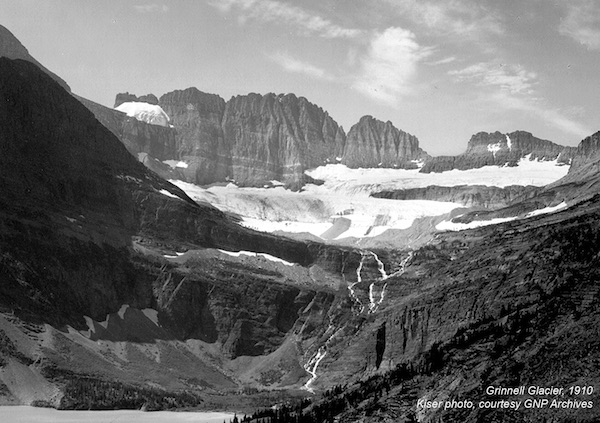
Grinnell Glacier in 1910/Fred Kiser photo, courtesy of Glacier National Park Archives
With the possibility that Glacier National Park will be glacierless by as soon as 2020, are you moving up your plans to visit the park?
That seems a reasonable question, both in light of recent weather patterns, warming temperatures, and the ability to glimpse a glacier upclose without traveling to Alaska. Not too many years ago scientists were predicting that Glacier's glaciers would be meltwater by 2030. But now they're moving the date up, to around 2020, due to the heightened pace of warming.
According to a story that ran on National Geographic's website in September 2013, "Since 1900, the mean annual temperature in Glacier National Park has increased by 2.4 degrees Fahrenheit (1.3 degrees Celsius)'1.8 times the global mean increase. Snowmelt is occurring up to a month earlier, and more precipitation is falling as rain rather than snow." And while one year does not make a trend make, snowfall this winter is running behind in Glacier, as is the snow water equivalent in that snowpack.
So, with the possibility that the park's glaciers will vanish in another five years, are you thinking of moving up your trip to Glacier?
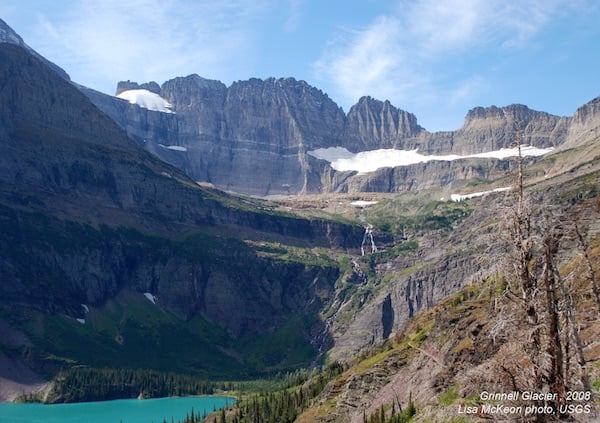
Grinnell Glacier in 2008./Lisa McKeon photo, USGS
Story Categories:
A copy of National Parks Traveler's financial statements may be obtained by sending a stamped, self-addressed envelope to: National Parks Traveler, P.O. Box 980452, Park City, Utah 84098. National Parks Traveler was formed in the state of Utah for the purpose of informing and educating about national parks and protected areas.
Residents of the following states may obtain a copy of our financial and additional information as stated below:
- Florida: A COPY OF THE OFFICIAL REGISTRATION AND FINANCIAL INFORMATION FOR NATIONAL PARKS TRAVELER, (REGISTRATION NO. CH 51659), MAY BE OBTAINED FROM THE DIVISION OF CONSUMER SERVICES BY CALLING 800-435-7352 OR VISITING THEIR WEBSITE. REGISTRATION DOES NOT IMPLY ENDORSEMENT, APPROVAL, OR RECOMMENDATION BY THE STATE.
- Georgia: A full and fair description of the programs and financial statement summary of National Parks Traveler is available upon request at the office and phone number indicated above.
- Maryland: Documents and information submitted under the Maryland Solicitations Act are also available, for the cost of postage and copies, from the Secretary of State, State House, Annapolis, MD 21401 (410-974-5534).
- North Carolina: Financial information about this organization and a copy of its license are available from the State Solicitation Licensing Branch at 888-830-4989 or 919-807-2214. The license is not an endorsement by the State.
- Pennsylvania: The official registration and financial information of National Parks Traveler may be obtained from the Pennsylvania Department of State by calling 800-732-0999. Registration does not imply endorsement.
- Virginia: Financial statements are available from the Virginia Department of Agriculture and Consumer Services, 102 Governor Street, Richmond, Virginia 23219.
- Washington: National Parks Traveler is registered with Washington State’s Charities Program as required by law and additional information is available by calling 800-332-4483 or visiting www.sos.wa.gov/charities, or on file at Charities Division, Office of the Secretary of State, State of Washington, Olympia, WA 98504.


National parks and their natural resources belong to you. The National Parks Traveler works to ensure you know how these essential places are being cared for.
Sign Up For Our Weekly Newsletter
Unsubscribe at any time.
INN Member

The easiest way to explore RV-friendly National Park campgrounds.

Here’s the definitive guide to National Park System campgrounds where RVers can park their rigs.
Our app is packed with RVing- specific details on more than 250 campgrounds in more than 70 national parks.
You’ll also find stories about RVing in the parks, tips helpful if you’ve just recently become an RVer, and useful planning suggestions.


Comments
Even without glaciers, there is so much to do in this park. And it's not like the lack of glaciers will kill off the scenery or the plethora of wildlife species. In my book, it remains the most stunning National Park i've ever had the pleasure of visiting.
Yes. To North Cascades, as well.
Great before and after pictures, Kurt. They remind me of what I looked like in 1947. Ugh! I'm melting, too! Or is it fair to call sagging melting? My point is: The Rocky Mountains are not about to sag, and one day (although we won't live to see it) will form great glaciers again. Probably Brian Williams's great grandfather, 10,000 times removed, offered the same sage advice. "Last chance to see the Bering Land Bridge. . . Damn! Now we will have to start building our own."
We are getting 4 to 8 inches of snow here in Washington and would be happy to export it all to Glacier if only there were a way to do so. I much rather see snow on the mountain than in my front yard and road.
Well said, Harry.
(We're having an interminably snowy winter in New England.)
In the summers of 1961 and 1962, I was a young geology student who had the privilege of working on glacial surveys on Middle Teton Glacier in GRTE, and Blackfoot Glacier in GLAC.
Today, both of those glaciers have shrunk to just remnants of what they were then. Blackfoot is, for all intents and purposes, gone. It broke into two separate glaciers some time ago and both are now not much more than permanent snowfields.
We could argue from now until forever about why this is happening. That would accomplish nothing -- as we've witnessed in these very pages. But whatever is happening and why it is happening is not something we should -- or can -- simply ignore.
There can be no doubt that with more than 7 billion people inhabiting our spaceship (and rapidly approaching 8 billion) our delicate planet is supporting more large living things than ever in its history.
Do we not have a serious responsibility to ourselves and our posterity to at least make a sincere effort to learn what we must do to protect our only home?
I'm reading an excellent book. The Human Age, The World Shaped by Us by Diane Ackerman. Written in wonderfully lyrical -- almost poetic -- language, she drops little bombs of common sense on just about every page. She uses a new word: Anthropocene to describe the Human Age on Earth. We've always used other names for earth's geologic ages, such as Permian or Holocene, but she believes it's time for a new one. Anthropocene -- the Human Age because of the incredible impact we humans are having upon the planet.
She points out that human biomass is now 10x greater than any other large animal species ever in the past. Humans and our domestic animals now make up 90% of ALL animal biomass on earth. A thousand years ago, we comprised only 2%.
Her message is simple. Earth is about 4.5 billion years old, but humans have completely transformed the planet and have become the dominant species in less than 200 years.
One of the simple truths that hit me between the eyes is this one: "We can't have cities, cars, jets without creating wastelands. For every act of creation, there is an act of destruction." When we build a skyscraper, we simultaneously create a hole where the material for that skyscraper was mined.
She writes about looking down on earth from space and seeing a planet lit by sparkling artificial lights: ". . . shopping centers and seaports sizzle with light, as if they are frying electrons."
Or: "Rocks of the future will tell the story of a time when Earth was swarmed over by intelligent apes who whipped the weather into something they hadn't quite intended."
An excellent book that we all should read.
Or shall we be satisfied to sit and do nothing more than argue with one another while we continue to foul the only nest we have?
Why not?
Read the book and find out. Or will you be satisfied to sit and do nothing more than argue with others while we continue to foul the only nest we have?
Sorry Lee - I don't buy into that fatalistic, zero sum negativity.
A bit of shameless promotion, if I may. Ten years ago, I wrote a book entitled ALLIES OF THE EARTH: RAILROADS AND THE SOUL OF PRESERVATION. It was all about a wonderful technology that we had and threw away. Well, not quite. We still use railroads to carry oil, coal, gravel, grain, and manufactured goods. But we no longer use them much to carry We the People. If we are going to wring our hands again about climate change, how about we think of SOLUTIONS. Mine is railroads for all of that "biomass" we humans now compose.
Bookshelves are full of authors pointing out "The Problem." On that, there are creative "insights" galore. But we already know the problem, don't we? We keep hoping for something "new" that will save us by still allowing us to consume--and grow. It's not in the cards, so we stack the deck again, in this case, by pretending that the "new" book says it all. It has a new term but still an ancient thesis: "We have met the enemy, and he is us."
Next time, take the train. And I dare you to enjoy it. There is even one to Glacier National Park so you can see the melting glaciers. And they won't stop melting if we keep using cars and airplanes. Now, if I can't get Al Gore out of his private jet--or Lincoln Town Car--what chance do I have with you?
Right, Alfred. We have squandered many opportunities. Passenger railroads are just one of many. When Utah was preparing to build the Frontrunner rail line between Ogden on the North and Provo on the south, there was tremendous hue and cry from those who opposed it. Not any more. Now I can make a round trip from here to the city by the saline puddle for a whopping $4.75 (senior rate). I'll be riding part of the Alaska Railway this summer.
I'm not wringing my hands uselessly. And I don't believe it is hopeless. Not yet, at least. We still have time to salvage things. But only if we get to work.
I'm trying very hard to reduce the footprint of my small hunk of biomass. I don't claim to know all the answers, but I do think we should be making a very real effort to learn what they are instead of wrangling endlessly over what they may or may not be.
As for this book, she does offer solutions -- at least what she thinks some solutions might be. But if none of the people who post endlessly here read it, they will never know what she suggests. They will never know if they just might, maybe, perhaps actually agree with some of what she offers. One of her most important points is exactly what you allude to, Dr. Runte -- the hope that something "new" will somehow save us from ourselves without requiring any sacrifice from anyone.
That was the point of my first post here.
Al Gore is a fool. But constantly using him as an excuse not to seek answers to serious problems is a foolish cop-out.
Again, I ask, shall we be satisfied to sit and do nothing more than argue with one another while we continue to foul the only nest we have?
I'm sorry, but anyone who believes that we intelligent apes are not fouling our nest must be deliberately blind.
Thanks, Lee. I do believe, and see evidence all around me, that those who refuse to acknowledge this reality are those who are apologists for the industries and individuals who add to the destructive momentum. It is good to identify them.
Or perhaps they have more vision than you.
Well, we're once again pretty far afield from the subject of this story, which was whether predictions of shrinking glaciers will affect your plans (or timing) to visit Glacier NP. That said, ec's bait points out that various posters on this site has a different "vision" about the future of the planet- and that suggests a different perception about where we are now, and have been in the past - in terms of things like use of resources.
ec says some have "more vision" than some others in that regard (and implies that he's in that camp), so it would be interesting to hear what that might be in terms of how we should use the resources of the planet.
Agreed, JT. It would be very interesting to hear something more than the usual dodges from the dodger. But it won't happen.
As for the question of whether the lack of glaciers in Glacier would prevent me from visiting, the answer is a big NO. But at the same time, a visit to a glacierless Glacier would be like attending the funeral of a good friend albeit in a beautiful place. On my last trip, I hiked very familiar trails into a totally unfamiliar landscape. It was a strangely emotional experience and not a happy one. It was as if there was a permanently vacant chair at a family dinner.
I'd be very interested in hearing from others what they are doing to try to reduce their own deposits of waste into our spherical nest. We intelligent apes face an incredibly difficult challenge, the outcome of which will determine if our species continues in dominance or diminishes toward eventual extinction. Are we intelligent enough to save ourselves?
I'm an optimist. I believe we are. But only if we choose to do so.
Now from ec and others of his band of doubtful dominate primates, may we hopeful primates hear their answers to a vital question: Where should we start? Please share your greater vision with us.
We should "start" by continuing to innovate and advance. You Debbie Downers are always predicting the worst, looking at the world, economy, money... as finite. You don't have the vision to see how man has constantly improved his well being and will continue to do so in the future. Today we live healthier, longer and with the best standard of living ever and the future holds that in the future that will only improve. No, I don't see the fouling you are so concerned will lead to our extinction.
By the way, Al, I have indeed ridden across from Seattle to Chicago on the Empire Builder. It was lovely, and a great way to travel. We even made a non-scheduled stop at midnight at Glacier NP to turn a fool over to the rangers after he drunkenly punched out a conductor. Being an icy mid-December, it looked mighty chilly in those handcuffs. I highly recommend the train ride.
re: "continuing to innovate and advance." Certainly no doubt those of us who comment on this site are very fortunate compared to most of the people on the earth, and even many who live in the U. S.
That said, we have a long way to go as a country by some measures. A chart of life expectancy by nation ranks the U. S. as # 37, behind virtually every Europen nation and even countries like Chile and Slovenia.
U. S. Rank in infant mortality is #26 out of 29 counties on a list of developed nations, and behind places like Poland, Czeck Republic, Korea, Spain and ...Slovakia.
Factors in those and overall death rates? According to this site, "Air pollution has now become the biggest environmental cause of premature death, overtaking poor sanitation and a lack of clean drinking water. In most OECD countries, the death toll from heart and lung diseases caused by air pollution is much higher than the one from traffic accidents."
Yes, "innovate and advance" can help solve this problem. A good place to start would be dramatically reducing use of coal to produce electricity, and therefore reduce health impacts from that energy source. How? "Innovations" such as solar and wind energy, or even (gasp) efforts to reduce energy use. Why don't we "innovate and advance in this area?
Lots of factors, but perhaps the biggest hurdle - such steps might cost us a few more dollars on our electric bill - and would certainly cut into profits for energy companies.
Just one example of many.
JT - excellent. It's pretty clear that we "Debbie Downers" are actually optimistic realists who believe that although the world's resources are indeed finite, we can survive and live well -- if we learn to innovate and advance within the limits imposed upon us by our finite earth. We may be starting to do that as we seek alternative energy sources and continue trying to better our stewardship of what the planet offers us.
Whether or not man has "constantly improved his well being and will continue to do so in the future" is certainly open to debate. That is what we need to do, but are we succeeding? Time will tell.
As for living longer and enjoying the best standard of living ever -- even that is open to question as JT so ably pointed out.
In the meantime, the invitation is still open. Ec, you have not told us anything specific. Here's your chance to drop the vapid generalizations and attack lines and tell us exactly HOW you believe we have improved our world and exactly what we will need to do to meet future challenges so that we may continue to live long and well.
All of us are consumers of what Earth offers. How do you propose that we be wise consumers whose consumption and waste products don't harm us and others?
If you truly have a vision, then share it. We might all learn something.
A good place to start might be to actually prove your claim that the world is somehow not finite. If you can do that, you will have completely revolutionized the laws of nature.
Remembering Blackfoot Glacier set me to thinking of other memories of that time long ago when another theory of earthly dynamics was being hotly debated.
It was something called "Plate Tectonics" and it had the scientific community sharply divided. To some old school geologists the idea that continents and ocean floors could actually slide around on the planet's surface was ludicrous. The battle raged in much the same way as our current arguments about anthrpomorphic climate change.
But as tools such as Glomar Challenger and the cores samples it drilled from the floor of the Atlantic Ocean began to provide solid evidence to support the theory, the scientific world began to offer more and more support -- even though some of it was certainly grudgingly given. Finally, when enough evidence had been collected, opposition to the theory faded to nothing and Plate Tectonics took its place as established fact.
Right now, all we have to either support or disprove anthropomorphic climate effects is tentative evidence. No one really can say for certainty just how it will all finally shake out. The problem, however, is that while human survival didn't rest upon Plate Tectonics, climate change might be different.
Some of us fear that by the time the science is settled on the question, we may have reached a tipping point -- a point of no return. It would be horrible if some of those old science fiction movies portraying a post-apocolyptic earth came true.
Shouldn't we, the intelligent apes who inhabit the planet at this point in time, at least try to address the possibility that the theory now being addressed might be valid?
Then, on the other hand, since none of us will be here to have to endure that uncertain future, why should we care? Why not just continue to enjoy what we think is The Good and Prosperous Life and damn the future inhabitants of Spaceship Earth?
Blackfoot Glacier is gone. Middle Teton Glacier is going. Neither of them are really consequential in the long run. But my great-great-great grandchildren might be.
I haven't gotten very far into Diane Ackerman's book, but what I've read so far tells me that this is not, as Dr. Runte alluded, just a book pointing out THE PROBLEM. Instead, she spends much of her writing telling us of hopeful -- but in America -- unheard of innovative solutions from other places in the world.
As ec said above, man is capable of innovating. But for some reason we in America seem to be falling farther and farther behind the rest of the world. Ackerman tells us of innovative projects in such places as the Thames River, Nederlands, Norway, Bangladesh and other places around the globe. But her stories of American innovation are sparsely populated.
Yet on page 64 she does share the story of an aquafarm in Long Island Sound that is the work of a young man from Newfoundland named Bren Smith. He he is working with something he calls "vertical farming" underwater. One of his crops is kelp. As we read, we learn that "Kelp is over 50 percent sugar. The Department of Energy did a study that showed if you took an area half the size of Maine and just grew kelp, you could produce enough biofuel to replace oil in the U.S. That's stunning. And without the negatives of growing land-based biofuel . . . It wastes a lot of water, fertilizer, and energy. But here you can have a closed-energy farm, using zero fresh water, zero fertilizer, and zero air [and also absorbing huge amount of carbon from the atmosphere] while providing fuel for local communities. I grow this kelp for food, but you could plant it in the Bronx River or in front of sewage treatment plants which would reduce their polluting. Or you could grow kelp for biofuel."
Yet we are not even exploring this seriously in America. Why not?
Could it be political? Could it be economic pressure from corporations that stand to lose profits from oil or coal extraction? Ackerman doesn't address those questions, but those of us who are paying attention already know the answers. That pretty well explains why even Bangladesh is ahead of the United States in efforts to create a sustainable system of agriculture and life for its people.
Is our American myopia driven by profitgreed?
What could happen if we, as a nation, were to launch an effort similar to that of placing a man on the moon to find solutions to our energy and climate challenges?
Good post, Lee.
re: "What could happen if we, as a nation, were to launch an effort similar to that of placing a man on the moon to find solutions to our energy and climate challenges?"
I believe we could make significant progress...but perhaps the biggest hurdle is getting anything approaching consensus that we even have any challenges/issues in terms of energy and climate. As long as significant numbers of Americans (including those with political and financial clout) don't feel there is a problem, there won't be any will to proceed.
A comfortable life-style and financial self-interest are powerful disincentives for change in the status quo.
Ilrelevant in relation to my comment. I was talking about life expectancy over time. There is no doubt that virtually worldwide, life expectancy has risen dramatically over time.
BTW - Did you notice that those WHO numbers were made up and not actual reported numbers? You anti-fossil fuel types sure have a liking for made up numbers.
While I am sceptical of their conclusions even they attribute it to cars not coal and note that it is countries like China and India that are the primary source. Yes, China and India should clean their air.
Already told you - increased life expectancy, better health, higher standard of living for the vast majority of the worlds population.
In the broadest sense the universe is infinite and there is little doubt we will be expaning into the universe and exploiting its resources. Closer to home what today seems "finite" is likely to be expanded in the future. Take oil for example. Original peak oil production was predicted to be hit in the 1970s. Innovations that improved drilling exploration and development have us producing more oil than ever before. Similarly there were predictions that we wouldn't be able grow enought food to feed the world's population. Again innovations in farming techniques have proved that fear unfounded. That was the context of my comment. That the Debbie Downers don't see the potential to expand through innovation. They see the issue as how to divide the pie rather than on how to grow it for the betterment of everyone.
Yes, we can endlessly allow some people to try to divert attention from the real issues by setting up endless circular arguments that accomplish nothing or we can work toward finding the innovations that will actually help us solve the problems.
Read Debbie Ackerman's book and then get back to us. I know it will take a little effort, but y'just might actually learn something if you would just take a chance and step out of the echo chamber.
I'll be visiting Glacier Bay and Mendenhall Glacier near Juneau this summer. I'll be interested to learn how those glaciers' stories compare to the histories of glaciers in the lower 48.
Another strawman. How have I tried to "divert" attention. By pointing out the facts?
Explain just one thing: If we are as innovative as you say we are, why aren't we Americans leading the world in innovations? Why are we trailing nations like Norway, Canada, China, India, Bangladesh and even some of those insignificant little places in Central Africa when it comes to innovation?
What does this have to do with glaciers in Glacier? A lot. The glaciers of the world are just one of many coal mine canaries (pun intended) that are trying to warn us to stop resisting progress and arguing against everything in the world and start seeking solutions. Our lack of leadership in seeking those solutions will cause us to lose American business, research and development, and manufacturing in the field of alternate energy and all the American jobs that could go with it.
Now it's time to go enjoy a sunny Sunday where most of the snow has melted from our mountain trails.
Lee - we too plan on a trip to Glacier Bay NP at some point this summer; hope to see you there. Mendenhall Glacier, in Juneau, is easily accessible and dramatic in scope, although of course photographs from the early 20th century show the changes. Let me know if you get up the Lynn Canal to Skagway. Here, our closest glacier - Harding Glacier, directly in front of my living room window - is covered in a snowfield right now, and through the early summer the snow recedes exposing the remaining glacier underneath. The view dominates town. What is sad is to see how much of it is no longer there.
Lee, I think you would have a hard time arguing that Bangladesh or Canada or any of those others have on the whole generated more innovations than America. But that is beside the point because I am talking about the innovation of man in general not any specific country. Innovations come from all over the world.
Rick, I will be in Glacier Bay only one day -- on the NPS guided boat excursion Wednesday, July 29 departing at 07:00. How I wish I had more money, but this is a poor man's trip. So I booked with Viking Tours out of St. Petersburg. Will ride the Alaska Ferry from Bellingham to Skagway. Take an excursion on the railroad. Then fly to Gustavus for the Glacier Bay trip. From there to Juneau for three days including the trip onto Mendenhall. Finally will fly back to Bellingham.
I could have tried to do it cheaper by trying to wing it and go for the adventure. But I learned a long time ago that adventure usually winds up being more expensive in the end. This is totally unfamiliar territory for me, so it may be more rewarding to let some people with more knowledge help me this first time.
So much world to explore and so little time and money!!!!!
Perhaps I'll be able to buy you a cuppa or a local Spruce Tip Ale when you're in Skagway. Kurt can tell you how to get in touch with me.
Lee - Hope you have a great trip to Alaska. Yes, the glaciers at both Mendenhall and Glacier Bay are definitely worth seeing now, rather than later - dramatic reductions in recent decades. Glad you're going to make the guided boat tour at Glacier Bay!
Our trip was 6 years ago, so info is a little dated, but there are several nice trails at Mendenhall. We enjoyed the East Glacier Loop (3.5 miles; it has a lot of steps on the east side of the loop, so take it going clockwise so all those stairs are on the downhill leg :-)
For breakfast or lunch try the Silverbow Bakery downtown in Juneau. We had a great and reasonably priced lunch, and the bread pudding shouldn't be missed :-)
Rick and Jim, thanks for the tips and invite. It's gonna be awfully hard waiting for July.
https://www.kpax.com/news/local-news/flathead-county/glacier-national-pa...
https://www.yahoo.com/news/great-dismantling-americas-national-parks-110...
Where's the carnage? Raising more money for the parks, getting rid of expensive and meaningless climate regs and clearing out the dead wood at the top are helping the parks not dismantling them. Which is probably why this opinion piece had no actual evidence of dismantling.