
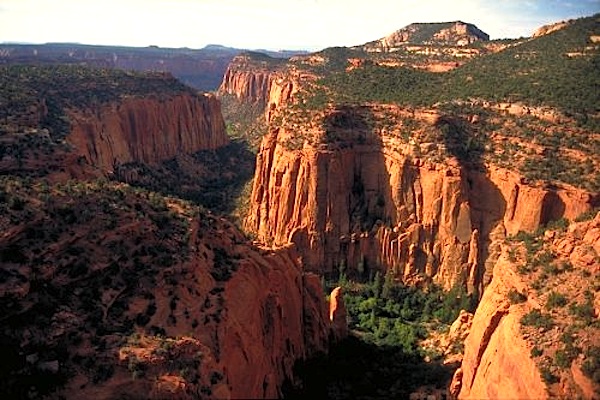
Magnificent canyonlands lie in the heart of the Grand Staircase-Escalante National Monument in Utah. Would they be better managed by the state?/BLM.
How much federal land is too much? When it comes to the state level, U.S. Sen. Ted Cruz of Texas believes 50.1 percent is too much. While he recently failed to force the federal government to reduce the size of its holdings, the Republican and other anti-government politicians bear watching, particularly with the coming fall elections.
During the Senate's recent donnybrook over the Bipartisan Sportsmen's Act, a measure that drew amendments like garbage draws flies, Sen. Cruz submitted one that would have prevented the federal government from owning more than half of a state's land mass. If the government's share was above 50 percent, the secretaries of the Interior and Agriculture departments would have to identify parcels that could either be transferred to the respective state, or auctioned off to the highest bidder.
Interestingly, just five states -- Alaska, Nevada, Utah, Oregon, and Idaho -- fall into the senator's bracket. We don't know how he settled on 50 percent (in his home state of Texas, just 1.8 percent of the landscape is owned by the U.S. government. Perhaps the amendment should also have called for the state to turn over 48 percent of its land to the federal government. ). Also unclear is who would facilitate the debate between the Interior Department (think national parks, fish and wildlife refuges, and BLM lands) and the Agriculture Department (think national forests) over who would dispose of acreage to reach the 50 percent level, but it likely wouldn't be pretty.
While the Sportsmen's Act failed to clear the Senate, things could change soon if the GOP takes control of the Senate, and retains its majority in the House of Representatives, in the fall elections.
Federal lands are not some surplus inventory to be jettisoned at the whim of a politician. By and large, the landscapes Sen. Cruz is eyeing contribute to our national identity, as Trout Unlimited's Steve Kandell noted in late June, help us manage the country's natural resources as a whole, provide incredible recreational opportunities, and contribute economically to both the states and the federal government.
Lands that once were considered wastelands -- places now known as Yellowstone National Park, for example -- today are revered for their spectacular beauty, and valued for providing wildlife habitat, filtering air and water with their forests, storing water, and, of course, serving our recreational needs. They also are key economic contributors, as the National Park Service touted late last week. Yellowstone, for example, generated nearly $382 million for its surrounding communities in 2013.
National forests provide not only recreation (more than a few ski resorts are on Forest Service lands), but timber, water, grazing lands, and in some cases mining. Fish and Wildlife Service refuges benefit waterfowl and wildlife in general, and offer tremendous recreational outlets, particularly for anglers and bird hunters, great birding, and wildlife watching opportunities in general. In 2011, 90.1 million people headed to wildlife refuges for some form of recreation, and spent $144.7 billion.
BLM lands, along with providing recreational outlets (consider Grand Staircase-Escalante National Monument in Utah or the nine wilderness areas in Oregon and Washington that the agency manages), also provide energy production, grazing lands, and valuable wildlife habitat.

Should the Sawtooth National Recreation Area in Idaho be turned over to the state, or auctioned off?/Michael Lanza, www.thebigoutside.com
Now, while an amendment such as Sen. Cruz's most certainly wouldn't prompt the federal government to turn Yellowstone over to the state of Wyoming, (the federal government's holdings in the Cowboy State fall below the 50-percent threshhold, at 48.2 percent, anyway), turmoil could be spawned in Alaska, Nevada, Utah, Oregon and Idaho. In Alaska, for instance, the National Park Service holdings amount to 52.6 million acres vs. the Forest Service's 21.9 million, the BLM's 72.9 million, and Fish and Wildlife Service's 76.6 million. In Utah, the Park Service lays claim to 2 million acres, which pales in comparision to BLM's 22.8 million acres.
But each of these agencies has its own constituency that likely would rise up to defend its holdings. And, really, would a state want to take over scablands managed by the BLM, or prefer the jewels of the National Park System? Either way, do the states have the resources to assume control and management of these places, or would they in turn auction off these landscapes to the highest bidder, regardless of their intended use?
If the federal government sliced its real estate footprint in those five states, would the lands continue to be managed as they have been? Would corporations swoop in for their resources and block public use? Or would they charge higher fees for public access? And, of course, what if someone else in Congress thought Sen. Cruz's disposal threshhold was too high, that it should be lowered to 25 percent, or 10 percent?
In the end, Americans as a whole would be the losers in this boondoggle. To blithely propose such a land giveaway is terribly shortsighted, incredibly so for someone who aspires to be president.
Story Categories:
A copy of National Parks Traveler's financial statements may be obtained by sending a stamped, self-addressed envelope to: National Parks Traveler, P.O. Box 980452, Park City, Utah 84098. National Parks Traveler was formed in the state of Utah for the purpose of informing and educating about national parks and protected areas.
Residents of the following states may obtain a copy of our financial and additional information as stated below:
- Florida: A COPY OF THE OFFICIAL REGISTRATION AND FINANCIAL INFORMATION FOR NATIONAL PARKS TRAVELER, (REGISTRATION NO. CH 51659), MAY BE OBTAINED FROM THE DIVISION OF CONSUMER SERVICES BY CALLING 800-435-7352 OR VISITING THEIR WEBSITE. REGISTRATION DOES NOT IMPLY ENDORSEMENT, APPROVAL, OR RECOMMENDATION BY THE STATE.
- Georgia: A full and fair description of the programs and financial statement summary of National Parks Traveler is available upon request at the office and phone number indicated above.
- Maryland: Documents and information submitted under the Maryland Solicitations Act are also available, for the cost of postage and copies, from the Secretary of State, State House, Annapolis, MD 21401 (410-974-5534).
- North Carolina: Financial information about this organization and a copy of its license are available from the State Solicitation Licensing Branch at 888-830-4989 or 919-807-2214. The license is not an endorsement by the State.
- Pennsylvania: The official registration and financial information of National Parks Traveler may be obtained from the Pennsylvania Department of State by calling 800-732-0999. Registration does not imply endorsement.
- Virginia: Financial statements are available from the Virginia Department of Agriculture and Consumer Services, 102 Governor Street, Richmond, Virginia 23219.
- Washington: National Parks Traveler is registered with Washington State’s Charities Program as required by law and additional information is available by calling 800-332-4483 or visiting www.sos.wa.gov/charities, or on file at Charities Division, Office of the Secretary of State, State of Washington, Olympia, WA 98504.


National parks and their natural resources belong to you. The National Parks Traveler works to ensure you know how these essential places are being cared for.
Sign Up For Our Weekly Newsletter
Unsubscribe at any time.
INN Member

The easiest way to explore RV-friendly National Park campgrounds.

Here’s the definitive guide to National Park System campgrounds where RVers can park their rigs.
Our app is packed with RVing- specific details on more than 250 campgrounds in more than 70 national parks.
You’ll also find stories about RVing in the parks, tips helpful if you’ve just recently become an RVer, and useful planning suggestions.


Comments
Kurt,
First, these politicians aren't "anti-government". Someone who is "anti-government" is an anarchist and politicians certainly aren't anarchists, they would lose their job.
That said, I would agree that citing a number like 50% is inappropriate. Any selected number would be entirely arbitrary. I'm guessing he threw out that number to get the process started.
You rightfully identify some places of spectacular beauty that probably should stay under national ownership - though I wasn't aware that Yellowstone was ever considered a wasteland. While some of these areas exist, there are vast portions of states such as Utah, Nevada, Arizona, New Mexico, Colorado...... that don't meet that crieteria. They serve no national purpose and are of no national interest. These are the lands that your "anti-government" folk are targeting.
As you are well aware, my bias is towards a more limited Federal government. I believe that lands that don't serve a national interest should be given back to the states. Thus, I believe it is the land itself that should generate that determination not 0%, not 100% nor some arbitary number in between.
Places of "spectacular beauty" are subject to the eye of the beholder. My wifes nephew was planning a trip to Utah to see Arches, Bryce, Zion and more. I suggested that he take Highway 12 and view The Grand Staircase. I was thrilled when he called me last night from Escalante and told me how spectacular the drive was on Highway 12. Some might call it a waste land but I feel it is worth protecting. I guess my point is putting a percentage on Federal ownership makes no sense in my view because some states have more worth protecting than others
If you Cruz, we all Luze!!!!!!!
I am left wondering what would be considered "national purpose" and of "national interest." Who would decide?
Surely we can get rid of the grasslands - no one goes there anyway. And why is the government in the forestry business anyway? We could pay off a lot of our debt if we just sold them all off. Deserts are just that - deserts. Nothing worthwhile in them, except some minerals in some locations and we could sell them, too. Imagine the money we could make if we sold all the Seashores to condo developers; that alone could sustain our economy for generations.
So, we should keep national parks and monuments because they are 'pretty.' The National Mall can stay, but we should allow corporate sponsorship (The Walmart Capitol Building has a nice ring, yes?), sold to the highest bidder.