
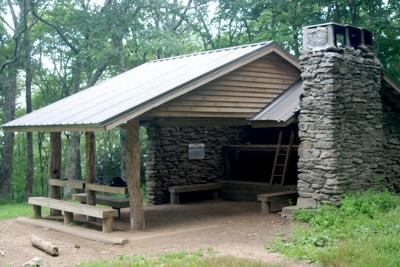
Federal officials have asked a court to dismiss a lawsuit brought against Great Smoky Mountains National Park officials for charging a $4 per person per night fee for backcountry users who spend the night in the woods at a shelter along the Appalachian Trail, such as this one at Spence Field, or in one of the backcountry campsites. Kurt Repanshek photo.
A group of backpackers who sued over a fee program instituted at Great Smoky Mountains National Park have failed to show they were harmed by the $4 nightly fees, according to a motion asking that the lawsuit be dismissed.
The backcountry fee of $4 per night per person, with a $20 per person cap per trip, took effect this past February. It is intended by park officials to help streamline and improve the backcountry permitting process and heighten the presence of rangers in the backcountry.
In suing to overturn the fee, Southern Forest Watch contends not only that the fee isn't merited, but draws on both Park Service history and mandates to contend the agency is precluded from charging the $4 per person per night fee.
In challenging that fee, which the plaintiffs contend was designed "with the end goal to control and limit use of the backcountry areas of the Smoky Mountains," the lawsuit points to a section of the National Park Service Organic Act that states "no natural curiosities, wonders, or objects of interest shall be leased, rented, or granted to anyone on such terms as to interfere with free access to them by the public..." (emphasis added.)
But in seeking dismissal of the lawsuit, U.S. Attorney William C. Killian maintains neither the organization nor its members have been harmed by the fee and lack standing to challenge it.
"Plaintiffs conclude that 'the new reservation system and backpacker tax is the epitome of impairment of the use and enjoyment of the Smoky Mountains. However, these statements are insufficient to show harm," the U.S. attorney wrote in the filing submitted to the court last week.
"None of these paragraphs particularize how the backcountry fee system causes harm to a named Plaintiff. Plaintiffs complain that there is a $4 per person, per night charge, and 'that there has never been a charge for backcountry camping in the Smoky Mountains' entire eight decades of existence," he continued in the 15-page filing. "Nevertheless, Plaintiffs have not alleged a harm caused by the fee that directly affected them. At bottom, Plaintiffs have ony alleged inconveniences and policies with which they disagree, and they have failed to state an actual or imminent harm to a named Plaintiff that has resulted from the new backcountry permit system."
The U.S. attorney also said the park superintendent has wide latitude when it comes to managing the Smokies, including the decision to charge a fee for overnight backcountry use. "... the statutes and regulations under which these decisions were made were intended to give the Park Superintendent broad management discretion," wrote Mr. Killian. "There is 'no law to apply.' The Plaintiffs want the Court to step into the shoes of the Park Superintendent and render a decision consistent with their own personal interests and desires."
The issue of fees in the National Park System comes up from time to time, with some park users in favor of them and others feeling they're unjust and unequally levied. At Great Smoky Mountains, the decision in 2011 to seek a fee for backcountry use brought outrage from some who enjoy the park.
The over-riding situation -- too many demands and needs, and precious few dollars -- is commonplace throughout the National Park System. There have been opinions voiced that the problem with the National Park Service budget is that it's top-heavy and thus denies precious dollars to flow down to the park level. Regardless, more and more parks are turning to fees -- backcountry fees, interpretive program fees, entrance fees and more -- to maintain the parks.
In defending the move, Great Smoky Superintendent Dale Ditmanson told the Traveler in February 2012 that, faced with an inadequate budget and unable to charge an entrance fee for any of his roughly 9 million yearly visitors, he saw no way of improving visitor services and protecting backcountry resources without charging users who spend the night in the woods.
In pushing back against the fee, the Southern Forest Watch group has received political support from such groups as the speaker of the Tennessee House of Representatives, the Knox County (Tennessee) Commission as well as county officials in Bradley and Blount counties in Tennessee and Swain County in North Carolina.
The organization said it would " respond to this in due course and continue the legal fight."

Story Categories:
A copy of National Parks Traveler's financial statements may be obtained by sending a stamped, self-addressed envelope to: National Parks Traveler, P.O. Box 980452, Park City, Utah 84098. National Parks Traveler was formed in the state of Utah for the purpose of informing and educating about national parks and protected areas.
Residents of the following states may obtain a copy of our financial and additional information as stated below:
- Florida: A COPY OF THE OFFICIAL REGISTRATION AND FINANCIAL INFORMATION FOR NATIONAL PARKS TRAVELER, (REGISTRATION NO. CH 51659), MAY BE OBTAINED FROM THE DIVISION OF CONSUMER SERVICES BY CALLING 800-435-7352 OR VISITING THEIR WEBSITE. REGISTRATION DOES NOT IMPLY ENDORSEMENT, APPROVAL, OR RECOMMENDATION BY THE STATE.
- Georgia: A full and fair description of the programs and financial statement summary of National Parks Traveler is available upon request at the office and phone number indicated above.
- Maryland: Documents and information submitted under the Maryland Solicitations Act are also available, for the cost of postage and copies, from the Secretary of State, State House, Annapolis, MD 21401 (410-974-5534).
- North Carolina: Financial information about this organization and a copy of its license are available from the State Solicitation Licensing Branch at 888-830-4989 or 919-807-2214. The license is not an endorsement by the State.
- Pennsylvania: The official registration and financial information of National Parks Traveler may be obtained from the Pennsylvania Department of State by calling 800-732-0999. Registration does not imply endorsement.
- Virginia: Financial statements are available from the Virginia Department of Agriculture and Consumer Services, 102 Governor Street, Richmond, Virginia 23219.
- Washington: National Parks Traveler is registered with Washington State’s Charities Program as required by law and additional information is available by calling 800-332-4483 or visiting www.sos.wa.gov/charities, or on file at Charities Division, Office of the Secretary of State, State of Washington, Olympia, WA 98504.


National parks and their natural resources belong to you. The National Parks Traveler works to ensure you know how these essential places are being cared for.
Sign Up For Our Weekly Newsletter
Unsubscribe at any time.
INN Member

The easiest way to explore RV-friendly National Park campgrounds.

Here’s the definitive guide to National Park System campgrounds where RVers can park their rigs.
Our app is packed with RVing- specific details on more than 250 campgrounds in more than 70 national parks.
You’ll also find stories about RVing in the parks, tips helpful if you’ve just recently become an RVer, and useful planning suggestions.


Comments
There have been opinions voiced that the problem with the National Park Service budget is that it's top-heavy and thus denies precious dollars to flow down to the park level
You've got that part dead right. The Kings of the NPS are trying to shoo flies. But the flies won't fly away. So what are they to do? Prepare for the next round with the flies. Because they opened the windows and this fee is a stinking pile. It could all have been avoided if Ditmanson, the Supt had minded his p's and q's. This suit has ramifications for every unit in the NPS if the Southern Forest Watch prevails. I'd say the NPS has more to lose than these plaintiffs. They (NPS) are accustomed to marching arrogantly on unchallenged.
Ditmanson typifies this attitude better than any of the highly paid superintendents. I think the NPS had better drop this Smokies fee lest they find themselves forced to defend all their other unjust fees. Word in the Smokies is that the Superintendent is being run out of town on account of his mishandling of this fee. Looking at the deceptions outlined in the lawsuit, I can see why.
Ditmanson is retiring in January after 36 years. He is over 60 and likely close to the maximum retirement benefit.
http://home.nps.gov/applications/digest/headline.cfm?type=PeopleNews&id=4044&urlarea=PeopleNews
Sara,
It was three years too late.
[color=#808000]The Notice of Proposed Rulemaking process used to implement the $4 fee on backcountry camping was severely flawed because it allowed the National Park Service to make those changes even though they misrepresented their proposal and then selectively ignored the majority of public comments (>800 comments against the backcountry fee and 45 comments for the backcountry fee either emailed to the Park or mailed through the postal service. This information was obtained via a Freedom of Information Act request by Southern Forest Watch from the Park Service). The Park Service basically just went through the required legal steps to advertise the change and solicit public input. They held two early evening meetings during the same week (Tuesday and Thursday) and did not document any of the verbal comments made to Park personnel by those attending the meetings. The Park Service was never obligated to accept any of our advice. Now that they've announced their decision, we, the public, apparently have no legal recourse.[/color]
Seeing the blatant disregard for public opinion by the NPS, we feel that what we really need is a complete revamping of the Notice of Proposed Rulemaking process. We'd like to see that process replaced with one that is more transparent and accountable to the public and gives us some path to appeal any rulemaking that appears to be based upon misrepresentations and/or bias against all logic--not to mention actions that are clearly at odds with the majority of public opinions.
Al Smith and Janice Henderson